Factoring Sum and Difference of Cubes:
Lesson 23.3 Presentation
Lesson diagrams and audio narration
Lesson Narrative · Audio, part 1
Lesson Narrative · Diagram
More videos
Factoring Sum and Difference of CubesMario's Math Tutoring
Factoring Sums and Differences of CubesMath Problems Solved Craig Faulhaber
How to factor the sum and the difference of two cubesbprp math basics
Factor the Sum and Difference of Two Cubes | Algebra ExplainedFriendlyTheorem

What career does this lesson unlock?
Adelaide will match a real-world profession to what you just learned and walk you through a day on the job.
Core Content
The sum and difference of cubes each follow their own specific,
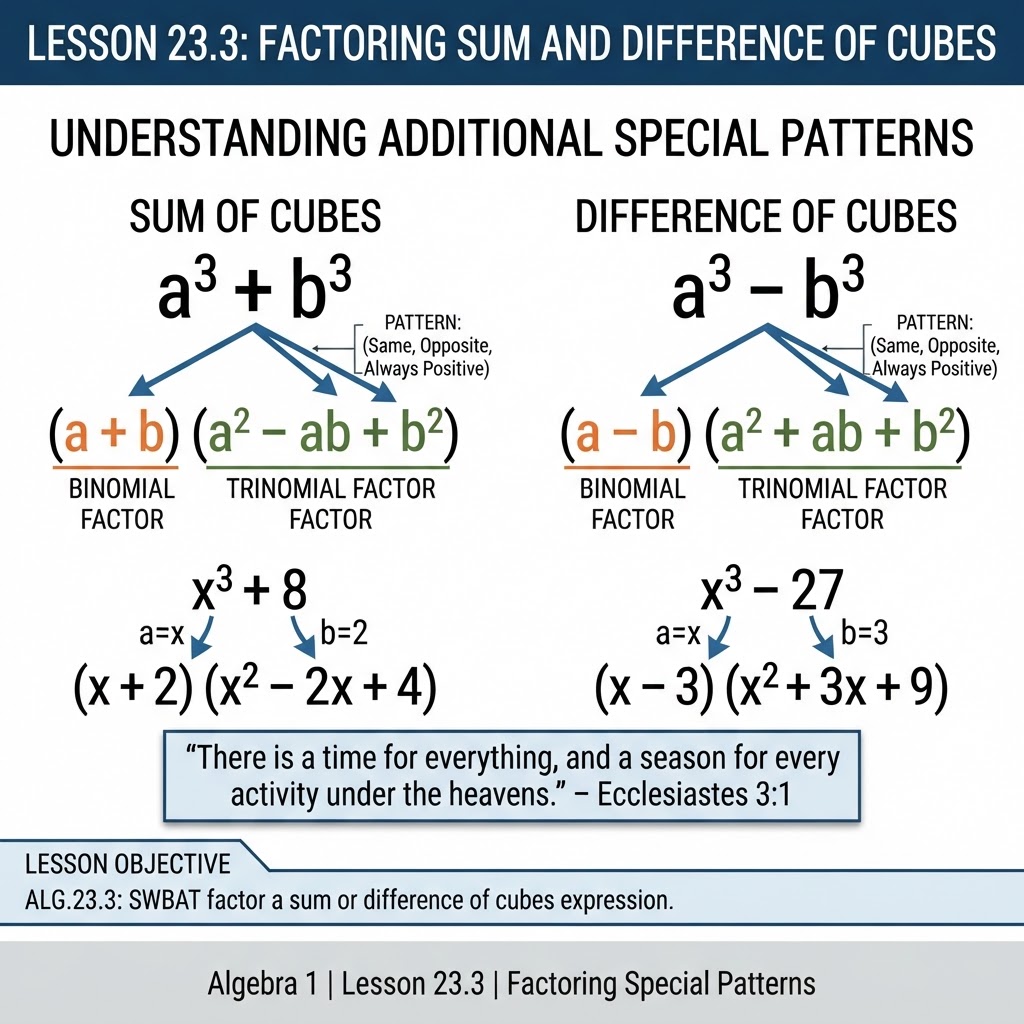
Predictable patterns allow us to decompose complex binomials into manageable binomial and trinomial factors. The sum of cubes formula is a^3 + b^3 = (a + b)(a^2 - ab + b^2), while the difference of cubes is a^3 - b^3 = (a - b)(a^2 + ab + b^2).
These formulas act as keys, transforming a simple subtraction or addition of cubic terms into a factored structure that reveals the underlying components of an equation.
A helpful mnemonic device students often use to remember the sign sequence in these formulas is SOAP. The S stands for Same as the original sign, the O stands for Opposite of the original sign, and the AP stands for Always Positive for the final term.
For a^3 + b^3, the first sign is plus, then minus, then plus. This ensures the signs stay consistent with the algebraic expansion requirements throughout.
Let us explore our first example: factoring x^3 + 27. First, identify that 27 is the perfect cube of 3, so a = x and b = 3. Using the sum of cubes formula, we write (x + 3)(x^2 - 3x + 9). Notice how we replaced a and b into the structure. The result uses the negative middle sign because the original expression was a sum, keeping the signs balanced properly.
To verify this result, we multiply the binomial by the trinomial using the distributive property. Multiplying x by each term gives x^3 - 3x^2 + 9x. Then multiplying 3 by each term gives 3x^2 - 9x + 27. When we combine like terms, the -3x^2 and +3x^2 cancel out, and the 9x and -9x cancel out as well. We are left with exactly x^3 + 27, confirming our factored form is indeed correct.
Now consider the difference of cubes: 8x^3 - 1. Here, 8x^3 is the cube of 2x, so a = 2x and b = 1. Applying the difference of cubes formula, we get (2x - 1)((2x)^2 + (2x)(1) + 1^2). Simplifying the trinomial terms gives (2x - 1)(4x^2 + 2x + 1).
The first sign is minus, the second is plus, and the final is always positive, perfectly following the SOAP logic structure.
Verification for this expression involves multiplying (2x - 1) by (4x^2 + 2x + 1). We distribute the 2x to get 8x^3 + 4x^2 + 2x, then distribute -1 to get -4x^2 - 2x - 1. Summing these results, the middle terms 4x^2 and -4x^2 vanish, along with the 2x and -2x terms. We arrive back at 8x^3 - 1, validating the algebraic expansion against the product of our identified factors.
A common mistake students make is misidentifying the perfect cube terms. For example, in 16x^3 - 2, one might assume 16 is a cube. However, we must first factor out the greatest common factor of 2, leaving 2(8x^3 - 1). Factoring first is a crucial step that reveals the hidden cubes.
Always check for a common factor before applying the cubic formulas to ensure the terms fit the required a^3 and b^3 definitions.
It is also vital to remember that the trinomial factor produced by these formulas, such as a^2 - ab + b^2, cannot be factored further using real numbers. Students sometimes attempt to find factors for this piece using the quadratic formula, but they will only find imaginary roots.
For Algebra 1, these expressions are considered fully factored. Recognizing this stopping point prevents wasted effort and keeps the mathematical process precise and efficient.
Graphically, these cubic functions are fascinating. A simple sum of cubes like f(x) = x^3 + 1 represents a cubic curve shifted vertically. Factoring helps us find the x-intercept at x = -1. While the trinomial part does not provide real intercepts, it describes the shape of the graph as it moves away from the root. Understanding how symbolic factors correlate to graphical features reinforces our grasp of how algebra maps onto coordinate space.
In terms of units, cubes represent volume, so we are essentially decomposing a three-dimensional volume into a rectangular base and a height. If we think of a cube with side length a plus a cube with side length b, the formula shows how those physical spaces rearrange into a product of a two-dimensional area and a linear length. This geometric interpretation connects abstract symbolic manipulation to the tangible world we inhabit daily.
Consider the difference of cubes as removing a volume from a larger structure. If you take a cube of side a and subtract a smaller cube of side b, the formula tells you exactly what geometric pieces remain. This symmetry between the additive and subtractive formulas mirrors the natural balance found in mathematical systems.
We see that math functions not as a series of random rules, but as an elegant, consistent language of creation.
The rigor of these formulas serves as a reminder that discipline brings clarity. In mathematics, we must follow the rules of operations to reach the correct solution. Similarly, in life, we often find that adhering to logical and moral frameworks provides the structure needed to navigate complex problems.
By mastering these formulas, you are exercising the intellectual discipline required to look past superficial complexity and discover the underlying truth contained within every equation.
When solving these, be careful with signs when the variable has a coefficient. For instance, in 27x^3 + 64y^3, a is 3x and b is 4y. The formula becomes (3x + 4y)(9x^2 - 12xy + 16y^2). Square the 3x to get 9x^2, and multiply 3x times 4y to get 12xy.
Every part of the term must be raised to the appropriate power, ensuring that coefficients and variables are both handled with equal precision throughout.
Reflecting on our work today, you have learned to identify perfect cubes, apply the SOAP rule for signs, and verify factors through expansion. These skills form a foundation for more advanced polynomial work in future lessons. As you continue your mathematical journey, remember that each step builds upon the last.
Embrace the patterns you find, for they are the keys to unlocking the complex beauty hidden within the fabric of our numerical world.
Subscription Library
Education.com Teacher Login
Standards-aligned lesson plans, worksheets, games, and activities for Pre-K through 8th grade.
Login credentials are being prepared. Check back soon, or ask your teacher.
© 2026 Learning by Grace. All rights reserved. This content is for enrolled students only and may not be copied, distributed, or reproduced.
