Choosing a Solving Method: Understanding
Lesson 27.5 Presentation
Lesson diagrams and audio narration
Lesson Narrative · Audio, part 1
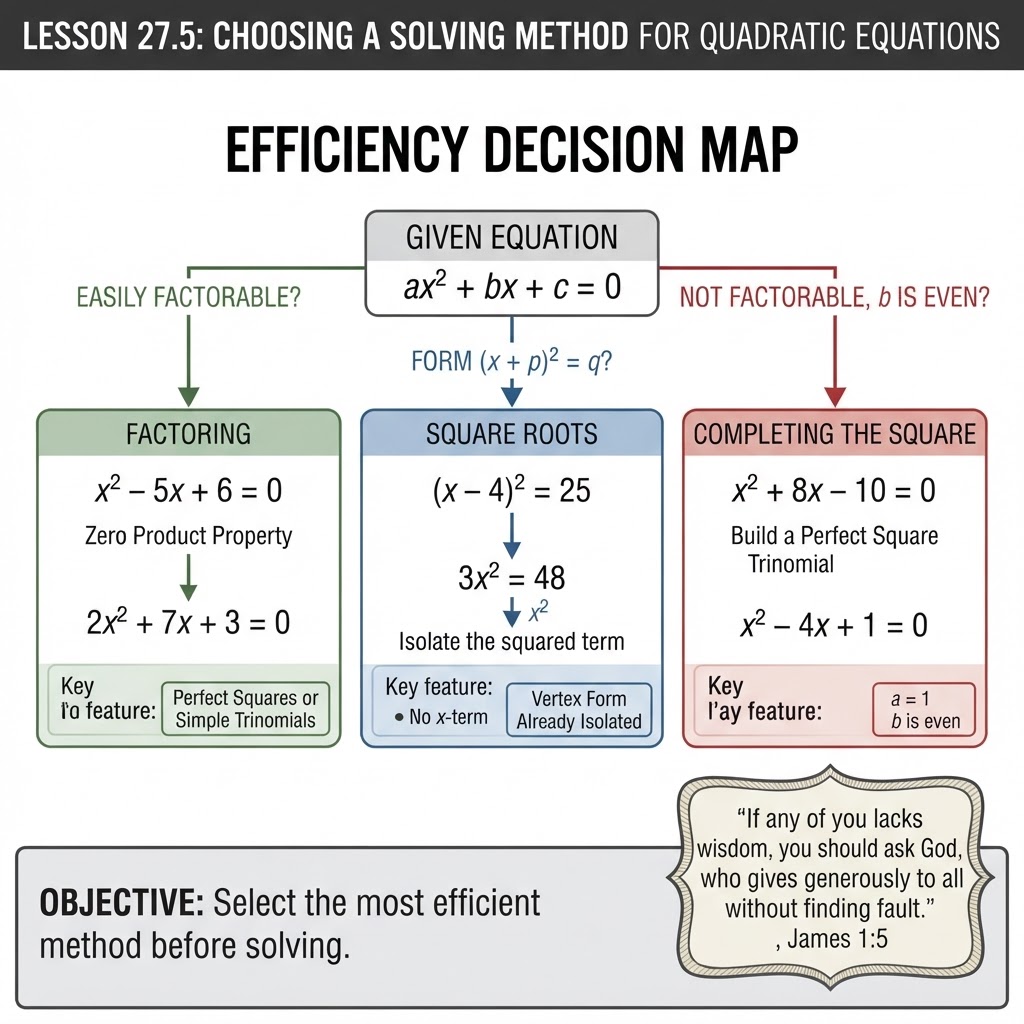
Lesson Narrative · Diagram
More videos
The Ultimate Problem–Solving Strategy | My Secret to Winning Physics, Math, and Coding CompetitionsSamuel Bosch
Find Problem, Solve Problem | Ariana Glantz | TEDxMemphisTEDx Talks
How To Solve Word Problems of Any Kind . Nutshell maths-2mathOgenius

Complementary Video
What career does this lesson unlock?
Adelaide will match a real-world profession to what you just learned and walk you through a day on the job.
Core Content
Today’s lesson is focused, mixed practice recognizing which solving method
Learning to solve quadratic equations requires a strategic eye to discern the structure hidden within numerical patterns. While rote memorization offers a starting point, true mastery demands choosing the most efficient method for each specific equation. Consider the expression x^2 - 9 = 0.
Recognizing this as a difference of squares allows you to bypass complex steps. Efficient choices reflect good stewardship of time and improve your overall accuracy.
Begin by examining the constant and linear terms. If an equation fits the x^2 = k format, applying square roots is the most direct path. However, if a linear term exists, such as in x^2 + 6x + 8 = 0, evaluate whether the expression is factorable.
If you identify two integers that multiply to the constant and add to the linear coefficient, factoring becomes your most effective algebraic tool.
- We seek two integers that multiply to -5 and add to
- These integers are 5 and -1. Thus, we rewrite the equation as (x + 5)(x -
- =
- Applying the zero product property, we find x + 5 = 0 or x - 1 = 0, yielding solutions x = -5 and x =
- Substituting x = 1 yields 1 + 4 - 5 = 0.
If factoring proves difficult, completing the square provides a reliable bridge. This method is powerful when the coefficient of x^2 is one and the linear coefficient is even. By taking half of the linear term, squaring it, and adding it to both sides, you create a perfect square trinomial.
This transformation allows you to isolate the variable using square roots, revealing that even complex expressions possess an underlying, manageable symmetry.
- Half of 6 is 3, and 3 squared is
- Adding 9 to both sides yields x^2 + 6x + 9 =
- This factors to (x + 3)^2 =
- Taking the square root of both sides gives x + 3 = 4 or x + 3 = -4.
Solving x + 3 = 4 gives x = 1, while x + 3 = -4 results in x = -7. Substitute x = 1 into x^2 + 6x - 7: 1 + 6 - 7 = 0. Substituting x = -7 yields 49 - 42 - 7 = 0. Both solutions are correct.
The completion method demonstrates how quadratic functions shift along the coordinate plane, connecting your algebraic steps directly to geometric reality while verifying the roots through simple substitution.
When equations resist factoring or completing the square, the quadratic formula x = (-b +/- sqrt(b^2 - 4ac)) / (2a) stands as the ultimate resource. This formula is derived from completing the square on the general form ax^2 + bx + c = 0.
It is a universal tool that works regardless of whether roots are integers, fractions, or irrational numbers, making it the most versatile method in your mathematical repertoire.
A common error is failing to set the equation to zero before identifying constants a, b, and c. Always ensure your equation resembles ax^2 + bx + c = 0. Furthermore, watch for signs when substituting into the formula. A negative coefficient or constant leads to errors if you are not meticulous with parentheses. Precision here prevents the accumulation of small, frustrating calculation mistakes that could compromise your final result.
- Here, a=2, b=-5, and c=-3. Using the formula, we find x = (5 +/- sqrt(25 - 4(2)(-3))) /
- This simplifies to (5 +/- sqrt(25 + 24)) / 4, which is (5 +/- sqrt(49)) /
- Thus, solutions are (5+7)/4 = 3 and (5-7)/4 = -0.5. Checking x = 3: 18 - 15 - 3 =
- These roots are precise x-intercepts.
When dealing with physical applications, such as a projectile's path, units are essential. You might calculate a time value like t = -2 seconds. In a real-world domain, time cannot be negative, so this solution is extraneous. Distinguishing between the abstract mathematical solution and physical reality is a critical skill. Math dictates we disregard results that fall outside the reasonable domain or constraints of our specific context and scenario.
Correlation between variables does not always imply that one causes the other to change in a real-world setting. In quadratic modeling, you describe a relationship between inputs and outputs, but understanding the narrative behind the data is as important as solving the equation.
Ensure your mathematical model aligns with the constraints of the situation, respecting the boundaries of the variables and the logic governing the problem at hand.
Linear relationships are distinct from quadratic curves because they exhibit constant rates of change. If your equation contains only terms of degree one, applying quadratic methods will lead to contradictions or errors. Always verify the degree of your equation before choosing your solving strategy.
Recognizing the difference between a straight line and a parabola is the first step in applying the appropriate analytical tools for the functional structure.
Reflecting on these methods reveals that mathematics is a study of order. Whether we choose the elegance of factoring or the robustness of the quadratic formula, we uncover truths about how quantities interact. This mirrors the discipline required to choose the most effective approach for any given circumstance.
By practicing these selections, you build a mental library that allows you to handle increasingly complex challenges with greater confidence and clarity.
Ultimately, your ability to select the most efficient method grows with practice. Do not be discouraged if a choice requires backtracking; even experienced builders occasionally refine their methods. Keep your focus on the structure of the equation, use the tools you have mastered, and maintain the integrity of your work through careful checking. Through this process, you develop the mathematical fluency necessary to excel in your upcoming advanced academic pursuits.
Subscription Library
Education.com Teacher Login
Standards-aligned lesson plans, worksheets, games, and activities for Pre-K through 8th grade.
Login credentials are being prepared. Check back soon, or ask your teacher.
© 2026 Learning by Grace. All rights reserved. This content is for enrolled students only and may not be copied, distributed, or reproduced.
Have something to share?
Submit your work — writing, art, videos, and more — for us to review.
My Submitted Work