Review: Factoring Polynomials I
Lesson 24.4 Presentation
Lesson diagrams and audio narration
Lesson Narrative · Audio, part 1
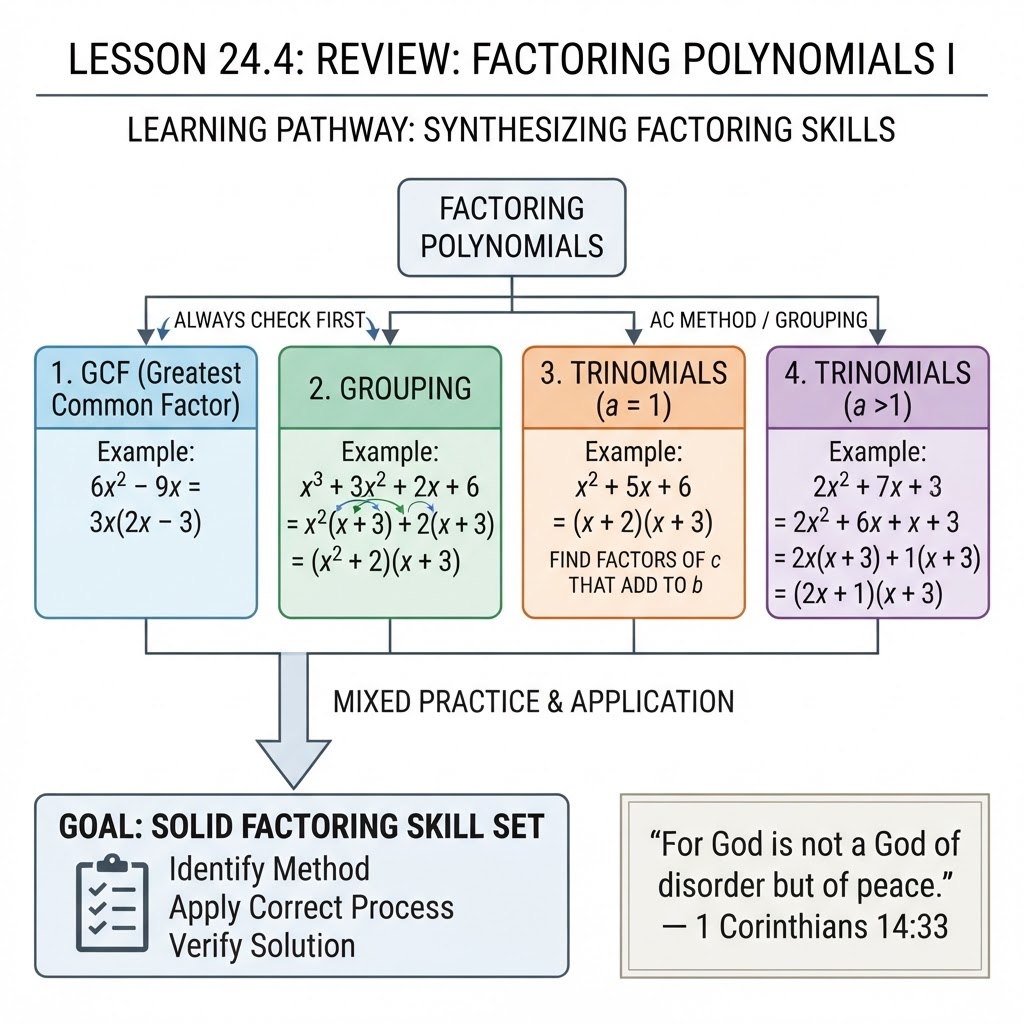
Lesson Narrative · Diagram
More videos
Factoring TrinomialsMr H Tutoring
Factoring Polynomials by GCF (The "Undistribute" Method)DowMath
Factoring by Grouping - Factoring PolynomialsMATH TEACHER GON
Factoring Polynomials | Algebra 1 STAAR EOC Test Review LessonMrs. Casias Math

Complementary Video
What career does this lesson unlock?
Adelaide will match a real-world profession to what you just learned and walk you through a day on the job.
Core Content
Today’s review brings together every skill from Module 22: factoring out
Mastering the greatest common factor, grouping, and systematic decomposition of quadratic trinomials requires more than rote memorization. It demands a deep appreciation for the structural harmony inherent in algebraic expressions. Just as a craftsman identifies the grain of wood to shape it effectively, we must identify the patterns of coefficients and variables to unlock the simplified form of a polynomial expression. Success begins with understanding these fundamental mathematical components.
- Our objective is to find two binomial factors whose product reproduces this trinomial. We begin by multiplying the leading coefficient, 6, by the constant term, 6, resulting in
- We search for two numbers that multiply to 36 and add to
- These integers are 9 and 4, which provide the essential key to splitting the linear middle term of the polynomial expression.
This splitting method is valid because of the distributive property, which allows us to expand and collapse terms without altering the total value of the expression. By rewriting 13x as 9x + 4x, we create a four-term expression: 6x^2 + 9x + 4x + 6.
This transformation is a strategic regrouping that prepares the polynomial for successful factoring by grouping, ensuring that each part of the expression maintains its internal algebraic integrity.
Next, we factor by grouping. We examine the first pair, 6x^2 + 9x, and extract the greatest common factor, 3x, leaving us with 3x(2x + 3). We then analyze the second pair, 4x + 6, and extract the common factor of 2, resulting in 2(2x + 3).
Since both groups share the binomial (2x + 3), we factor it out to reach the final binomial form of (3x + 2)(2x + 3).
- The factored (3(1) + 2)(2(1) +
- results in (5)(5), which is also
- Testing x = 0 similarly gives 6 =
- This direct substitution confirms the identity 6x^2 + 13x + 6 = (3x + 2)(2x +
- is absolutely correct and mathematically consistent.
A common mistake involves mishandling negative signs during the grouping process. If the third term is negative, such as in 2x^2 - 5x - 3, one must be careful to distribute the negative sign across the entire group. Failure to do so leads to errors in the binomial factors.
Precision with signs reflects a commitment to truth, acknowledging that even small omissions lead to significant deviations from the correct algebraic solution.
- Multiplying the lead coefficient 10 by the constant negative 6 gives negative
- We seek two numbers that multiply to negative 60 and sum to negative
- Testing factors of 60, we find negative 15 and positive 4 fit perfectly. Thus, we rewrite the expression as 10x^2 - 15x + 4x - 6, which retains the original quadratic value.
Continuing the grouping, we factor 5x from the first pair, 10x^2 - 15x, to get 5x(2x - 3). Then, we factor 2 from the second pair, 4x - 6, to get 2(2x - 3). Because the expression (2x - 3) appears in both sections, we identify it as the common binomial factor.
Combining the terms gives us the final factored form, (5x + 2)(2x - 3), completing the process with clear, logical, and consistent algebraic application.
- Using our factored form, (5(2) + 2)(2(2) -
- becomes (12)(1), which is also
- The algebraic consistency here is satisfying, mirroring the reliability we find in mathematical laws, where consistent inputs always yield predictable and accurate outcomes through strict adherence to established, verified, and foundational principles.
In graphical terms, factoring these polynomials helps us identify the roots of a quadratic equation. When we set the expression (5x + 2)(2x - 3) equal to zero, we find the x-intercepts of the parabola. These points represent the values where the function crosses the horizontal axis.
Understanding this connection elevates factoring from a symbolic exercise to a visual mapping of the relationship between quadratic equations and their corresponding geometric curves.
While we often work with integers, remember that domain restrictions apply in certain real-world scenarios, such as when a variable represents time or physical dimensions. In such cases, we might reject negative solutions as extraneous. Recognizing when a mathematical answer translates into a physical reality requires critical thinking, which is a vital skill. Mathematical fluency involves knowing not just how to compute, but when a result applies to our context.
Always check for a greatest common factor before attempting to factor a trinomial. Ignoring this step often makes the remaining numbers unnecessarily large, increasing the likelihood of arithmetic errors. For instance, in 12x^2 + 18x + 6, pulling out a 6 first yields 6(2x^2 + 3x + 1), which is much easier to factor. This disciplined habit of seeking the simplest form first keeps our work organized and prevents complex errors.
The connection between the factors and the expanded form is absolute. Algebra provides a rare, clean environment where the rules of logical causation are clearly defined. Every sign and coefficient has a purpose in the final product. By studying these patterns, we train our minds to look for order, recognizing that truth is discoverable when we apply the correct tools and verify our work through rigorous substitution and logical analysis.
As we conclude this review, remember that the proficiency you gain today provides the foundation for work with higher-degree polynomials and rational expressions. Approach each problem with the patience to be methodical and the humility to double-check your work. When your calculations are sound and your methods are logical, you arrive at the correct answer not by chance, but by the careful application of the foundational principles that govern algebra.
Subscription Library
Education.com Teacher Login
Standards-aligned lesson plans, worksheets, games, and activities for Pre-K through 8th grade.
Login credentials are being prepared. Check back soon, or ask your teacher.
© 2026 Learning by Grace. All rights reserved. This content is for enrolled students only and may not be copied, distributed, or reproduced.
