Using the Quadratic Formula:
Lesson 28.2 Presentation
Lesson diagrams and audio narration
Lesson Narrative · Audio, part 1
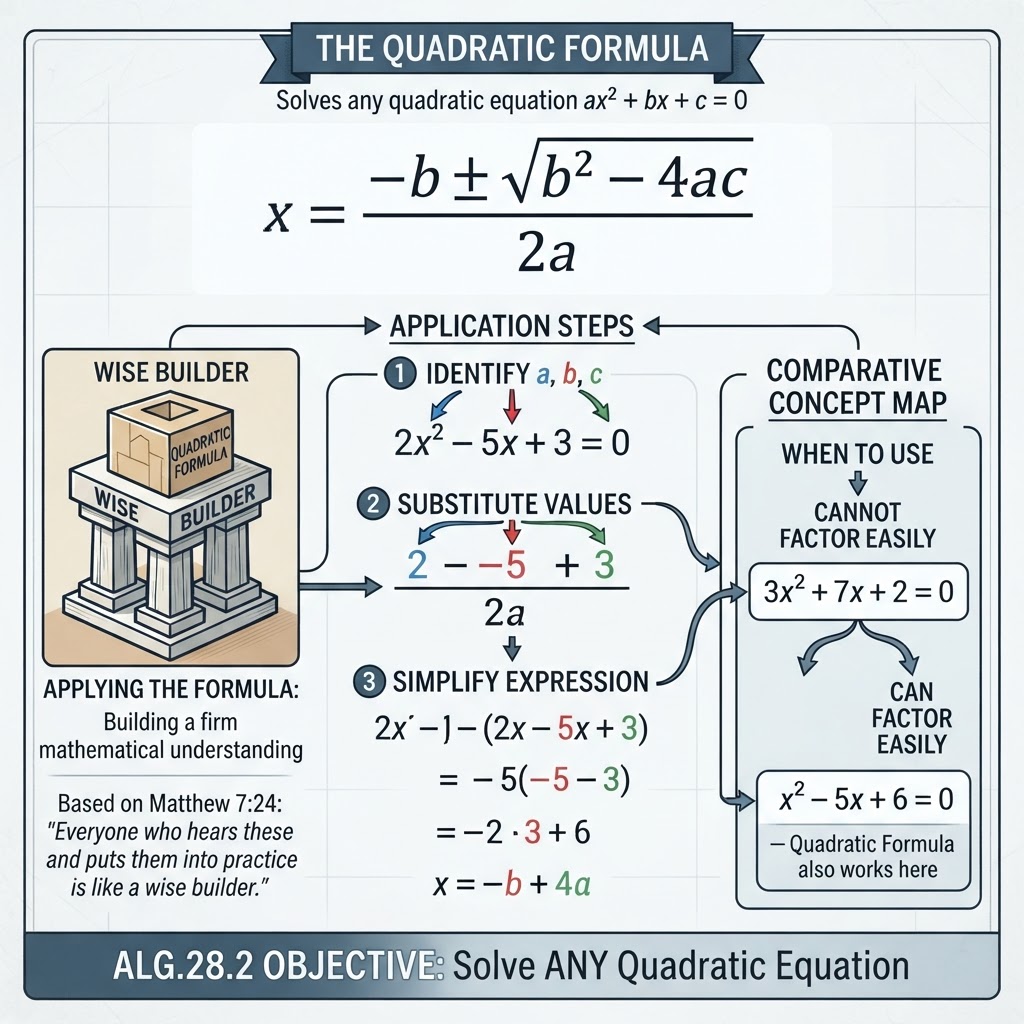
Lesson Narrative · Diagram
More videos
How To Solve Quadratic Equations Using The Quadratic FormulaThe Organic Chemistry Tutor
Solving Quadratics by Using the Quadratic FormulaProfessor Dave Explains
Quadratic formula - Corbettmathscorbettmaths
You use the quadratic formula all the time, but where did it come from?bprp math basics

Complementary Video
What career does this lesson unlock?
Adelaide will match a real-world profession to what you just learned and walk you through a day on the job.
Core Content
The quadratic formula, x equals negative b plus or minus the square root of
The quadratic formula, defined as x equals negative b plus or minus the square root of the quantity b squared minus 4ac, all divided by 2a, is a universal tool for solving any quadratic equation. Derived from completing the square on the standard form ax squared plus bx plus c equals 0, this formula provides a robust method to find roots, even when factoring fails or when solutions involve irrational or complex numbers.
To derive this formula, start by subtracting c from both sides and dividing by a to set the leading coefficient to one. Adding the square of half the middle term, which is b over 2a squared, to both sides creates a perfect square trinomial.
Simplifying results in the equation x plus b over 2a quantity squared equals b squared minus 4ac over 4a squared, which is ready for root extraction.
The expression under the radical, b squared minus 4ac, is the discriminant and serves as a diagnostic indicator for root types. A positive discriminant confirms the parabola intersects the x-axis twice. A discriminant of zero signifies the vertex touches the axis exactly once, while a negative value indicates no real intersections exist, leading to complex solutions involving the imaginary unit i. These geometric behaviors provide visual confirmation for your algebraic results.
Consider the quadratic 2x squared plus 7x plus 3 equals 0, where a is 2, b is 7, and c is 3. Substituting these into the formula yields x equals negative 7 plus or minus the square root of 49 minus 24, all divided by 4.
This simplifies to negative 7 plus or minus 5 divided by 4, resulting in two distinct roots, x equals negative 0. 5 and x equals negative 3.
- 5 by substituting it back into the original expression 2x squared plus 7x plus
- Calculating 2 times
- 25 minus
- 5 plus 3 yields
- 5 minus
- 5 plus 3, which equals exactly zero. This successful substitution confirms the result.
Using this method acts as a safeguard against arithmetic errors, ensuring your algebraic manipulations remain consistent, accurate, and truly representative of the original equation.
Examine an irrational case: x squared minus 6x plus 4 equals 0. With a equal to 1, b equal to negative 6, and c equal to 4, the formula provides x equals 6 plus or minus the square root of 36 minus 16, divided by 2.
This simplifies to 6 plus or minus the square root of 20, all divided by 2, which reduces to the exact radical form 3 plus or minus square root 5.
These irrational roots, 3 plus square root 5 and 3 minus square root 5, represent exact x-intercepts. Decimal approximations, roughly 5. 236 and 0. 764, aid visualization, but mathematicians prefer the radical form for its absolute precision. Maintaining radical form avoids the compounding rounding errors that occur when approximating values prematurely.
Excellence in mathematics requires this commitment to exactness, ensuring every step of your derivation holds up under close logical examination.
Common errors frequently involve coefficient signs. If b is negative, negative b becomes a positive value. Conversely, if c is negative, subtracting 4ac turns into adding the product of 4ac. Always explicitly list your a, b, and c values before starting calculations.
This organized approach minimizes silly mistakes caused by haste, allowing you to focus on the structural integrity of your equation rather than risking errors during fast, unverified mental math.
Geometric interpretation assists in visualizing these steps. The formula locates the line of symmetry at x equals negative b divided by 2a. The plus or minus component marks the horizontal distance from this line to the roots. When the discriminant is large, roots are far apart; when it is small, they are closer together. This symmetry reflects the inherent balance found in all quadratic relationships within the coordinate plane.
Domain restrictions apply when models represent physical phenomena. If x represents time, negative roots are often extraneous or physically impossible. Always evaluate solutions against the problem context. If a model predicts a negative duration for an object, consider whether that indicates a pre-starting state or falls outside the valid time interval. Rigorous interpretation of variables is just as important as the algebraic process used to calculate the numerical root values.
Distinguishing correlation from causation is essential when applying models to data. A quadratic fit may show a strong correlation between two variables, but it does not prove causation. Mathematical models are tools for describing patterns and require careful logical scrutiny.
We use these equations to organize our understanding of observed data, acknowledging that human-created models are limited reflections of deeper, more complex truths regarding how different systems actually interact.
When equations involve physical units, rigorous dimensional analysis is vital to maintain algebraic integrity. You cannot combine terms representing area, such as square meters, with linear distance without violating fundamental arithmetic laws, as these represent distinct physical properties. By tracking units throughout your derivation, you ensure your final solution possesses actual physical significance rather than mere numerical convenience.
Strict dimensional consistency is a cornerstone of scientific inquiry, distinguishing precise solutions from superficial calculations that fail under logical scrutiny in complex physical systems.
Mastering the quadratic formula requires structural precision akin to engineering. You must identify coefficients and process negative signs with absolute intentionality; a single oversight propagates errors that invalidate your result. This process demands algebraic discipline, prioritizing accuracy over speed. By verifying each intermediate step, you ensure your output remains a reliable representation of reality.
This systematic methodology transforms potential calculation errors into opportunities for deeper analytical insight, guaranteeing that the final output accurately models the underlying mathematical structure.
Finally, remember that every quadratic equation tells a unique story revealed by the discriminant. Whether roots emerge as rational, irrational, or complex, you now possess the robust framework necessary to uncover these solutions. Approach these challenges with focused care to sharpen your logic and prepare for more advanced studies.
Your diligence serves as a testament to your pursuit of excellence, reflecting the elegant, inherent order woven into the mathematical universe.
Subscription Library
Education.com Teacher Login
Standards-aligned lesson plans, worksheets, games, and activities for Pre-K through 8th grade.
Login credentials are being prepared. Check back soon, or ask your teacher.
© 2026 Learning by Grace. All rights reserved. This content is for enrolled students only and may not be copied, distributed, or reproduced.
