Finding Intercepts of a Parabola:
Lesson 26.4 Presentation
Lesson diagrams and audio narration
Lesson Narrative · Audio, part 1
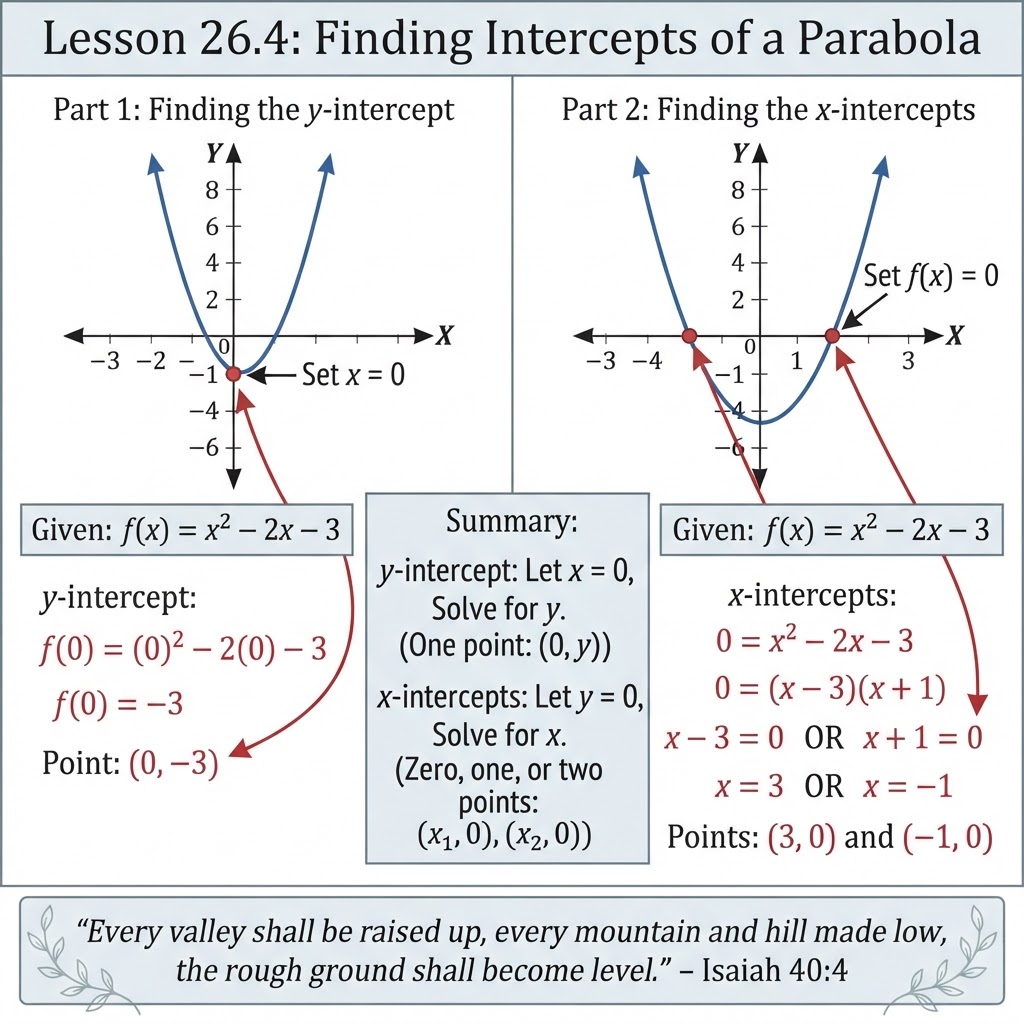
Lesson Narrative · Diagram
More videos
Finding the Y-Intercept of a Parabola | Quadratics Series Ep.2Homemade Mathematics
Finding the X-Intercepts of a ParabolaMath Academy
How do you find the x and y intercept of a quadraticBrian McLogan
Finding intercepts from an equation | Algebra I | Khan AcademyKhan Academy

Complementary Video
What career does this lesson unlock?
Adelaide will match a real-world profession to what you just learned and walk you through a day on the job.
Core Content
A parabola’s y-intercept is found by setting x to zero, while its x-intercepts,
Roots or zeros are located where the function output equals zero. These points represent the crossing of the coordinate axes, which provides a numerical anchor for visualizing the curve. By setting the y-coordinate to zero, we transform the quadratic equation into a standard form expression that allows us to solve for x-values, pinpointing exactly where the arch of the parabola meets the horizontal axis of the graph during our analysis.
The y-intercept is simple to identify because every quadratic function in standard form, f(x) = ax^2 + bx + c, possesses a value of c that serves as the y-coordinate when the input is zero. Since any number multiplied by zero vanishes, substituting zero for x eliminates the linear and quadratic terms, leaving only the constant. This arithmetic shortcut reminds us that even when complex variables appear, foundational truths remain steady throughout.
Finding x-intercepts requires rigorous calculation, especially when the parabola does not cross the axis at convenient integers. When we set f(x) = 0, we must solve the quadratic equation 0 = ax^2 + bx + c. The most reliable method is the quadratic formula, x = (-b +/- sqrt(b^2 - 4ac)) / (2a).
This formula acts as a mathematical compass, reliably guiding us to the precise locations of roots regardless of numerical complexity.
Consider the example f(x) = x^2 - 5x + 6. To find the y-intercept, we substitute zero for x, resulting in f(0) = 0^2 - 5(0) + 6, which yields 6. Thus, the y-intercept is (0, 6). This point indicates the starting vertical height of the parabola before it descends toward the x-axis.
This works because the function represents a continuous mapping where every x-input corresponds to exactly one y-output, ensuring stability in our model.
- =
- By applying the zero product property, we determine that x must be 2 or
- Consequently, the parabola crosses the x-axis at (2,
- and (3, 0). This factorization provides an exact solution that confirms our initial assessment of the parabolic curve.
We verify these intercepts by substituting the values back into the original expression. Plugging in 2, we get 2^2 - 5(2) + 6, which equals 4 - 10 + 6, or zero. Similarly, plugging in 3 results in 9 - 15 + 6, also equaling zero.
This process of verification serves as a check, ensuring that our algebraic manipulation accurately reflects the true behavior of the function, much like checking steps ensures we remain on path.
Now consider the case: f(x) = 2x^2 + 4x - 1. The y-intercept is the constant, -1, resulting in the point (0, -1). However, the x-intercepts are not immediately obvious through basic factoring. We must use the quadratic formula where a = 2, b = 4, and c = -1.
Using the formula, x = (-4 +/- sqrt(16 - 4(2)(-1))) / (2(2)), we calculate the discriminant as 16 + 8, which is 24.
- Since the square root of 6 is approximately
- 45, our intercepts are roughly
- 225 and -2.
- These are irrational numbers, demonstrating that intercepts are often precise values existing between whole integers.
Recognizing these irrational roots is vital, as they reveal the finer details of the parabola that simplistic whole-number estimations would fail to capture with accuracy.
A common mistake is confusing the vertex with an intercept. The vertex is the peak or valley of the curve, while intercepts are points on the axes. Misidentifying these leads to distorted graphs. Always confirm your intercept points by plotting them alongside the vertex.
If your intercepts do not align with the symmetry of the parabola, recheck the sign of your coefficients, particularly when dealing with negative values during quadratic calculations performed earlier.
Domain restrictions are rare in basic quadratic functions since they are defined for all real numbers. However, in applied contexts, the domain may be restricted to non-negative values. An intercept at a negative x-value might be algebraically correct but contextually irrelevant.
Understanding the context helps us filter mathematical results, ensuring that our final interpretations are grounded in reality while keeping our algebraic operations clean, logical, and consistent with the given variables.
When interpreting the signs of coefficients, note that a positive leading coefficient, a, causes the parabola to open upward, meaning it will likely have two, one, or zero x-intercepts based on the discriminant. If the discriminant is negative, the square root involves an imaginary unit, indicating the parabola never crosses the x-axis. This mathematical reality mirrors the idea that not every trajectory leads to a physical intersection with our expected boundaries.
Using these tools allows us to map out the behavior of any quadratic function with precision. As we manipulate these equations, we learn that variables are not chaotic but follow predictable rules. By consistently solving for intercepts, we develop a systematic approach to problem-solving.
This habit of discipline transfers beyond the classroom, teaching us to look for the points where our own actions intersect with our responsibilities in an intentional way.
Reflect on the symmetry of the intercepts. Because a parabola is symmetric about its axis, the x-intercepts will always be equidistant from the x-coordinate of the vertex. If you find the vertex at x = -1 for the previous example, notice that the intercepts are located at -1 + sqrt(6)/2 and -1 - sqrt(6)/2. This inherent balance reinforces the elegant structure present in quadratic mathematics, showing that symmetry is fundamental.
In conclusion, mastering intercepts provides a structural framework for understanding quadratic curves. Whether through factoring or the quadratic formula, we find the specific points that define the parabolic journey. As we calculate these values, we engage with the underlying logic of the universe, recognizing that while mathematics is a human language, the patterns we discover reflect an enduring, predictable order that supports our ability to model and comprehend the world around us.
Subscription Library
Education.com Teacher Login
Standards-aligned lesson plans, worksheets, games, and activities for Pre-K through 8th grade.
Login credentials are being prepared. Check back soon, or ask your teacher.
© 2026 Learning by Grace. All rights reserved. This content is for enrolled students only and may not be copied, distributed, or reproduced.
