The Discriminant: Understanding How to
Lesson 28.3 Presentation
Lesson diagrams and audio narration
Lesson Narrative · Audio, part 1
Lesson Narrative · Diagram
More videos
What is the discriminant and what does it meanBrian McLogan
Finding the Number of Solutions to Quadratic Equations Using the DiscriminantMath Learning Made Easy
Discriminant - What is it? and What does it tell you?Calculus by Christee
How to Determine the Discriminant and the Number of Solutions │AlgebraGoTutor Math

Complementary Video
What career does this lesson unlock?
Adelaide will match a real-world profession to what you just learned and walk you through a day on the job.
Core Content
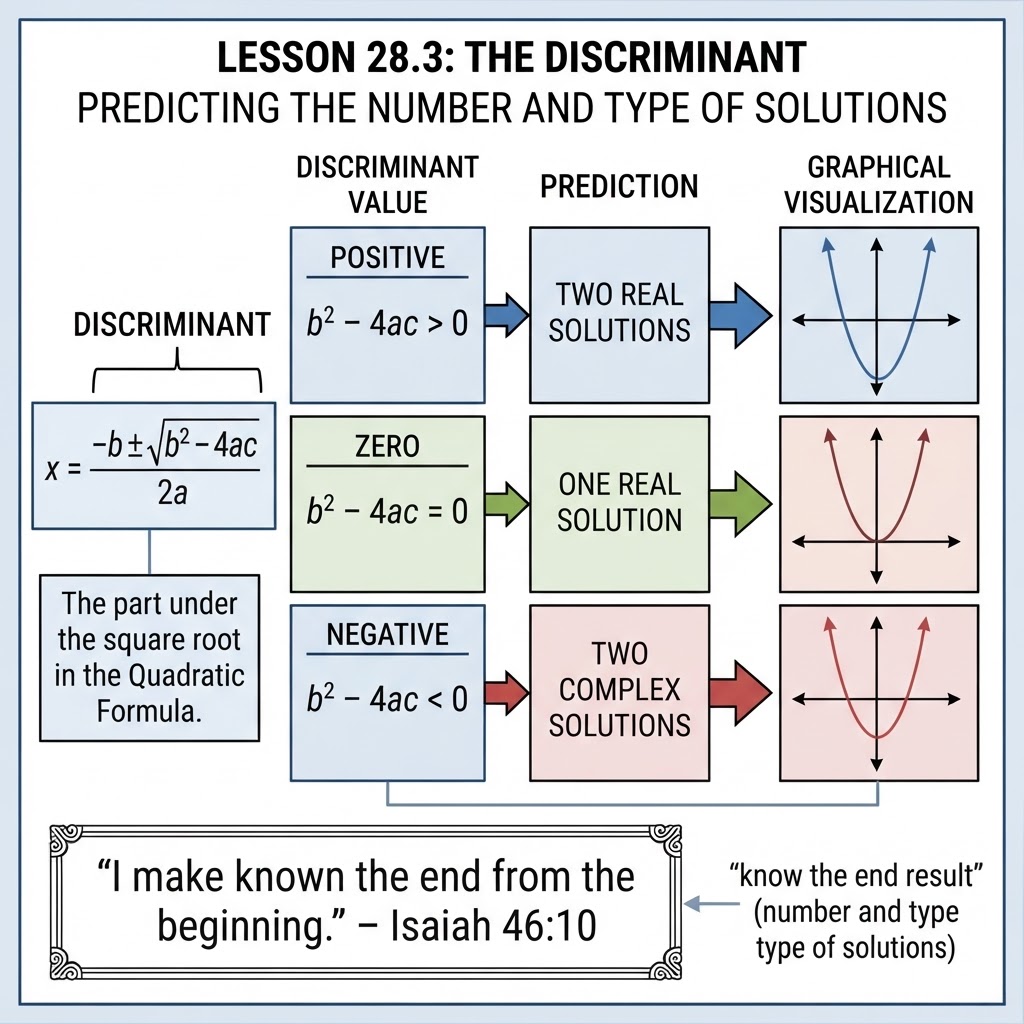
The discriminant, the expression b squared minus 4ac found under the
The radical sign in the quadratic formula serves as the ultimate diagnostic tool for any quadratic equation in standard form. By isolating the values of a, b, and c, we can extract the discriminant, denoted by the Greek letter delta or simply the expression b squared minus 4ac.
This value acts like a lens, allowing us to peek into the behavior of the parabola before solving for any roots.
When we calculate the discriminant, we are primarily interested in whether the resulting number is positive, zero, or negative. If the value is greater than zero, the quadratic formula will yield two distinct real roots. Graphically, this means the parabola crosses the x-axis at two unique points.
This dual nature arises because we are evaluating the root of a positive number, creating two separate values for our variable x.
Consider the equation x squared minus 5x plus 6 equals zero. Here, a equals 1, b equals -5, and c equals 6. Plugging these into b squared minus 4ac gives us (-5) squared minus 4(1)(6), which simplifies to 25 minus 24, resulting in 1.
Since 1 is greater than zero, we expect two distinct real roots. Factoring gives (x-2)(x-3) equals zero, showing the roots are exactly 2 and 3.
To verify this, we substitute these values back into the original equation. For x equals 2, we get 4 minus 10 plus 6, which equals zero. For x equals 3, we get 9 minus 15 plus 6, which also equals zero. Both satisfy the equality, validating our discriminant prediction.
This process shows that the nature of the roots is entirely dependent on the balance between the linear coefficient and the product constant.
If the discriminant equals exactly zero, the situation changes significantly. In this scenario, the term under the radical becomes zero, and the quadratic formula reduces to negative b divided by 2a. This indicates that there is only one real root, often called a repeated root.
On a graph, the vertex of the parabola sits perfectly on the x-axis, touching it at exactly one point without passing through the axis.
Take the example of x squared minus 4x plus 4 equals zero. With a equals 1, b equals -4, and c equals 4, the discriminant becomes (-4) squared minus 4(1)(4), or 16 minus 16, which is zero. Because the discriminant is zero, we anticipate one repeated root.
Factoring the quadratic gives (x-2) squared equals zero, which confirms that x equals 2 is the only solution for this quadratic equation.
Verification for this case is simple. By substituting 2 into the original equation, we find 4 minus 8 plus 4 equals zero, which holds true. This outcome illustrates the efficiency of the discriminant, as it saves us from tedious calculations when the parabola is perfectly balanced.
The math reveals how specific coefficients force the parabola to align precisely with the horizontal axis, touching at the vertex point of the curve.
The third possibility occurs when the discriminant is a negative number. Because we cannot take the square root of a negative value within the set of real numbers, we conclude that there are no real roots. In this case, the parabola remains entirely above or below the x-axis, never crossing it. The roots exist only in the realm of complex numbers, involving the imaginary unit i, discussed in advanced algebra.
Imagine the equation x squared plus x plus 5 equals zero. Here, a is 1, b is 1, and c is 5. Calculating the discriminant, we get 1 squared minus 4(1)(5), which is 1 minus 20, or -19. Since -19 is less than zero, we immediately know there are no real solutions. The graph of this function would float above the x-axis, never intersecting it regardless of the domain.
It is common for students to confuse the sign of the discriminant with the direction of the parabola. Remember that the leading coefficient, a, determines whether the parabola opens upward or downward, while the discriminant tells us about the x-intercepts.
A negative discriminant does not mean the equation is wrong; it simply means the solution set does not touch the real x-axis, illustrating the complexity of these algebraic systems.
A frequent error involves failing to identify the correct signs for the coefficients. Always treat the subtraction signs in the standard form as part of the integer. If your equation is x squared plus 3x minus 2, then c is -2.
Neglecting that negative sign will lead to an incorrect discriminant, which completely misidentifies the nature of the roots. Precision in extraction is vital in this algebraic analysis process.
When applying the discriminant to real-world word problems, you must consistently evaluate if physical constraints restrict the mathematical domain. For instance, if the variable x represents time in seconds, we generally discard negative roots as irrelevant. The discriminant allows us to verify if a projectile crosses the zero-height mark before we engage in the algebraic complexity of the full quadratic formula.
By analyzing the sign of b² - 4ac, we quickly determine if real solutions exist within our physical constraints, ensuring that our algebraic logic remains tethered to scenarios where variables like time, distance, or mass cannot feasibly be negative.
Looking beneath the surface of the equation teaches us to appreciate the elegant design hidden within these numerical relationships. Patterns such as these suggest a world structured by underlying logic and order, inviting us to be diligent in our search for mathematical truth.
By mastering the discriminant, we practice the vital discipline of looking past superficial features to identify the fundamental nature of a system. This analytical perspective is a transferable skill that extends far beyond our current classroom lessons, fostering critical thinking.
In conclusion, the discriminant is a powerful diagnostic tool that categorizes quadratics with minimal effort. Whether the result is positive, negative, or zero, the logic governing the roots remains consistent and reliable. By practicing this method, you gain a deeper intuition for how different quadratic components interact to define the shape and position of a parabola.
Keep these relationships in mind, as they provide the essential structural foundation for all advanced work in graphing and solving complex higher-order polynomial equations effectively.
Subscription Library
Education.com Teacher Login
Standards-aligned lesson plans, worksheets, games, and activities for Pre-K through 8th grade.
Login credentials are being prepared. Check back soon, or ask your teacher.
© 2026 Learning by Grace. All rights reserved. This content is for enrolled students only and may not be copied, distributed, or reproduced.
