Using Factoring to Solve Equations:
Lesson 23.5 Presentation
Lesson diagrams and audio narration
Lesson Narrative · Audio, part 1
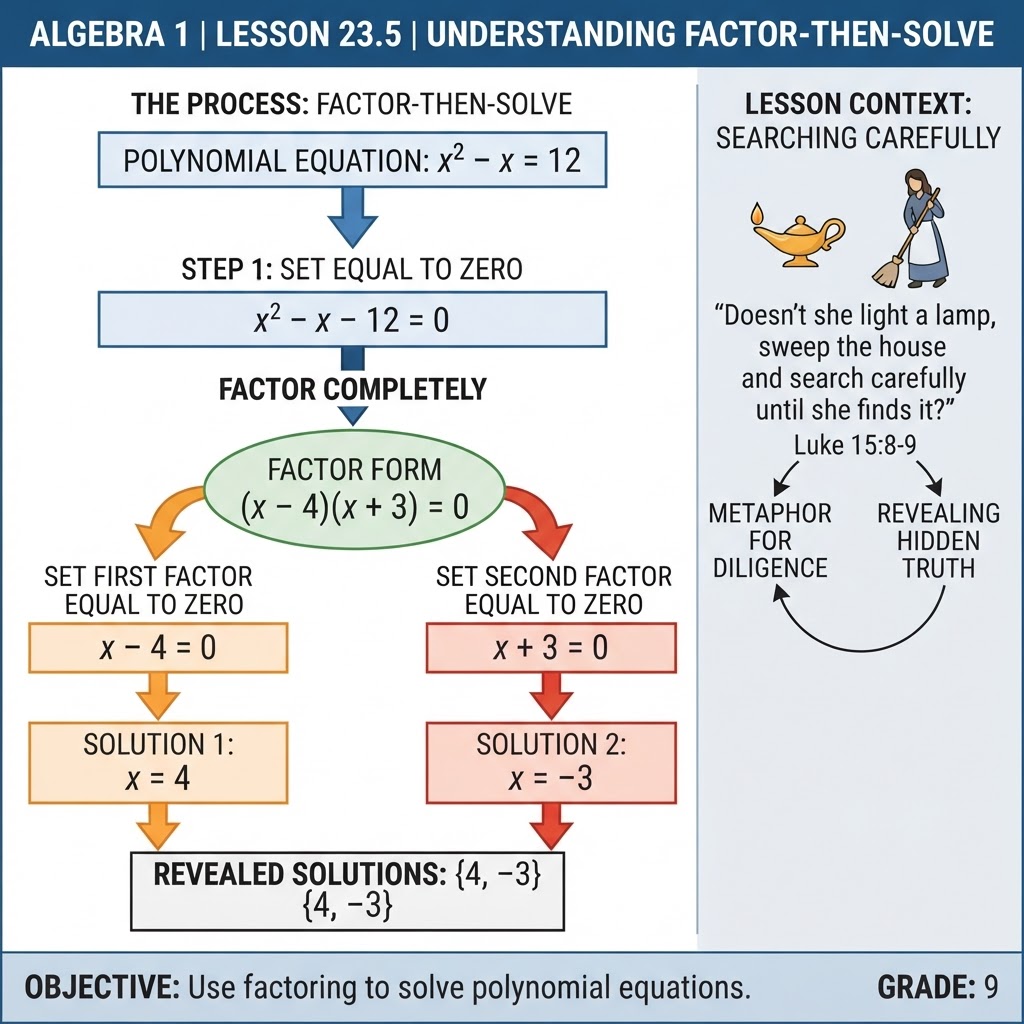
Lesson Narrative · Diagram
More videos
Solving polynomial functions using their graphs | Precalculus | Khan AcademyKhan Academy
Solving polynomial inequalities in factored form | Precalculus | Khan AcademyKhan Academy

Complementary Video
What career does this lesson unlock?
Adelaide will match a real-world profession to what you just learned and walk you through a day on the job.
Core Content
Once a polynomial equation is set equal to zero and factored completely,
You can utilize the Zero Product Property to isolate roots of quadratic functions. This property states that if the product of two real numbers is zero, then at least one factor must be zero. Mathematically, if ab equals zero, then either a equals zero or b equals zero.
This elegant rule transforms a quadratic equation into two simpler linear equations that are much easier to navigate and solve accurately for any given variable.
- To solve this, identify two numbers that multiply to 10 and add to
- These numbers are 2 and
- Thus, the expression factors into the quantity x plus 2 times the quantity x plus 5 equals
- Applying the Zero Product Property, set each binomial factor to zero independently, resulting in x plus 2 equals 0 and x plus 5 equals 0.
Solving these two linear equations yields x equals negative 2 and x equals negative 5. To verify, substitute these values into the original equation. If you plug in negative 2, you get 4 minus 14 plus 10, which equals zero.
Similarly, plugging in negative 5 gives 25 minus 35 plus 10, which also results in zero. The roots are confirmed as valid solutions because they satisfy the original equation perfectly every single time.
It is important to remember that this method only works when the quadratic expression equals zero. If your equation equals a non-zero constant, move all terms to one side before attempting to factor. For example, if you have x squared plus 7x equals negative 10, you must add 10 to both sides to return to the standard form x squared plus 7x plus 10 equals 0. This prepares the equation for solving.
A common mistake is trying to solve for x before factoring. If you see x squared plus 7x plus 10 equals 0, do not try to isolate x squared or x immediately. Factoring relies on the structure of the product.
If you fail to factor fully or forget the Zero Product Property, you might lose one of the two roots. Always look for a common factor or the appropriate pattern before making moves.
Graphical representation provides a helpful visual bridge. If you were to graph the function y equals x squared plus 7x plus 10, you would see a parabola that intersects the x-axis at negative 2 and negative 5. The solutions to the equation are the x-intercepts.
Understanding this connection helps you visualize why there are often two distinct solutions to a quadratic equation, representing where the path meets the axis point.
- Consider 2x squared plus 5x minus 3 equals
- We look for factors of negative 6 that sum to
- These numbers are 6 and negative
- Rewriting the middle term, we get 2x squared plus 6x minus 1x minus 3 equals
- Factor by grouping to obtain 2x times x plus 3 minus 1 times x plus 3 equals 0.
This leaves us with the factored form 2x minus 1 times x plus 3 equals 0. Setting each factor to zero, we get 2x minus 1 equals 0, which leads to x equals one-half, and x plus 3 equals 0, which leads to x equals negative 3.
The logic holds that each factor represents a specific condition under which the product collapses to zero. Checking negative 3 gives 18 minus 15 minus 3, zero.
Checking the value of one-half is also straightforward. Two times one-fourth is one-half. Five times one-half is two and a half. One-half plus two and a half is three. Three minus three is zero. Both solutions are verified. This process demonstrates that algebraic factoring remains robust even with non-integer roots, provided the arithmetic is handled carefully. Accuracy in each step ensures that the final result remains consistent with the original expression given.
- Factoring this yields the quantity x minus 3 squared equals
- In this case, there is only one distinct solution, x equals
- This occurs when the vertex of the parabola touches the x-axis at exactly one point. Recognizing these perfect square trinomials saves time and reflects the underlying geometry of parabolas.
When solving these equations, ensure you track negative signs with care. A single missing sign during the factoring process will change the roots entirely. If your factored expression does not multiply back to the original equation, re-examine your factors. Mathematics requires this kind of persistent review.
Verifying your work protects you from errors that could compromise the integrity of the entire logical chain you have built through your systematic algebraic steps.
Units of measurement can play a role in real-world problems. If x represents a dimension like width or time, negative solutions might be extraneous or physically impossible. Always evaluate whether your algebraic results make sense in the context of the word problem.
Domain restrictions are not just arbitrary math rules; they define the boundaries of what is possible within specific constraints, guiding us toward the correct and logical mathematical result.
We must distinguish between an exact solution and an approximation. Factoring provides exact values. If a quadratic cannot be factored into rational components, you might need methods like the quadratic formula, but factoring remains the most elegant starting point. Quadratic equations describe curves and acceleration patterns.
Mastering these tools allows us to describe the dynamic nature of changing variables and physical relationships with greater mathematical precision and a deep level of understanding.
As you move forward, keep practicing this orderly approach to problem-solving. Organizing your steps clearly not only prevents confusion but also mirrors the order found in the natural world. Factoring is more than a mechanical exercise; it is an analytical process that uncovers the hidden roots of equations.
By finding these roots, you gain insight into the function itself, allowing you to see the bigger picture as you solve problems.
Subscription Library
Education.com Teacher Login
Standards-aligned lesson plans, worksheets, games, and activities for Pre-K through 8th grade.
Login credentials are being prepared. Check back soon, or ask your teacher.
© 2026 Learning by Grace. All rights reserved. This content is for enrolled students only and may not be copied, distributed, or reproduced.
Have something to share?
Submit your work — writing, art, videos, and more — for us to review.
My Submitted Work