Independent and Dependent Events:
Lesson 33.2 Presentation
Lesson diagrams and audio narration
Lesson Narrative · Audio, part 1
Lesson Narrative · Diagram
More videos
Probability - Independent and Dependent EventsThe Organic Chemistry Tutor
Independent and Dependent EventsAnywhere Math
Compound probability of independent events | Probability and Statistics | Khan AcademyKhan Academy
Statistics|Probability - 3 | Independent vs Dependent Events | LearnereaLearnerea

Complementary Video
What career does this lesson unlock?
Adelaide will match a real-world profession to what you just learned and walk you through a day on the job.
Core Content
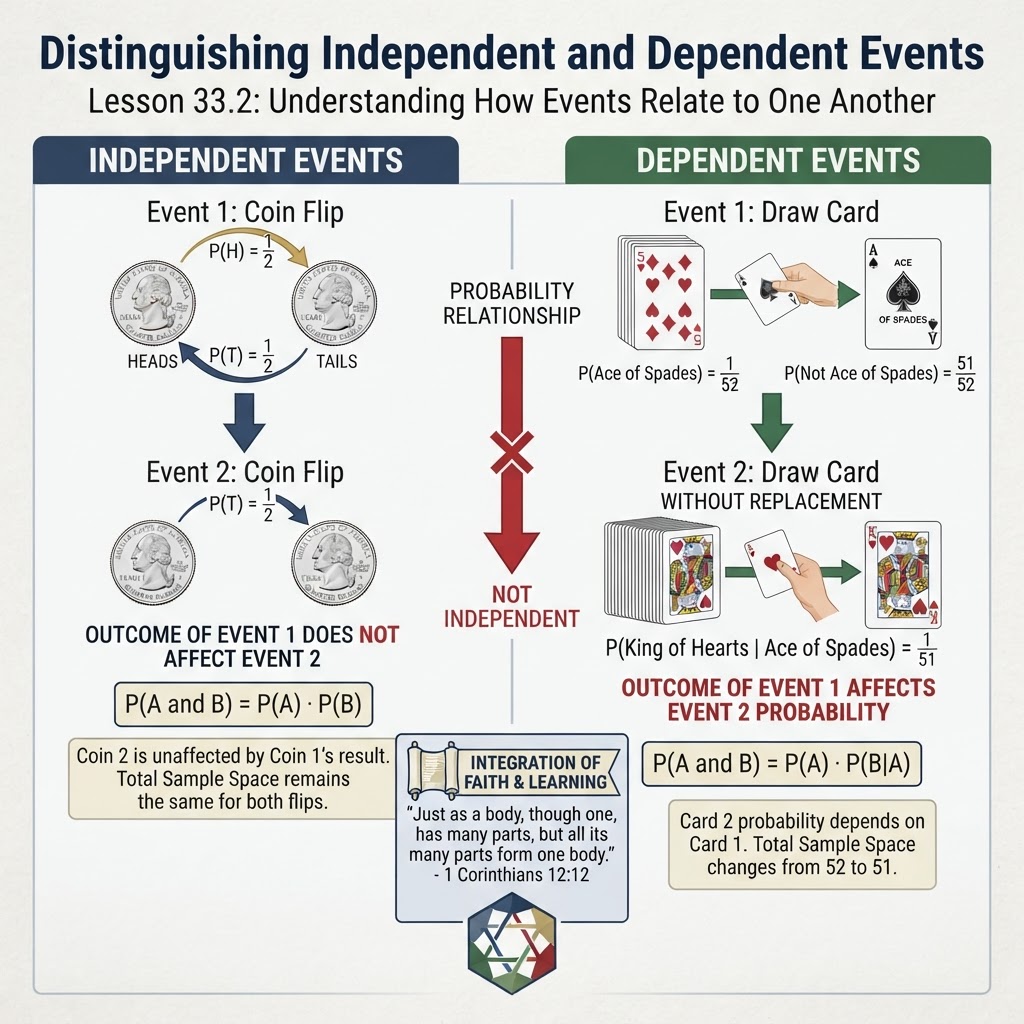
Independent events do not affect each other’s outcome, like flipping two
Probability often involves independent events like flipping coins or spinning a numbered wheel twice. When flipping a coin, the first result provides no information about the second. Mathematically, we define two events A and B as independent if the probability of both occurring, P(A and B), equals the product of their individual probabilities: P(A) * P(B). This multiplicative property is the primary tool for calculating outcomes in multi-stage experiments.
Contrast this with dependent events, where the first occurrence alters the sample space for the second. Imagine drawing cards from a deck without replacement. If you pull an Ace first, fifty-one cards remain, and the count of Aces drops to three.
This change in the denominator and numerator demonstrates that the second event's probability is conditional upon the outcome of the first draw. This requires adjusting our arithmetic for each stage.
To handle dependent events, we use the general multiplication rule: P(A and B) = P(A) * P(B | A), where P(B | A) is the probability of B given A occurred. This conditional notation is essential for accuracy. Algebraically, the conditional probability adjusts the weight of the second event based on the constraints imposed by the first. Understanding this nuance prevents the error of assuming independence when physical constraints dictate otherwise in experiments.
Consider a bag containing four red and six blue marbles. You want the probability of drawing two red marbles without replacement. The first event has a probability of 4/10 or 0. 4. Because we do not replace the marble, the bag now contains nine total marbles, three of which are red. The second probability is 3/9 or 1/3. Multiplying these gives 4/10 * 3/9, which equals 12/90 or 2/15.
To verify this result, we map every branch of the experiment. Each branch represents a distinct outcome, and the product of the probabilities along the path confirms our calculation. In our marble example, 4/10 * 3/9 simplifies to 12/90, which reduces to 2/15. Converting this fraction to a decimal yields approximately 0. 1333. This systematic verification ensures our logic aligns perfectly with the constraints of the physical sample space provided here.
A common mistake is failing to update the sample size during sequential sampling. If you draw two marbles with replacement, the denominator remains ten for both events because the bag returns to its original state. Always ask if the experimental conditions reset or if they evolve.
The algebraic difference between 4/10 * 4/10 and 4/10 * 3/9 is significant, representing the difference between returning to the status quo versus reacting.
Consider another example involving a standard deck of fifty-two cards. What is the probability of drawing a King and then a Heart, assuming no replacement? The first event, drawing a King, is 4/52. If the first card was the King of Hearts, only twelve hearts remain among fifty-one cards.
If the King was not a heart, thirteen hearts remain. This scenario creates two paths, showing how dependence complicates simple calculations.
In cases where multiple paths exist, we apply the addition rule for mutually exclusive scenarios. The total probability is the sum of the probabilities of each path: (1/52 * 12/51) + (3/52 * 13/51). Evaluating this gives 12/2652 + 39/2652, which equals 51/2652. Reducing this fraction provides a clear probability of 1/52. This methodical breakdown prevents the oversight of variable interactions, ensuring that our algebraic models remain robust and responsive.
It is vital to distinguish these probability rules from correlation. While probability calculations describe how events influence one another within a closed system, correlation measures the statistical tendency of two variables to change together. Causation is a stronger claim, implying a direct mechanism of influence.
In our math lessons, we focus solely on the algebraic mechanisms of dependence, which provide the framework for understanding how one event restricts future available possibilities.
The domain of probability is strictly bounded between zero and one. An impossible event has a probability of zero, while a certain event has a probability of one. When performing calculations, if your result falls outside this interval, revisit your multiplication steps immediately.
Furthermore, ensure that the sum of all mutually exclusive probabilities in a sample space equals one. This internal consistency check is a powerful tool for catching arithmetic errors.
Symbolically, we denote independent events using P(A | B) = P(A). This equation tells us that the probability of A is unaffected by the occurrence of B. If this equality fails, the events are mathematically dependent. Recognizing this symbolic relationship is more efficient than intuitively guessing whether events interact.
By relying on the algebraic definition, we can objectively classify event relationships even when the context makes the interaction seem non-intuitive or ambiguous.
When calculating probabilities, we must recognize that these values are dimensionless ratios representing the likelihood of successful outcomes compared to the total possible sample space. Whether your experiment involves drawing marbles without replacement or rolling dice, the procedure is consistent: first define the initial sample space, then carefully account for how the outcome of the first event modifies the composition of the set before the second stage.
By applying the multiplication rule to these conditional or independent probabilities, you are mathematically modeling the intersection of events. Maintaining these rigorous algebraic habits ensures your work remains accurate, preventing errors when variables shift between consecutive stages of a complex scenario.
Throughout this curriculum, we observe that these rules represent the inherent order of our world. While we utilize human notation to map these possibilities, the underlying patterns reflect a universe operating with reliable consistency. Mastering probability laws allows us to navigate uncertainty with precision, not because we can predict the future, but because we discern the mathematical structure established within these systemic designs.
Recognizing this consistency confirms that probability is not mere guesswork, but a reflection of logical frameworks that govern all multi-stage experiments.
As you approach final problems, focus on comprehending the structure of the system being analyzed. Whether you must choose to add or multiply, you must justify your operation based on the logical requirements of the experiment. Through careful practice, you will develop the mental discipline needed to apply these algebraic tools reliably, ensuring your solutions are sound, verified, and consistent with the fundamental properties of probability theory.
Subscription Library
Education.com Teacher Login
Standards-aligned lesson plans, worksheets, games, and activities for Pre-K through 8th grade.
Login credentials are being prepared. Check back soon, or ask your teacher.
© 2026 Learning by Grace. All rights reserved. This content is for enrolled students only and may not be copied, distributed, or reproduced.
