Review: Polynomials and Quadratic
Lesson 35.3 Presentation
Lesson diagrams and audio narration
Lesson Narrative · Audio, part 1
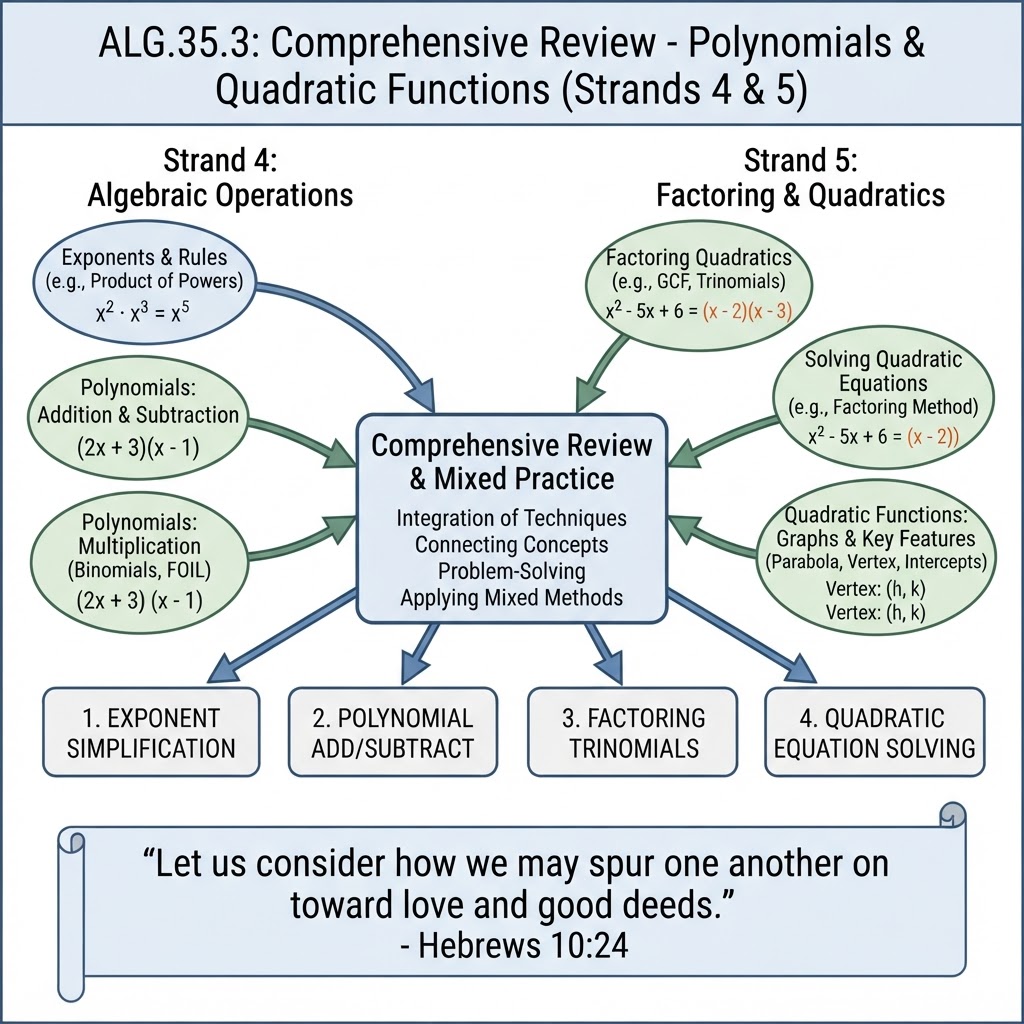
Lesson Narrative · Diagram
More videos
Mastering Polynomials Review: 5 Must-know Concepts!Algebra-1 with Mr. Peters
How To Solve Quadratic Equations By Factoring - Quick & Simple! | Algebra Online CourseThe Organic Chemistry Tutor
Factoring vs Completing the Square vs Quadratic FormulaBrian McLogan
How To Solve Quadratic Equations Using The Quadratic FormulaThe Organic Chemistry Tutor

Complementary Video
What career does this lesson unlock?
Adelaide will match a real-world profession to what you just learned and walk you through a day on the job.
Core Content
Today’s review reaches back to Strands 4 and 5, bringing together
Polynomial operations and quadratic equations provide a unified framework for problem solving. As you synthesize these concepts, think of polynomial terms as building blocks that, when arranged properly, reveal the underlying structure of a function. Whether adding binomials or solving a trinomial for its roots, the goal remains consistency. Mathematics provides a structured language to describe relationships that mirror the orderly, predictable nature of the world around us.
When adding or subtracting polynomials, we must strictly adhere to the rule of combining like terms. This operation is valid because the distributive property allows us to group variables of the same degree together. A common mistake occurs when students incorrectly distribute a negative sign across a parenthetical expression, which changes the internal terms. Remember to treat subtraction as the addition of a negative, ensuring signs are flipped accurately throughout.
-
- (x^2 - 4x + 7). Distributing the negative transforms this into 3x^2 + 5x - 2 - x^2 + 4x -
- Combining the squared terms gives 2x^2, linear terms result in 9x, and the constants aggregate to -9. The final simplified form is 2x^2 + 9x -
- Verification is achieved by substituting x = 1 into the original expression and the result to ensure both sides match perfectly.
Multiplication of polynomials relies on the FOIL method or the distributive property applied multiple times. Multiplying (x + 3)(x - 5) requires us to distribute each term of the first binomial into the second. This produces x^2 - 5x + 3x - 15, which simplifies to x^2 - 2x - 15.
The validity of this step is grounded in the area model of rectangles, where total area is the sum of product dimensions.
Factoring, the inverse process of multiplication, requires identifying greatest common factors before binomial pairs. For the trinomial 2x^2 - 8x - 24, we first factor out the GCF of 2 to obtain 2(x^2 - 4x - 12). We then identify two numbers that multiply to -12 and add to -4.
These numbers are -6 and 2, leading to the factored form 2(x - 6)(x + 2). Verification involves expanding the result to reach original.
When quadratic equations cannot be factored, we turn to the quadratic formula: x = (-b +/- sqrt(b^2 - 4ac)) / (2a). This formula is derived from the process of completing the square, making it a universal tool for finding roots. The discriminant, b^2 - 4ac, dictates the nature of solutions.
If positive, you have two real roots; if zero, one repeating root; if negative, you have complex solutions. The method is always reliable.
-
The square root of 49 is
-
Thus, the roots are (-5 +
-
/ 4 and (-5 -
-
/ 4, resulting in 0.5 and -3.
-
5 back into 2x^2 + 5x -
-
This gives 2(0.
-
- 5(0.
-
- 3, which is
-
5 +
-
5 - 3, equaling exactly zero. This confirms our logic is sound. Always remember that the quadratic formula is an exact method.
Even when values appear messy, the formula ensures that the relationships between variables remain perfectly balanced and technically precise throughout every stage of your algebraic derivation.
Graphical representations serve as a visual bridge to these symbolic results. A quadratic equation in the form y = ax^2 + bx + c represents a parabola. The roots we solve for algebraically are the x-intercepts where the graph crosses the horizontal axis.
Understanding that these points represent where the y-value is zero connects the visual trajectory of the curve to the numerical solutions found through factoring or the quadratic formula.
Domain restrictions are vital when functions model real-world scenarios. While an abstract parabola continues infinitely, a physical model might only exist for specific ranges. If a variable represents time in seconds, we must restrict the domain to t >= 0. Ignoring such constraints often leads to solutions that are mathematically correct but contextually invalid. Always check if your calculated roots fall within the logical parameters set by the problem statement.
Correlation versus causation is an important distinction during review. In data sets, variables might appear to follow a quadratic trend, showing a strong correlation, but that does not mean one variable directly forces the other into that specific path. Polynomial models are powerful tools for prediction, but they remain symbolic interpretations of reality. Always distinguish between the raw data and the mathematical model used to describe it, maintaining academic skepticism.
Common errors often involve sign confusion or incorrect grouping during factoring. When working with equations, keep your workspace clean and aligned. If you find yourself repeatedly arriving at a wrong answer, retrace your steps to identify the specific sign change or arithmetic error.
Just as a craftsman inspects his work for flaws, a student must review algebraic steps to ensure every move is mathematically justified. Accuracy is the hallmark.
Consider how these patterns exist in nature, such as the path of a projectile or the reflection of light. These quadratic shapes appear throughout creation, suggesting a level of intentionality that mathematics helps us observe. While we use math to solve for variables, we are also learning to appreciate the elegant complexity of the universe. Mastering these steps allows you to participate in understanding the logic that underpins our physical world.
As you conclude this review, reflect on how these tools have evolved from simple operations to complex problem-solving strategies. You are now equipped to navigate polynomial expressions and quadratic equations with confidence. This proficiency is a result of consistent practice and careful reasoning. Take time to review these worked examples until the process feels natural. By internalizing these methods, you establish a firm foundation for the higher-level mathematical challenges ahead.
Subscription Library
Education.com Teacher Login
Standards-aligned lesson plans, worksheets, games, and activities for Pre-K through 8th grade.
Login credentials are being prepared. Check back soon, or ask your teacher.
© 2026 Learning by Grace. All rights reserved. This content is for enrolled students only and may not be copied, distributed, or reproduced.
