Review: Solving by Factoring and Square
Lesson 30.3 Presentation
Lesson diagrams and audio narration
Lesson Narrative · Audio, part 1
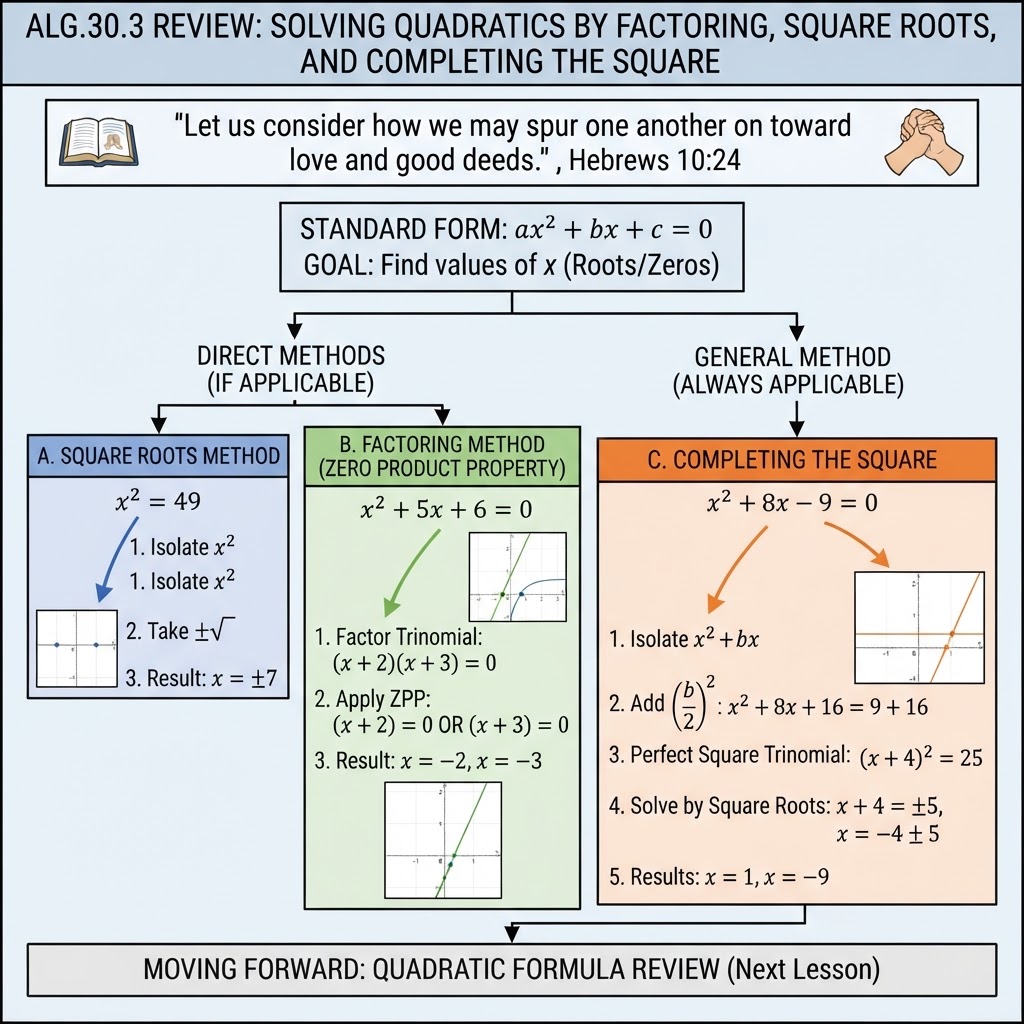
Lesson Narrative · Diagram
More videos
Factoring vs Completing the Square vs Quadratic FormulaBrian McLogan
How To Solve Quadratic Equations By Factoring - Quick & Simple! | Algebra Online CourseThe Organic Chemistry Tutor
How To Solve Quadratic Equations Using The Square Root Property | AlgebraThe Organic Chemistry Tutor
4 WAYS TO SOLVE A QUADRATIC EQUATION | Algebra 1 & 2 | Factoring, Square Roots, Quadratic Formulayour math tutor

Complementary Video
What career does this lesson unlock?
Adelaide will match a real-world profession to what you just learned and walk you through a day on the job.
Core Content
Today’s review revisits every solving method from Module 27: factoring,
Using the square root property for equations fitting specific quadratic forms requires both procedural memory and pattern recognition. When you encounter x squared minus nine equals zero, you immediately see the difference of two squares. Factoring this into the product of two binomials, x minus three times x plus three, reveals the zeroes through the Zero Product Property. Identifying these structures allows for swift and accurate solutions to quadratic equations.
The Zero Product Property is the engine behind factoring. It states that if two numbers multiply to zero, one must be zero. By setting each factor equal to zero, you isolate the values of x that satisfy the original equation. This logical necessity ensures that we find all possible roots.
Just as we seek truth by examining individual components of a claim, we examine factors to reveal the equation's solution set.
- Instead of factoring, we isolate the squared term. Adding 20 to both sides yields 4x squared equals
- Dividing by 4 gives x squared equals
- Taking the square root of both sides, we find x equals plus or minus the root of 5.
This method requires attention to the plus or minus sign. Forgetting this leads to losing half of the solution space, which is a common error. Geometrically, the plus or minus signifies that both a positive and negative input can yield the same output when squared, reflecting the symmetry of the parabola.
When you write x equals the square root of 5, you have captured only one side of the truth, missing the complete picture.
When we examine a perfect square trinomial such as x squared plus 6x plus 9 equals 0, we can utilize the shortcut of collapsing the expression into x plus 3 quantity squared. Setting this equal to zero, we take the square root of both sides to find x plus 3 equals 0, which results in x equals negative 3. This method is elegant because it bypasses the manual process of factoring quadratic trinomials.
Efficiency in mathematics often mirrors wisdom. By identifying the structure of a problem, we choose the most direct path. If the equation has a middle linear term and a constant, factoring is the standard route. If the equation lacks a middle term, or if it is already expressed as a squared binomial, the square root property is far faster. Recognizing these patterns saves time and minimizes the chance for calculation errors during tests.
-
A strategic student recognizes the left side as a perfect square trinomial. We rewrite the left side as x minus 5 squared equals
-
Now, the square root property becomes the obvious choice. Taking the square root of both sides, we get x minus 5 equals plus or minus
-
The math holds firm through this simplification.
-
To verify, we substitute 9 back into the original: 81 minus 90 plus 25 equals
-
Checking 1, we get 1 minus 10 plus 25 equals
-
Both checks confirm our work is accurate. This process demonstrates that algebraic flexibility is a powerful tool for solving problems quickly and correctly.
Another vital consideration is the nature of the roots. Sometimes, the solutions are not rational numbers. When you use the square root property and arrive at a result like x squared equals 7, the solution x equals plus or minus the square root of 7 is exact. Converting this to a decimal is an approximation. We prefer the exact form, as it preserves the integrity of the original value for later steps.
A common mistake involves applying the square root property to expressions that are not yet isolated. For example, in the equation x squared plus 9 equals 0, attempting to take the square root of both sides immediately is impossible in the real number system. You must first subtract 9, leaving x squared equals negative 9. Because no real number squared can be negative, we correctly conclude there are no real solutions.
Graphical representations provide a way to verify these algebraic results. The roots we calculate are the x-intercepts where the parabola touches or crosses the horizontal axis. If our algebra yields two distinct values, the graph should intersect the x-axis at two points.
If we find a single repeated root, the vertex of the parabola sits exactly on the axis. Visualizing these curves helps confirm that our numeric solutions align with functions.
Units also play a critical role when these equations model physical scenarios. If a variable represents time or length, negative roots are often discarded as extraneous because time and distance are generally non-negative. Being mindful of the domain of your variables ensures that your final answer is not just mathematically correct but also contextually meaningful. Always pause to consider whether your numerical results fit the reality of the given problem set.
As you continue to practice, look for the underlying simplicity in complex arrangements. Many equations are purposefully structured to test whether you can spot a shortcut. Just as we seek to build our character with discipline, we build our mathematical proficiency through steady, deliberate practice of these foundational methods.
By carefully identifying the structure of every equation you face, you transform potential confusion into a clear, methodical path toward a reliable solution.
This concludes our review of factoring and square roots. You now have two distinct, reliable ways to dismantle quadratic expressions. As you move forward, keep these methods in your toolkit, choosing them not based on guesswork but on the visual structure of the equation.
With patience and attention to the signs, you will find that these problems become manageable tasks, allowing you to focus on the beauty of algebraic inquiry today.
Subscription Library
Education.com Teacher Login
Standards-aligned lesson plans, worksheets, games, and activities for Pre-K through 8th grade.
Login credentials are being prepared. Check back soon, or ask your teacher.
© 2026 Learning by Grace. All rights reserved. This content is for enrolled students only and may not be copied, distributed, or reproduced.
