Complex Solutions: Understanding What
Lesson 28.4 Presentation
Lesson diagrams and audio narration
Lesson Narrative · Audio, part 1
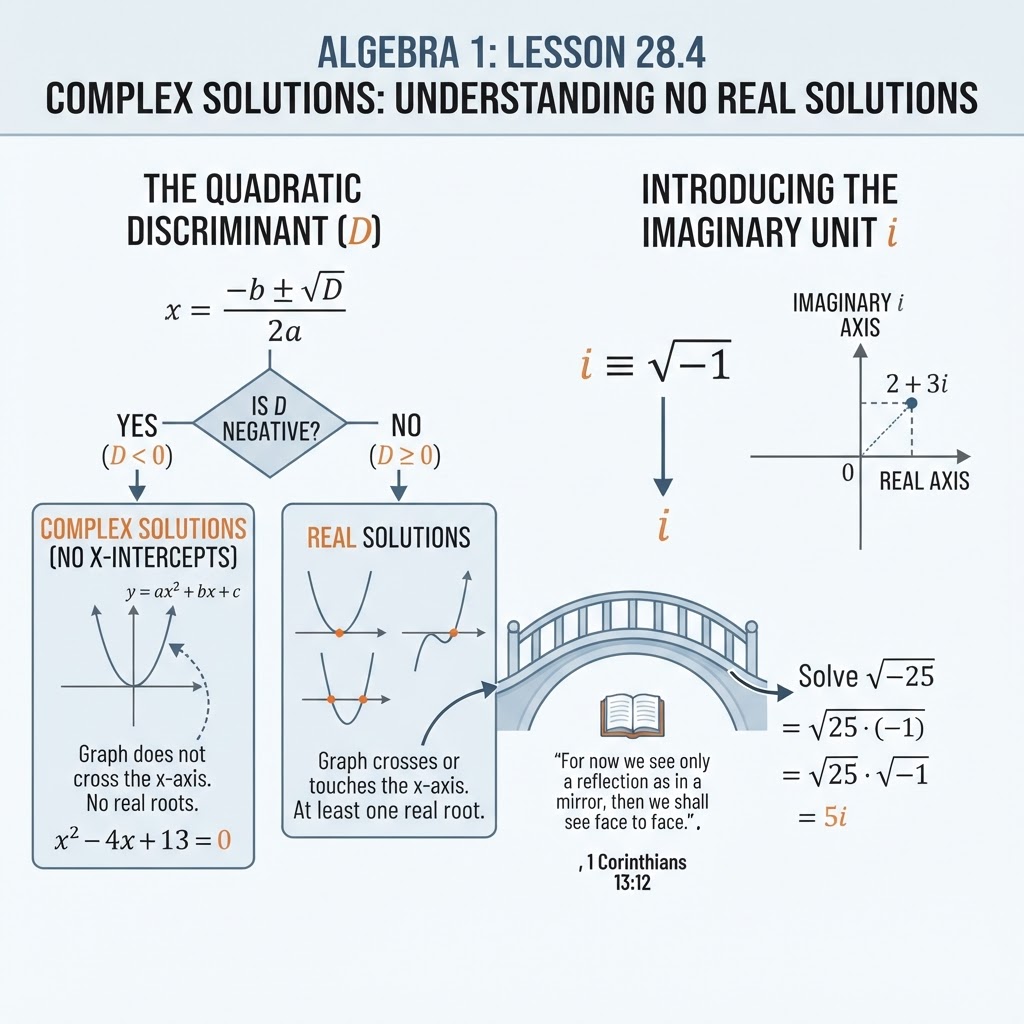
Lesson Narrative · Diagram
More videos
Complex Numbers - Practice ProblemsThe Organic Chemistry Tutor

Complementary Video
What career does this lesson unlock?
Adelaide will match a real-world profession to what you just learned and walk you through a day on the job.
Core Content
When a quadratic equation’s discriminant is negative, its solutions involve
Complex numbers extend the real number system to include values arising when we encounter square roots of negative numbers. In standard algebra, any real number squared results in a non-negative product. When we face a negative discriminant, denoted as b squared minus 4ac, the quadratic formula requires us to take a square root of that value, which necessitates introducing the imaginary unit i as a mathematical necessity for solving such equations.
The imaginary unit i is defined formally as the square root of negative one. By establishing this foundational value, we create a mathematical bridge that allows us to solve quadratic equations that do not cross the x-axis on a coordinate plane.
While the graph itself does not show real intercepts, the algebraic solutions exist as complex numbers in the form a + bi, where a and b are real numbers and i remains.
Consider the quadratic equation x squared plus 4 equals zero. To solve for x, we subtract 4 from both sides to get x squared equals negative 4. We then take the square root of both sides, resulting in x equals plus or minus the square root of negative 4.
Since the square root of negative 4 is equivalent to the square root of 4 times the square root of negative 1, it simplifies to 2i.
This result shows that x equals 2i or negative 2i. To verify, substitute 2i back into the original equation. Squaring 2i gives 2 squared times i squared, which is 4 times negative 1, equaling negative 4. Adding 4 to negative 4 confirms the result is zero.
This process demonstrates that even when a solution seems invisible on a standard graph, algebraic rules provide a consistent path to determine the correct numerical values for solutions.
Students often mistakenly believe that because i is called imaginary, it lacks utility. However, this is simply a historical nomenclature choice. Just as we use negative numbers to represent debt or temperatures below zero, complex numbers provide a systematic way to track phases and oscillations in electrical engineering and signal processing.
Much like our faith, these concepts require us to trust in logical structures that extend far beyond our immediate physical vision today.
Let us examine a second example: x squared minus 2x plus 5 equals zero. Using the quadratic formula, where a equals 1, b equals negative 2, and c equals 5, we calculate the discriminant: negative 2 squared minus 4 times 1 times 5, which equals 4 minus 20, resulting in negative 16.
Because the discriminant is negative, we know our solutions will be complex conjugates, meaning they share real and imaginary parts.
Applying the formula, we have x equals negative negative 2 plus or minus the square root of negative 16, divided by 2 times 1. This simplifies to 2 plus or minus 4i, all divided by 2. When we divide both terms in the numerator by 2, we obtain 1 plus or minus 2i.
These are the two complex solutions for the equation, representing where the parabola would interact with an expanded number space.
To check our work, we verify the solutions 1 plus 2i and 1 minus 2i. The equation must be equivalent to the product of x minus (1 plus 2i) and x minus (1 minus 2i). Multiplying these binomials yields x squared minus x(1 minus 2i) minus x(1 plus 2i) plus (1 plus 2i)(1 minus 2i), which simplifies exactly back to our original quadratic x squared minus 2x plus 5.
A common mistake in these problems involves the sign of the discriminant. Students often forget to account for the negative inside the square root correctly. It is essential to treat the negative sign as a factor of negative 1, which becomes i outside the radical.
Failing to carry the negative correctly through the quadratic formula is the most frequent cause of error. Always prioritize writing out every step of the radical simplification.
Notice that the imaginary unit i behaves algebraically just like a variable such as x, with the exception that i squared is always replaced by negative 1. This property keeps our calculations within the set of complex numbers. Do not confuse the letter i with a variable that can take on any value; it is a fixed constant, acting as a scalar factor that defines the vertical component of the complex plane.
Just as we discern truth through the lens of faith, recognizing that unseen spiritual realities are true, we accept complex numbers as a valid expansion of our mathematical field. Both systems require us to look past the surface level of the physical world.
In math, this is the graph that fails to touch the x-axis; in life, it is the quiet assurance of purpose despite the visible circumstances of personal hardship.
When you encounter a negative discriminant, do not panic or assume the equation is unsolvable. It is merely asking you to step into the complex number system. Remember that the solutions will always appear in conjugate pairs unless the real part is zero.
This symmetry is a beautiful aspect of quadratic equations, reflecting a balance that remains stable and predictable across all calculations, provided you follow the rules of binomial distribution.
As you progress, you will see how these complex solutions define the behavior of systems that do not have real roots. Whether you are dealing with projectile paths or circuits oscillating with alternating current, the algebra remains the same. By grounding your work in these logical steps, you ensure that your results are not just correct, but a reliable representation of the hidden dynamics governing the equation you are currently studying.
Ultimately, proficiency in complex algebra is about expanding your perception. By mastering the imaginary unit, you are equipping yourself to handle more advanced functions that describe the intricacies of our physical environment. Keep focusing on the precision of your arithmetic and the clarity of your symbolic representation, and you will find that these complex values provide a coherent and elegant solution to problems that once appeared impossible to solve in reality.
Subscription Library
Education.com Teacher Login
Standards-aligned lesson plans, worksheets, games, and activities for Pre-K through 8th grade.
Login credentials are being prepared. Check back soon, or ask your teacher.
© 2026 Learning by Grace. All rights reserved. This content is for enrolled students only and may not be copied, distributed, or reproduced.
