Factoring Completely: Understanding How
Lesson 23.4 Presentation
Lesson diagrams and audio narration
Lesson Narrative · Audio, part 1
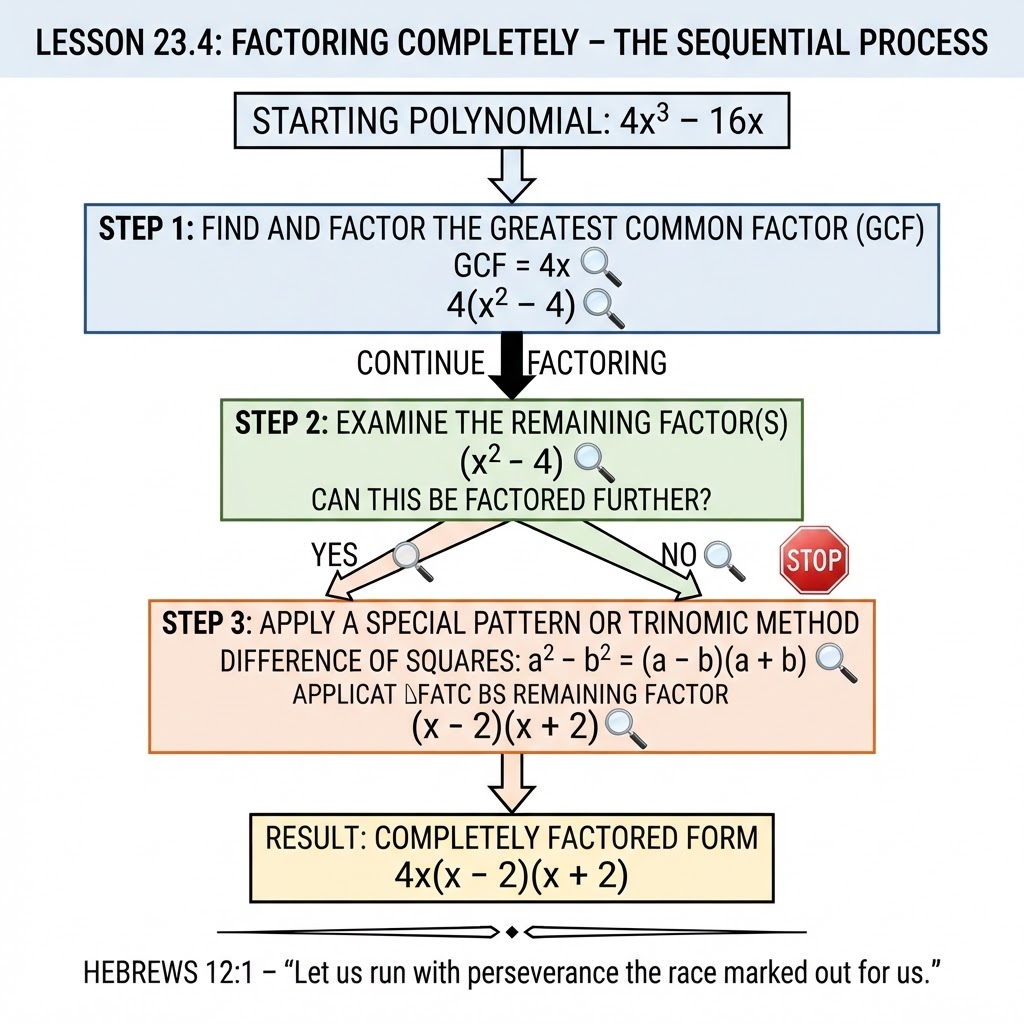
Lesson Narrative · Diagram
More videos
Factoring completely with a common factor | Algebra 1 | Khan AcademyKhan Academy
How to Factor CompletelyProfessor Noy
How to Factor Completely in College AlgebraCole's World of Mathematics
Common Monomial Factoring - Polynomial Factoring - Grade 8 MathMATH TEACHER GON
Factor Polynomials - Understand In 10 minTabletClass Math
6) Common Factor | factorisation grade 10kevinmathscience

Complementary Video
What career does this lesson unlock?
Adelaide will match a real-world profession to what you just learned and walk you through a day on the job.
Core Content
Factoring completely means continuing to factor a polynomial until every
A factor is prime when it cannot be broken down further using integer coefficients. Many students mistakenly assume that a single factoring step is sufficient, but this leads to incomplete answers that miss the full structure of the expression. To factor completely, we must adopt a methodical approach, starting with the extraction of the greatest common factor, or GCF, which acts as the foundation for subsequent decomposition within the expression.
The GCF is the largest monomial that divides evenly into every term of the polynomial. By identifying this factor first, we simplify the coefficients and reduce the powers of the variables, making the remaining expression much easier to manipulate. Imagine this process as clearing away debris before building; if you overlook a common factor, the resulting trinomial or binomial remains unnecessarily complex and prevents you from identifying patterns like difference of squares.
Once the GCF is removed, analyze the remaining polynomial. If it is a quadratic trinomial of the form ax squared plus bx plus c, search for two numbers that multiply to a times c and add to b. This method ensures that we correctly identify the factors.
If the polynomial is a binomial, we check specifically for the difference of squares pattern, which is written as a squared minus b squared.
The difference of squares is a powerful tool because it recognizes that a structure of x squared minus a constant square can always be factored into the product of two conjugates: x plus a and x minus a. This pattern is essential because it allows us to break down expressions that initially look solid. By distinguishing these patterns, we move beyond guessing and apply systematic rules that guarantee accuracy in our algebraic results.
Consider the expression 3x cubed minus 12x. To factor this completely, we first observe that both terms share a common factor of 3x. Dividing each term by 3x leaves us with x squared minus 4. Because x squared minus 4 is a difference of squares where 4 is the square of 2, we can factor it further into x plus 2 and x minus 2. The completely factored result is 3x times x plus 2 times x minus 2.
To verify this result, we perform polynomial multiplication to check the original expression. First, multiply x plus 2 by x minus 2 to obtain x squared minus 4. Next, multiply this result by the 3x we pulled out initially. Distributing 3x across the binomial gives 3x cubed minus 12x.
Since this matches our starting point, we have confirmed that our factorization is correct and satisfies the original algebraic requirements of the problem statement.
A common mistake students make is failing to check if inner terms can be factored further after the initial GCF is removed. Another error involves sign confusion, especially when subtracting a binomial. Always remember that signs are part of the factors.
If you factor out a negative number, the signs of every term inside the parentheses must change. Careful attention to these negative signs prevents errors that often plague the final stage.
-
We begin by identifying the GCF, which is
-
Extracting this leaves us with 2 times the quantity x squared plus 5x plus
-
Now, we focus on the trinomial x squared plus 5x plus
-
We need two numbers that multiply to 6 and add to
-
These numbers are 2 and
-
Thus, the trinomial factors into x plus 2 times x plus 3.
-
We check this by expanding: x plus 2 times x plus 3 yields x squared plus 5x plus
-
Multiplying this entire result by the original GCF of 2 produces 2x squared plus 10x plus
-
The consistency of these results confirms that our identifying factors is effective.
In mathematics, looking for simplicity beneath complexity requires patience. When we encounter a problem that seems impenetrable, breaking it down into smaller parts allows us to grasp its true essence. This is a reflection of the order found in the world, where hidden patterns govern the way things work.
Just as we refine a polynomial, we refine our understanding by observing these consistent, logical laws that never change in mathematical practice.
When we represent these equations graphically, the factors reveal the x-intercepts of the function. For 2x squared plus 10x plus 12, the factors x plus 2 and x plus 3 indicate that the parabola crosses the x-axis at negative 2 and negative 3. The leading coefficient of 2 tells us how steep the curve is. These connections demonstrate that factoring is a visual map of the function behavior for every polynomial.
Be mindful of domain restrictions if you are working with rational expressions, though for polynomials, the domain is typically all real numbers. If you were dividing by these factors later, you would need to note that x cannot equal negative 2 or negative 3 because division by zero is undefined.
Keeping these constraints in mind is vital for maintaining the integrity of your mathematical work throughout every step of the problem solving process.
As you continue to practice, you will develop an intuition for these patterns, noticing them instantly upon seeing the polynomial. This fluency is the goal of our study. Do not be discouraged if you encounter a problem that requires several passes to factor completely.
Each step brings you closer to the underlying truth of the expression, confirming that even complex arrangements of variables can be broken down into their fundamental building blocks.
Ultimately, the discipline of factoring develops a mind capable of analytical thought and persistent inquiry. When you verify your work through multiplication, you are engaging in a process of accountability, ensuring that your logic holds up under scrutiny. This systematic approach prepares you for higher-level mathematics, where such habits of mind are necessary for tackling intricate problems. Continue to trust the process, look for the GCF first, and verify everything.
Subscription Library
Education.com Teacher Login
Standards-aligned lesson plans, worksheets, games, and activities for Pre-K through 8th grade.
Login credentials are being prepared. Check back soon, or ask your teacher.
© 2026 Learning by Grace. All rights reserved. This content is for enrolled students only and may not be copied, distributed, or reproduced.
