Meet the Engineer: Understanding How
Lesson 34.1 Presentation
Lesson diagrams and audio narration
Lesson Narrative · Audio, part 1
Lesson Narrative · Diagram
More videos
How does a STRUCTURAL ENGINEER use math? | How careers use math featuring SchaeferDoodles and Digits | Educational Math Videos
When Mathematics Meets EngineeringZach Star
The Math ACTUALLY Used In Civil Structural EngineeringMat Picardal
Mathematical Relevance - Mechanical EngineeringSwinburne Commons

Complementary Video
What career does this lesson unlock?
Adelaide will match a real-world profession to what you just learned and walk you through a day on the job.
Core Content
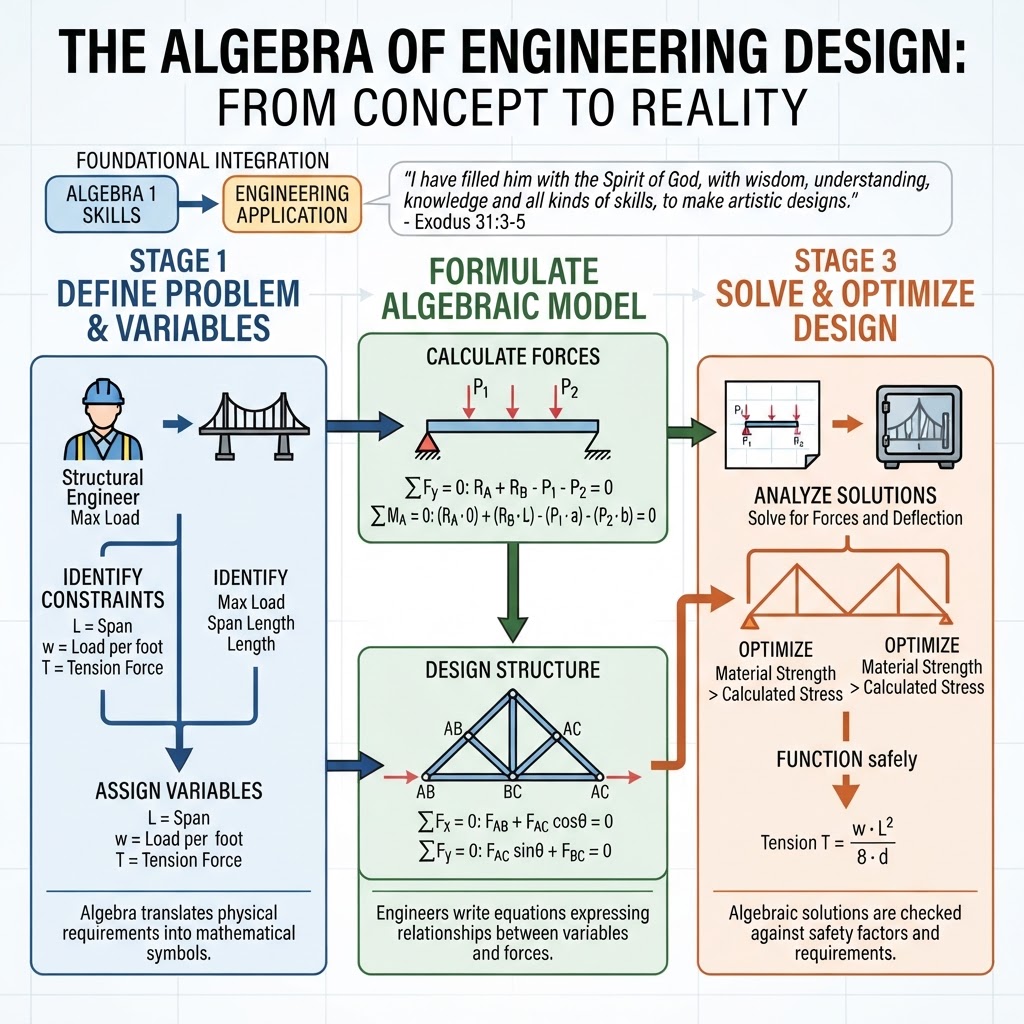
Engineers rely on algebra constantly, from calculating loads and forces to
Designing the structural integrity of the buildings that shape our modern world requires careful calculation. Civil engineering is essentially the art of applying mathematical models to predict how physical materials behave under pressure. When we use algebra, we translate real-world physical constraints into equations.
A variable like x might represent the weight of a beam, while a constant represents the supportive capacity, allowing us to find the equilibrium points accurately.
Consider the fundamental concept of a load-bearing beam supported by two columns at its ends. If we represent the total weight W on the beam as a force distributed evenly, we can model the reaction force R at either support using linear equations.
If the total weight is W, the upward force provided by each support is R equals 0. 5W. This linear relationship allows us to predict structural stability before construction.
When discussing structural forces, we must distinguish between exact linear relationships and engineering approximations. In mathematical theory, a beam deflects linearly based on the load applied. However, real-world materials have limits where they might buckle or permanently deform. Engineers use linear models as a baseline for safety, but they always incorporate a factor of safety to account for the physical reality that materials are not perfectly uniform or predictable.
Let us explore a first worked example involving a vertical support system. Suppose a cantilever beam supports a sign weighing 150 pounds, plus its own weight of 25 pounds per foot. If the beam length is x feet, the total load L in pounds is expressed as L = 25x + 150.
If the support system fails at 500 pounds, we solve 25x + 150 = 500. Subtracting 150 gives 25x = 350, so x = 14.
To verify this result, substitute x = 14 back into the original expression: 25 multiplied by 14 is 350, and 350 plus 150 equals 500. This confirms our calculated limit. Unit consistency is vital here; we must ensure that our weight in pounds matches the load capacity in pounds.
If the length were given in inches instead of feet, our equation would require a conversion factor, illustrating why checking units is critical.
A common mistake in these models is confusing correlation with causation. Just because a thicker beam correlates with higher load capacity, it does not mean that adding thickness is always the solution for every structural failure. Other factors like material density, beam shape, and the distribution of stress points play a role.
Algebra helps us isolate these variables, but the engineer must still exercise discernment to identify which variable is driving change.
Domain restrictions are essential in engineering models. In our previous example of L = 25x + 150, the variable x represents physical length, which must be greater than zero. A negative length has no meaning in the physical realm of construction.
By defining our domain as x > 0, we ensure that our algebraic model remains grounded in physical reality. Always check that your solution makes sense within the physical context provided.
- The equation becomes T + T + 20 =
- Combining terms gives 2T + 20 =
- Subtracting 20 leaves 2T = 80, so T = 40.
Checking this result, we find that the first cable carries 40 pounds, and the second carries 40 + 20, which is 60 pounds. The sum of 40 and 60 is exactly 100, matching our total load requirement. This validates our symbolic solution.
Notice how the linear structure of the equation mirrors the physical distribution of forces, showing that math acts as a mirror for the physical laws governing our created environment.
When solving these equations, watch for sign errors, particularly when dealing with forces acting in opposing directions. If downward force is positive, an upward reaction force might be considered negative. Maintaining consistent sign conventions across your model is the only way to ensure the final result is reliable.
A single mistake in a sign can lead to a structural prediction that is dangerously inaccurate or fundamentally flawed for the project.
In the workplace, an engineer often deals with complex systems where multiple forces act simultaneously. These are solved using systems of linear equations. Just as we use algebra to balance these invisible forces, we reflect the order established in creation.
We are called to be stewards of this creation, and our precision in mathematical modeling is a testament to the care we take in planning structures for the public.
Visualizing these linear equations through graphs provides necessary clarity for structural analysis. The slope effectively represents the rate at which force increases relative to incremental weight or length additions, where a steeper slope indicates higher sensitivity to structural load changes.
By sketching these lines for various components, engineers immediately identify where projected loads surpass material capacities. The point of intersection between two or more lines mathematically represents the critical equilibrium where the entire system reaches its absolute maximum functional load before failure occurs.
If you struggle with the abstraction of these problems, remember that variables are merely placeholders for tangible physical properties. When stuck, return to the descriptive narrative to map specific values. Carefully identify the rate of change, the initial starting value, and your final performance goal.
Translating these verbal requirements into precise symbolic notation allows you to engage in the same disciplined, rigorous thinking that professional structural engineers rely upon daily to ensure safety and stability in their complex civil projects.
As you proceed, apply these algebraic principles as a universal framework for sophisticated problem-solving. Whether you are analyzing a steel beam or planning logistical systems, the ability to isolate variables, model functional relationships, and verify outcomes through logical deduction remains a foundational skill.
Stay diligent with your calculations, remain focused on realistic physical constraints, and continue to appreciate the underlying mathematical order that reveals the hidden strength of our built world.
Subscription Library
Education.com Teacher Login
Standards-aligned lesson plans, worksheets, games, and activities for Pre-K through 8th grade.
Login credentials are being prepared. Check back soon, or ask your teacher.
© 2026 Learning by Grace. All rights reserved. This content is for enrolled students only and may not be copied, distributed, or reproduced.
