Deriving the Quadratic Formula:
Lesson 28.1 Presentation
Lesson diagrams and audio narration
Lesson Narrative · Audio, part 1
Lesson Narrative · Diagram
More videos
How To Prove The Quadratic Formula By Completing The SquareThe Organic Chemistry Tutor
Deriving the Quadratic FormulaEddie Woo
Deriving the Quadratic FormulaPatrick J
Proof of quadratic formula | Polynomial and rational functions | Algebra II | Khan AcademyKhan Academy

Complementary Video
What career does this lesson unlock?
Adelaide will match a real-world profession to what you just learned and walk you through a day on the job.
Core Content
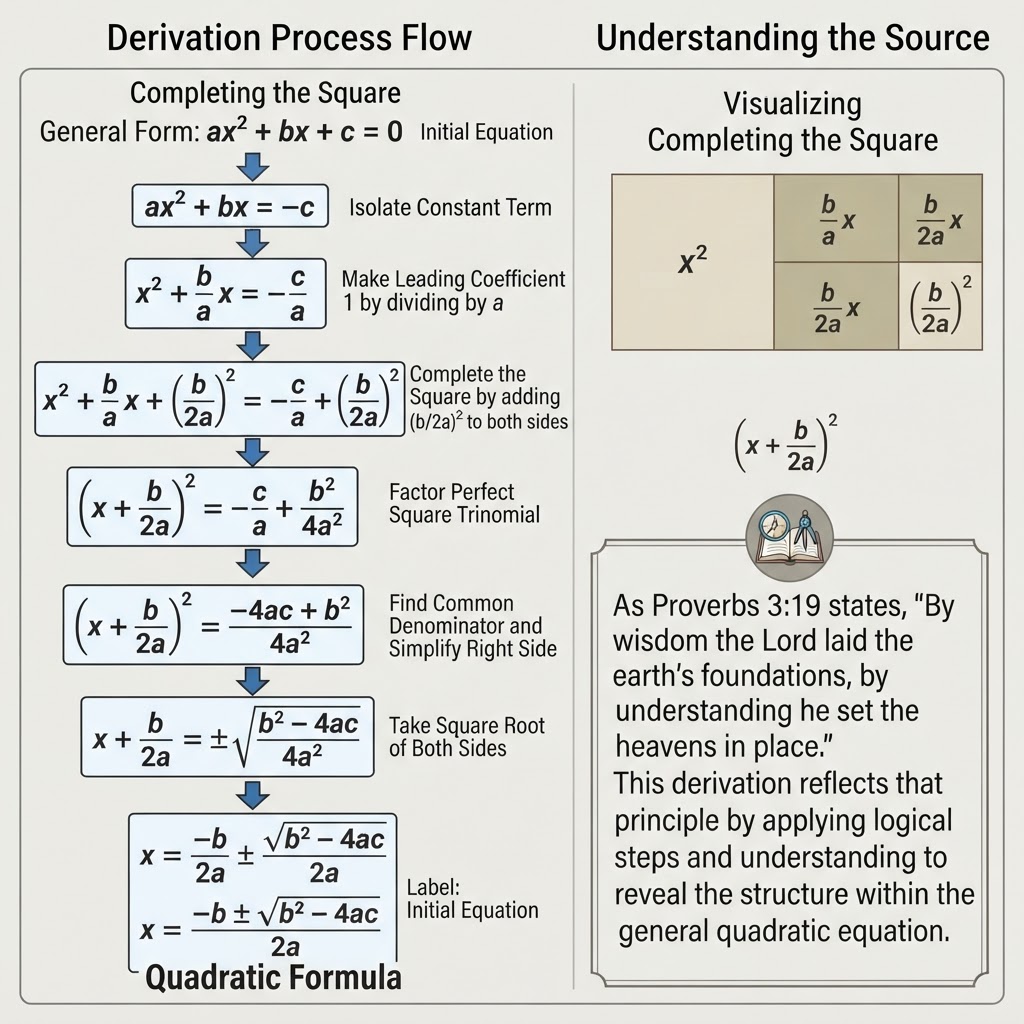
The quadratic formula is not an arbitrary rule handed down from nowhere,
The quadratic formula is a direct consequence of completing the square for the general equation ax^2 + bx + c = 0. We begin by isolating variable terms. Subtracting c from both sides yields ax^2 + bx = -c. This initial step sets the stage for manipulating the expression into a perfect square trinomial, bridging our foundational arithmetic work to the broader analytical methods required for higher mathematics and structured problem solving.
Next, divide the equation by the lead coefficient a, provided a is not zero. This domain restriction is necessary because division by zero is undefined. The equation becomes x^2 + (b/a)x = -c/a. By standardizing the leading coefficient to one, we create the perfect environment to identify the specific value needed to complete the square, ensuring our algebraic steps remain balanced and logically sound throughout the entire formal derivation process.
To complete the square, we take half of the linear coefficient b/a, yielding b/(2a). Squaring this value gives us b^2/(4a^2). We add this result to both sides to preserve equality. This operation is valid because adding the same quantity to both sides maintains the balance of the equation, reflecting a standard algebraic technique where every addition must be accounted for within our system to ensure the final result remains accurate.
The equation now reads x^2 + (b/a)x + b^2/(4a^2) = b^2/(4a^2) - c/a. The left side is a perfect square trinomial, factoring into (x + b/(2a))^2. On the right, finding a common denominator results in (b^2 - 4ac)/(4a^2). This simplification is crucial, as it condenses complex terms into a single, manageable expression that reveals the discriminant, b^2 - 4ac, which determines the nature of the solutions for any given quadratic equation.
Now we apply the square root property to both sides. Taking the square root, we obtain x + b/(2a) = ±sqrt(b^2 - 4ac) / (2a). Note that the denominator simplifies because the square root of 4a^2 is 2a. This step requires us to consider both the positive and negative roots, acknowledging that a quadratic function can intersect the x-axis at two distinct points, revealing the inherent symmetry found within the parabolic curve.
Finally, isolate x by subtracting b/(2a) from both sides. This leads us to the standard quadratic formula: x = (-b ± sqrt(b^2 - 4ac)) / (2a). This result is not just a collection of symbols, but a reliable tool for solving any quadratic equation.
It serves as a testament to the order in mathematics, where consistent principles allow us to predict outcomes with certainty regardless of the specific coefficients involved in equations.
-
Here, a=2, b=5, and c=-3. Substituting these values, we get x = (-5 ± sqrt(5^2 - 4(2)(-3))) / (2(2)). Calculating inside the radical, 25 - (-24) equals
-
The square root of 49 is
-
Thus, x = (-5 ±
-
/ 4, yielding two potential solutions: x = 2/4 which is 0.5, or x = -12/4 which is -3.
-
We get 2(0.25) + 5(0.5) - 3 = 0.5 + 2.5 - 3 =
-
The result is confirmed. Similarly, checking x = -3 yields 2(-3)^2 + 5(-3) - 3 = 18 - 15 - 3 =
-
By verifying our results through direct substitution, we ensure the integrity of our calculations and practice the diligence required to handle complex problems with precision.
-
Here, a=1, b=-6, and c=7. Applying the formula, x = (6 ± sqrt((-6)^2 - 4(1)(7))) /
-
Inside the radical, we have 36 - 28, which is
-
The square root of 8 simplifies to 2sqrt(2). Thus, x = (6 ± 2sqrt(2)) / 2, which simplifies to the exact values x = 3 + sqrt(2) and x = 3 - sqrt(2).
-
414 =
-
414 and 3 -
-
414 =
-
- Graphs help us visualize these solutions as x-intercepts.
By observing the parabola, we see how the vertex and the axis of symmetry relate to these roots, providing a spatial confirmation of the numerical values we derived through orderly algebraic manipulation.
One common mistake is failing to include the sign of coefficients. If the equation is -x^2 + 4x - 3 = 0, ensure a=-1, b=4, and c=-3. Another error involves the square root of the discriminant. If the discriminant is negative, we move into the domain of complex numbers.
This suggests the graph does not cross the x-axis, an important insight into the limitations of functions mapped specifically on the real coordinate plane.
While we often discuss exact values, it is important to distinguish between symbolic exactness and decimal approximations. The quadratic formula provides an exact representation, whereas decimals are merely useful tools. Understanding this distinction is vital, as it keeps our mathematical logic grounded in truth.
We respect the precision of our variables even when the final numerical value requires us to round for practical applications in engineering, science, or other fields of study.
It is useful to look at the discriminant, b^2 - 4ac, as a diagnostic tool. If the discriminant is greater than zero, we have two real roots. If it equals zero, there is exactly one real root, indicating the parabola touches the x-axis at its vertex.
This classification system reflects the tendency in mathematics to categorize phenomena based on observable traits, illustrating how taxonomy aids our comprehension of the systems we study.
As you continue to use the quadratic formula, remember that each step is a logical progression rooted in the foundational axioms of algebra. The derivation process demonstrates that seemingly complex results can be broken down into manageable pieces through patient effort.
By applying these methods, we engage in a process of discovery that reflects the structured and logical nature of the world we inhabit, fostering both mathematical proficiency and deeper understanding.
Subscription Library
Education.com Teacher Login
Standards-aligned lesson plans, worksheets, games, and activities for Pre-K through 8th grade.
Login credentials are being prepared. Check back soon, or ask your teacher.
© 2026 Learning by Grace. All rights reserved. This content is for enrolled students only and may not be copied, distributed, or reproduced.
