Strand Review: Applications of Quadratic
Lesson 30.5 Presentation
Lesson diagrams and audio narration
Lesson Narrative · Audio, part 1
Lesson Narrative · Diagram
More videos
MCR3U - What Ticket Price Maximizes Revenue Quadratic Word Problem - Grade 11 FunctionsAllThingsMathematics
Solving Problems Involving Parabola and Its Properties (Part 2)LearnWithTeacherBeth
Algebra 1 SOL Review Part 3Michael A Green

Complementary Video
What career does this lesson unlock?
Adelaide will match a real-world profession to what you just learned and walk you through a day on the job.
Core Content
You have spent this whole strand learning to graph, solve, and apply
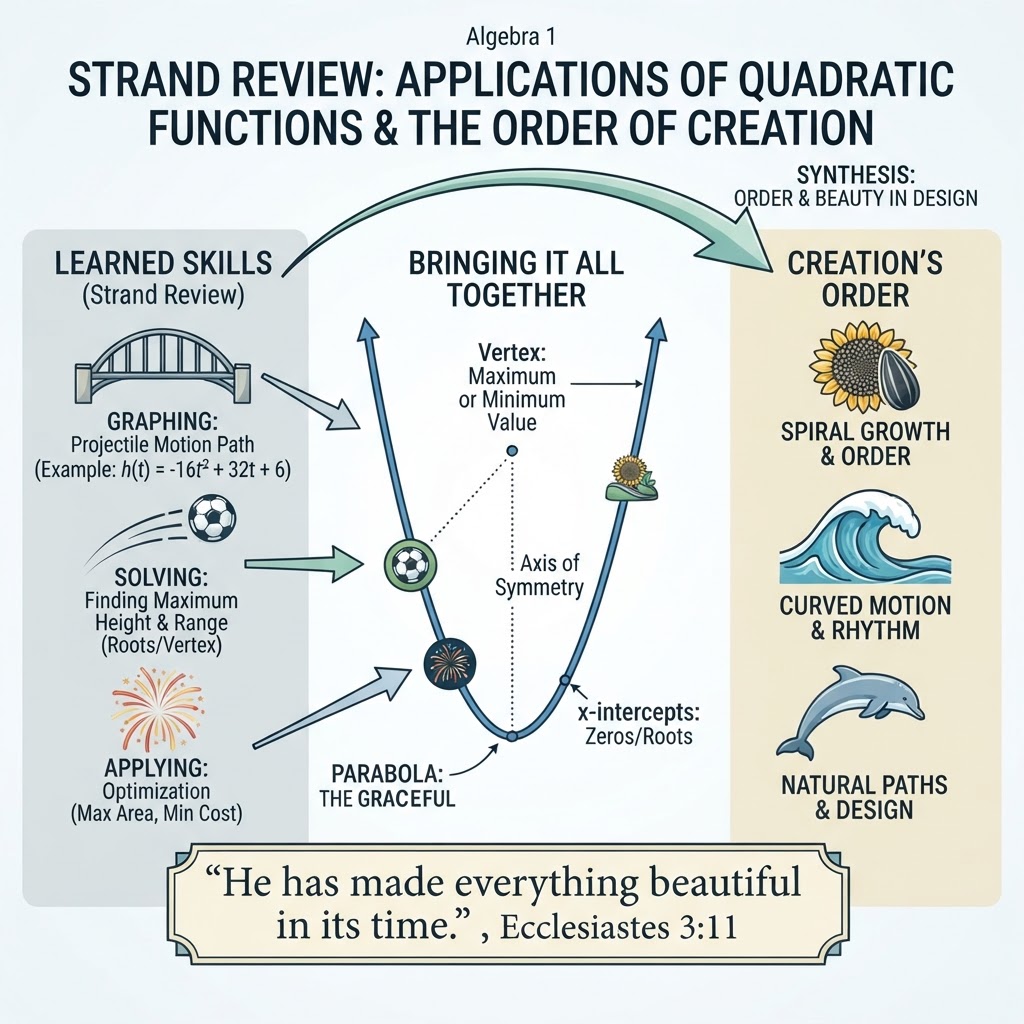
With quadratic equations, you possess the tools to bridge the gap between abstract symbols and the physical world. In engineering, quadratic functions serve as the primary language for describing objects influenced by gravity. When an object is launched, its vertical position over time is modeled by a downward-opening parabola, reflecting the constant acceleration that keeps us grounded. This framework allows us to analyze trajectories with high levels of mathematical precision.
The vertex of this arc represents the maximum height reached, while the x-intercepts denote the moments the object contacts the ground. Understanding these points requires moving beyond memorization of the quadratic formula. View the vertex (h, k) as a coordinate where h is the time elapsed and k is the maximum altitude. The symmetry of the parabola ensures the object reaches its peak precisely halfway through its total flight time duration.
Consider a stone thrown upward from an initial height of 5 meters with an initial velocity of 20 meters per second. The height h(t) is modeled by h(t) = -5t^2 + 20t + 5. To find the time of maximum height, we identify the vertex using t = -b/(2a).
Here, a = -5 and b = 20, so t = -20 / (2 * -5), which equals exactly 2 seconds total.
To determine maximum height, substitute t = 2 back into the original function. Calculating h(2) = -5(2^2) + 20(2) + 5 gives -5(4) + 40 + 5, resulting in 25 meters. This result is valid because it correlates the input of time to the output of displacement.
We can verify this by checking the symmetry of the parabola at t = 1 and t = 3, both of which yield 20 meters, confirming the vertex is 25.
Domain restrictions are essential because mathematical functions often extend into negative values that lack physical meaning. In this stone example, the domain is restricted to t >= 0. We stop calculating when the height equals zero. Solving -5t^2 + 20t + 5 = 0 using the quadratic formula, we find t = (-20 +/- sqrt(400 - 4(-5)(5))) / -10. This simplifies to t = (-20 +/- sqrt(500)) / -10, yielding approximately 4. 24 seconds total flight.
Common errors often involve signs. If you neglect the negative coefficient on the t^2 term, the parabola appears to open upward, suggesting the stone flies toward infinity rather than falling. Always consider the physical context: if a coefficient describes gravity, it must be negative. Another error is failing to account for initial height. If the stone starts 5 meters up, h(0) must equal 5, not 0, ensuring an accurate starting point.
A second example involves optimizing area, such as a farmer building a fence against a barn. If the farmer has 40 meters of fencing, the area equation is A(w) = w(40 - 2w), which simplifies to A(w) = -2w^2 + 40w. This represents a downward-opening parabola.
The vertex of this function provides the width that yields the maximum possible area, a critical calculation for efficient stewardship of the available resources.
We calculate the width at the vertex using w = -b/(2a) where a = -2 and b = 40. This gives w = -40 / (2 * -2) = 10 meters. The length is 40 - 2(10) = 20 meters. Multiplying these gives a maximum area of 200 square meters.
By testing w = 9 or w = 11, we find areas of 198 square meters, confirming 10 meters is the dimension that maximizes the enclosed field area.
It is vital to distinguish between linear relationships and quadratic ones. Linear functions imply a constant rate of change, such as earning five dollars per hour. Quadratic functions, conversely, imply a changing rate of change, which is exactly how gravity or area expansion works.
If you observe a graph and see a curve rather than a straight line, your model must be quadratic to remain accurate to the underlying natural laws involved.
Correlation does not always imply causation, but in these physics applications, the quadratic model is built upon established physical laws. When we see a parabola in projectile motion, the gravity constant causes the trajectory. Be careful not to force a quadratic fit onto data that is actually linear.
Always evaluate the context to see if the scenario involves acceleration or area before selecting your mathematical tool for the given problem.
Units must be tracked meticulously throughout every step of your calculation. If initial velocity is in meters per second and time is in seconds, the height result must be in meters. Mismatched units are a source of error that masks the order inherent in the math.
Converting between feet and meters or seconds and minutes requires consistent unit analysis to ensure the final numerical answer makes sense in the real world.
When solving these equations, checking work using a secondary method like factoring or completing the square builds confidence. If you use the quadratic formula to find the zeros, verify those values by graphing the function on a coordinate plane. If the graph crosses the x-axis at the same points you calculated, your logic is sound. Consistency across symbolic, graphical, and numerical representations serves as a robust validation of your reasoning.
In our pursuit of truth, mathematics reveals the structure of the world, much like a blueprint helps a builder understand a house. Recognizing these patterns allows us to solve problems that improve our lives and help us serve others effectively.
While success in algebra does not equate to moral standing, the diligence required to master these concepts reflects a character disciplined in truth, precision, and the respectful study of design.
As you move forward, remember that every variable represents something real. Whether you are calculating the flight path of an object or the maximum area of an enclosure, you are engaging with the logic of the universe. Keep your steps clear, check your signs, respect the domain, and apply these methods with care. By synthesizing these skills, you ensure your work is mathematically accurate and a reflection of intentional, focused stewardship.
Subscription Library
Education.com Teacher Login
Standards-aligned lesson plans, worksheets, games, and activities for Pre-K through 8th grade.
Login credentials are being prepared. Check back soon, or ask your teacher.
© 2026 Learning by Grace. All rights reserved. This content is for enrolled students only and may not be copied, distributed, or reproduced.
Have something to share?
Submit your work — writing, art, videos, and more — for us to review.
My Submitted Work