Review: Exponent Rules
Lesson 24.1 Presentation
Lesson diagrams and audio narration
Lesson Narrative · Audio, part 1
Lesson Narrative · Diagram
More videos
Exponent Rules with ExamplesMario's Math Tutoring
Review of Exponent RulesAlgebra 1 - Ladue Mathematics
Unit 5 Lesson 1: Review of Exponent RulesJessica Green
A Quick Review of Exponent Rules - Algebra 1New Normal Statistics

Complementary Video
What career does this lesson unlock?
Adelaide will match a real-world profession to what you just learned and walk you through a day on the job.
Core Content
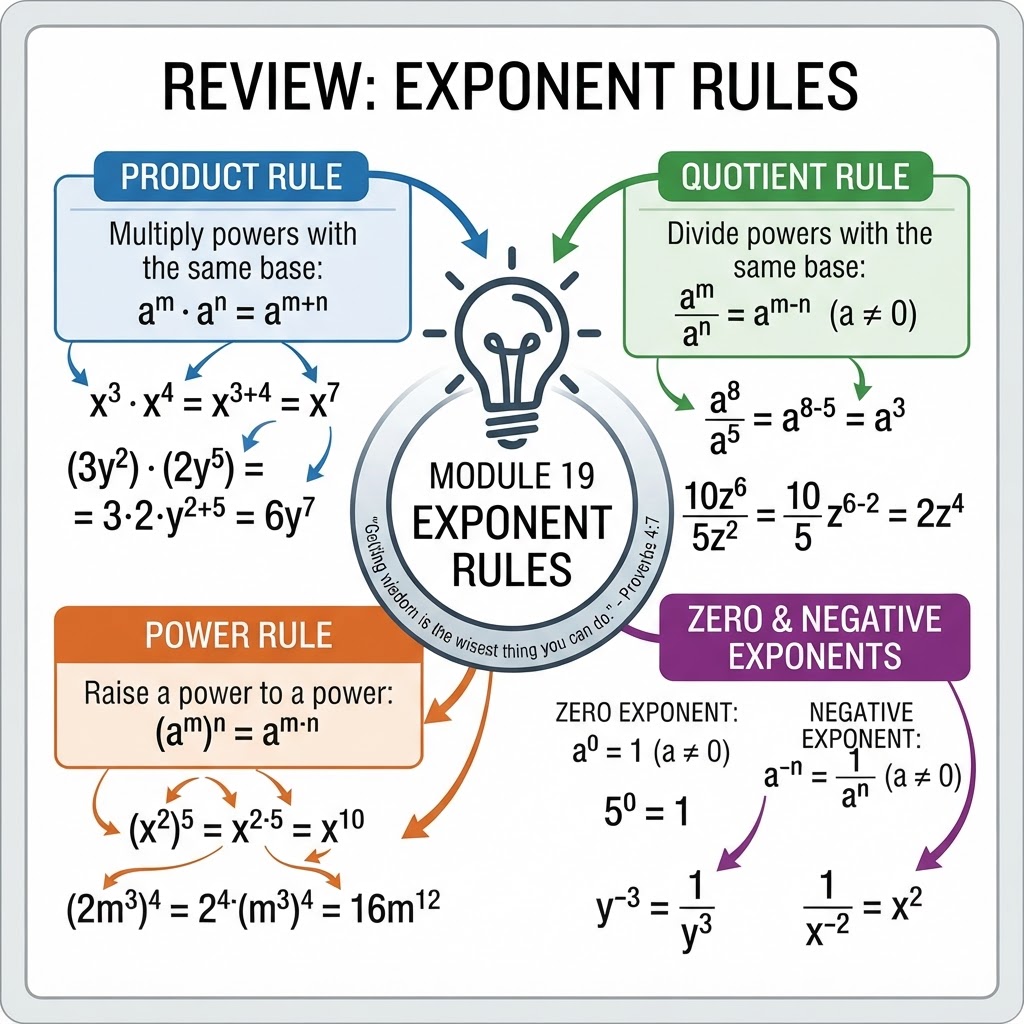
Today’s review brings together every exponent rule from Module 19: the
Mastering algebra requires understanding the product rule, quotient rule, power of a power rule, and zero exponent property. These foundational tools allow us to condense multi-step expressions into manageable forms with precision. To succeed, remember an exponent is shorthand for repeated multiplication.
Avoiding the error of multiplying the base by the exponent is essential, as that misconception undermines the logical integrity of your algebraic work and leads to incorrect final results.
Let us begin by examining the product rule, which dictates that when multiplying expressions with identical bases, you add the exponents. This rule remains valid because multiplying powers of the same base increases the total count of that factor. Consider 3^2 times 3^4.
Written out, this represents (3 times 3) multiplied by (3 times 3 times 3 times 3), which equals 3^6, correctly demonstrating that 2 plus 4 equals 6.
For our first worked example, simplify (x^5 times y^2) times (x^3 times y^7). By applying the commutative property, we group like bases: (x^5 times x^3) times (y^2 times y^7). Applying our rule yields x^(5+3) times y^(2+7), resulting in x^8 times y^9. To verify, we substitute x=2 and y=1.
The original yields 32 times 1 times 8 times 1, totaling 256. Our simplified result is 2^8 times 1^9, confirming accuracy.
The quotient rule serves as the inverse, where dividing identical bases requires subtracting exponents. This holds true because factors in the numerator are cancelled by equivalent factors in the denominator, reducing the total count of the base. For an expression like m^10 divided by m^4, we calculate m^(10-4) to arrive at m^6. Ensure the base is non-zero, as division by zero is undefined, creating a necessary domain restriction for structural consistency.
When facing negative exponents, remember a negative power signifies the reciprocal. If you encounter x^-3, it is equivalent to 1/x^3. This definition ensures our power rules remain consistent even when the operation shifts. Integrating this into the quotient rule, we see that x^2 divided by x^5 results in x^-3, which correctly simplifies to 1/x^3. These rules work in harmony, reflecting a consistent internal logic within our broader numbering system today.
Next, consider the power of a power rule, stating (a^m)^n = a^(m*n). This represents repeated multiplication of an exponential term. If you have (2^3)^2, it means (2^3) times (2^3), which equals 2^(3+3) or 2^6. This rule is particularly powerful when simplifying complicated expressions involving nested parentheses.
By multiplying the inner and outer exponents, we rapidly condense the expression, provided we distribute the power to every coefficient and variable within the grouping.
Our second worked example requires simplifying (2x^3 times y^-1)^3. Applying the power rule to each factor individually, we obtain 2^3 times (x^3)^3 times (y^-1)^3. This results in 8 times x^9 times y^-3. To express this using only positive exponents, rewrite the y term in the denominator: 8x^9 / y^3.
Checking with x=1 and y=2, the original is (2 times 1 times 0. 5)^3, which is 1^3 or 1. Our result 8/8 gives 1.
The zero exponent rule is elegant, defining any non-zero base raised to the power of zero as exactly one. This might seem counterintuitive, but consider the quotient rule: x^a / x^a equals x^(a-a), which is x^0. Since any non-zero value divided by itself equals one, x^0 must be one.
This rule provides a necessary anchor for exponents, ensuring that our mathematical systems do not collapse under these specific types of algebraic operations.
Distinguishing between variables and constants is vital when applying these rules. A common error occurs when students forget to raise the coefficient to the power. In (3x)^2, the correct result is 9x^2, not 3x^2. The exponent distributes to every factor inside the parentheses. Similarly, understand that (x+y)^2 is not x^2 + y^2. Exponent rules govern multiplication and division, not addition or subtraction, which represents a distinct, critical boundary in algebraic manipulation.
When visualizing these operations, imagine a scale where exponents represent the quantity of a base. Multiplication acts as an additive force, while division acts as a subtractive force. This visual model helps distinguish between exact algebraic identities and mere correlations.
An identity like the product rule is always true, representing a causal link between the base count and the simplified exponent, ensuring we avoid common mistakes while modeling these various mathematical scenarios.
Units also play a supporting role in these expressions. If x represents meters, then x^2 represents square meters, a measure of area. Applying exponent rules allows us to convert between units consistently. If you multiply a length of x meters by a width of x meters, the result is x^2 square meters.
Respecting these dimensions adds a layer of reality to your abstract work, reminding us that algebra describes our physical world.
When evaluating expressions involving negative bases, exercise extreme caution regarding sign placement. Consider the distinction between (-2)^2 and -2^2; the former yields positive 4 because the exponent applies to the entire quantity within the parentheses, effectively multiplying negative two by itself.
Conversely, -2^2 results in negative 4 because the exponent strictly targets the base value of two, leaving the negative sign to be applied only after the squaring process occurs. This structural nuance is critical, as neglecting the reach of the exponent often leads to common mechanical pitfalls.
By prioritizing precision in your notation, you eliminate ambiguity and ensure that your mathematical logic remains sound throughout the entire simplification process.
As we synthesize these skills, reflect on how exponent rules function as a powerful, concise language for representing complex phenomena like exponential growth and decay. Algebra serves as a rigorous framework for quantifying the physical world. Mastering these laws allows you to manipulate these symbolic descriptions with accuracy, fostering a disciplined mindset characterized by clarity and logical coherence.
Every operation you perform reinforces a habit of precision, training you to view mathematics not as a collection of disjointed steps, but as a unified, predictable system.
Ultimately, rely on the rules practiced today as your most reliable tools for navigating algebraic complexities. These laws are consistent, logical extensions of numerical behavior rather than arbitrary memorization targets. Whether simplifying intricate fractions or evaluating algebraic terms, you must apply these principles steadfastly.
Approach your assessments with absolute confidence, knowing that your diligence in reviewing fundamental exponent logic has prepared you to solve problems with both speed and mathematical accuracy.
Subscription Library
Education.com Teacher Login
Standards-aligned lesson plans, worksheets, games, and activities for Pre-K through 8th grade.
Login credentials are being prepared. Check back soon, or ask your teacher.
© 2026 Learning by Grace. All rights reserved. This content is for enrolled students only and may not be copied, distributed, or reproduced.
