Completing the Square: Understanding How
Lesson 27.4 Presentation
Lesson diagrams and audio narration
Lesson Narrative · Audio, part 1
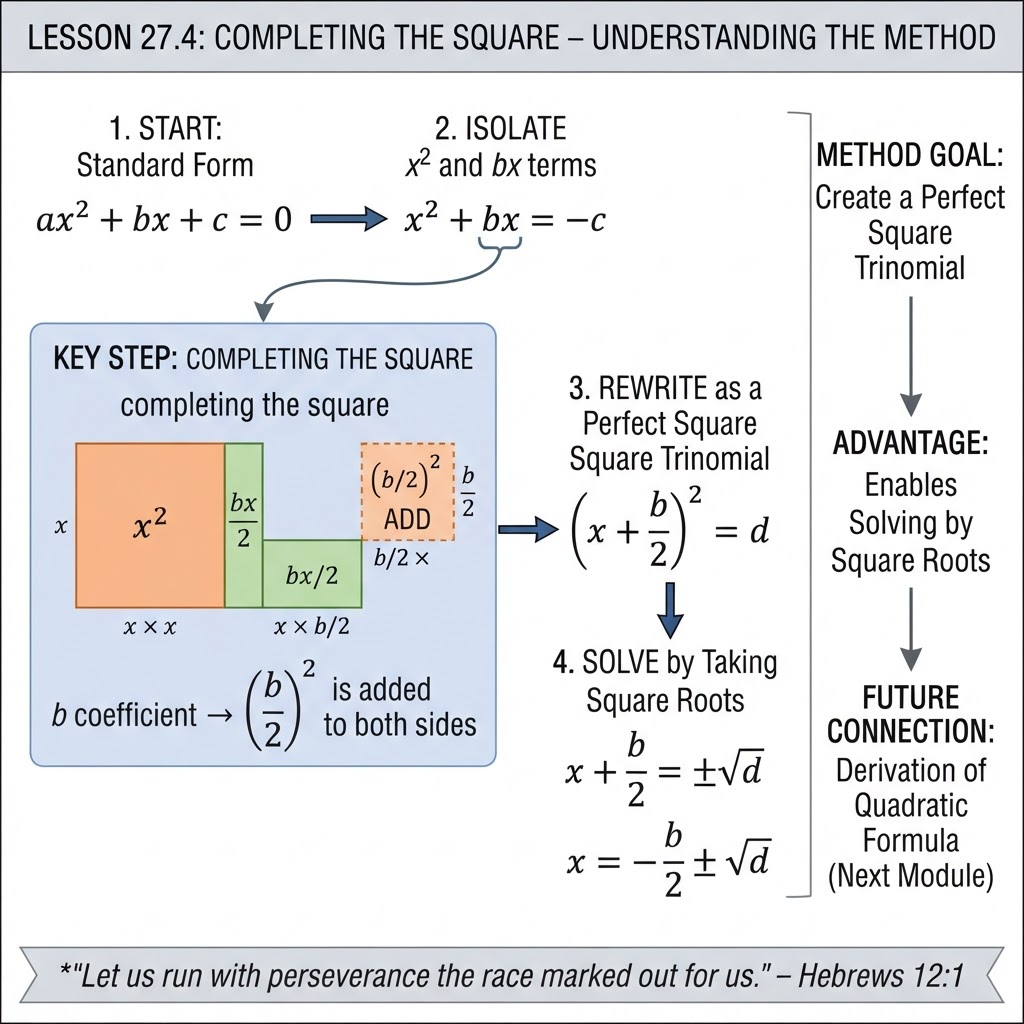
Lesson Narrative · Diagram

Complementary Video
What career does this lesson unlock?
Adelaide will match a real-world profession to what you just learned and walk you through a day on the job.
Core Content
Completing the square rewrites a quadratic equation into a perfect square
Completing the square transforms standard quadratic equations into vertex form, y = a(x - h)^2 + k. This reveals the parabola peak or valley. By adding a specific constant, we maintain equality while reframing the expression. This technique effectively isolates variables to solve for unknown values with precision.
Every operation must preserve the underlying balance of the initial equation throughout each procedural step, ensuring that our mathematical manipulations remain valid and logically consistent.
Begin the process by considering the expression x^2 + bx. To create a perfect square trinomial, identify the value needed to complete the square. Algebraically, divide the linear coefficient b by two, yielding b/2, and then square this quotient to get (b/2)^2. Adding this constant to the expression completes the square. This specific addition is the fundamental step required to harmonize the quadratic and reach a factorable, perfect square form.
Solve x^2 + 8x + 7 = 0 by subtracting 7 from both sides to isolate the variable terms, yielding x^2 + 8x = -7. Determine the constant by taking half of 8, which is 4, and squaring it to obtain 16.
Add 16 to both sides of the equation to maintain balance, resulting in x^2 + 8x + 16 = 9. This completes the square successfully and prepares the expression for factoring.
With the left side now a perfect square, write it as (x + 4)^2 = 9. Apply the square root property to find x + 4 = 3 or x + 4 = -3. Subtracting 4 from each side provides the solutions x = -1 and x = -7.
Substitute -1 into the original equation: (-1)^2 + 8(-1) + 7 equals 1 - 8 + 7, which correctly yields zero, confirming our initial algebraic calculation is entirely accurate.
The second solution, x = -7, also holds true: (-7)^2 + 8(-7) + 7 equals 49 - 56 + 7, which is also zero. This verification confirms our work. By completing the square, we have translated the quadratic into a form where the vertex is located at (-4, -9).
This vertex form provides both the roots through calculation and the critical turning point of the parabola, showing the relationship between roots and vertices.
A common mistake involves failing to add the constant to both sides of the equation. Because an equation is a delicate balance, changing one side necessitates an identical change to the other. If you ignore the second side, you shift the graph incorrectly and produce values that do not satisfy the original equation. Ensure every algebraic operation respects the equality, maintaining the integrity of the expression throughout the entire solving process.
Another error occurs when the leading coefficient of the x^2 term is not one. Before you can complete the square, factor out the coefficient of x^2 from the first two terms. If you have 2x^2 + 12x + 10 = 0, divide the entire equation by two to reach x^2 + 6x + 5 = 0 before proceeding. This preliminary division is essential for the completion of the square process to function.
- Divide by 2 to get x^2 + 4x - 5 =
- Moving the constant gives x^2 + 4x =
- Taking half of 4 and squaring it yields
- Adding 4 to both sides produces x^2 + 4x + 4 =
- This simplifies to (x + 2)^2 =
- Taking the square root leads to x + 2 = 3 or x + 2 = -3, yielding roots 1 and -5.
Check x = 1 by evaluating 2(1)^2 + 8(1) - 10, which becomes 2 + 8 - 10, equaling zero. Check x = -5 by evaluating 2(-5)^2 + 8(-5) - 10, which gives 2(25) - 40 - 10, resulting in 50 - 40 - 10, also zero.
Each step remains valid because we maintained equivalence by dividing the equation and balancing our additions. This universal method works for any quadratic where the discriminant is non-negative, providing reliable roots.
Algebraic manipulation provides exact solutions, which are distinct from scientific approximations. Quadratic roots are points of intersection, not mere correlations between variables. By setting the expression to zero, we identify the specific input values that satisfy the system. Understanding this distinction helps us appreciate the objective truth residing within the formal structure of these mathematical equations. This method offers clarity, revealing the exact points where the curve crosses the horizontal axis.
Domain restrictions are rarely an issue with standard quadratic equations because polynomials are defined for all real numbers. However, when applying these equations to real-world scenarios, such as calculating the time a projectile stays in the air, we must restrict the domain to non-negative values.
Math acts as a tool to map logical outcomes, and its application requires wisdom and an understanding of the specific boundary conditions for each context.
Watch for signs during the squaring process. Any number, positive or negative, becomes positive when squared. A frequent point of confusion arises when the middle coefficient b is negative. If b is -6, half of it is -3, and squaring that still results in positive 9.
Keeping careful track of these negative signs is a form of integrity in our work, reflecting a commitment to accuracy and detailed algebraic attention.
Completing the square demonstrates that every quadratic has a hidden, underlying structure waiting to be revealed. Through this method, we gain the ability to visualize the vertex and the roots without needing to graph the function. It is a powerful way to organize information, moving from complexity toward simplicity.
We often face situations that require us to pause, look for the missing piece, and restore internal order and balance.
As you continue practicing, remember that mastery comes through deliberate effort and checking your work. Each variable isolated and each equation balanced serves as a testament to the order inherent in mathematics. By learning these steps, you are not just solving a worksheet; you are developing the analytical discipline needed to navigate challenges. Approach each problem with confidence, knowing you possess the skills to transform and solve any quadratic equation.
Subscription Library
Education.com Teacher Login
Standards-aligned lesson plans, worksheets, games, and activities for Pre-K through 8th grade.
Login credentials are being prepared. Check back soon, or ask your teacher.
© 2026 Learning by Grace. All rights reserved. This content is for enrolled students only and may not be copied, distributed, or reproduced.
