Preparing for the Capstone: Reflecting on
Lesson 35.5 Presentation
Lesson diagrams and audio narration
Lesson Narrative · Audio, part 1
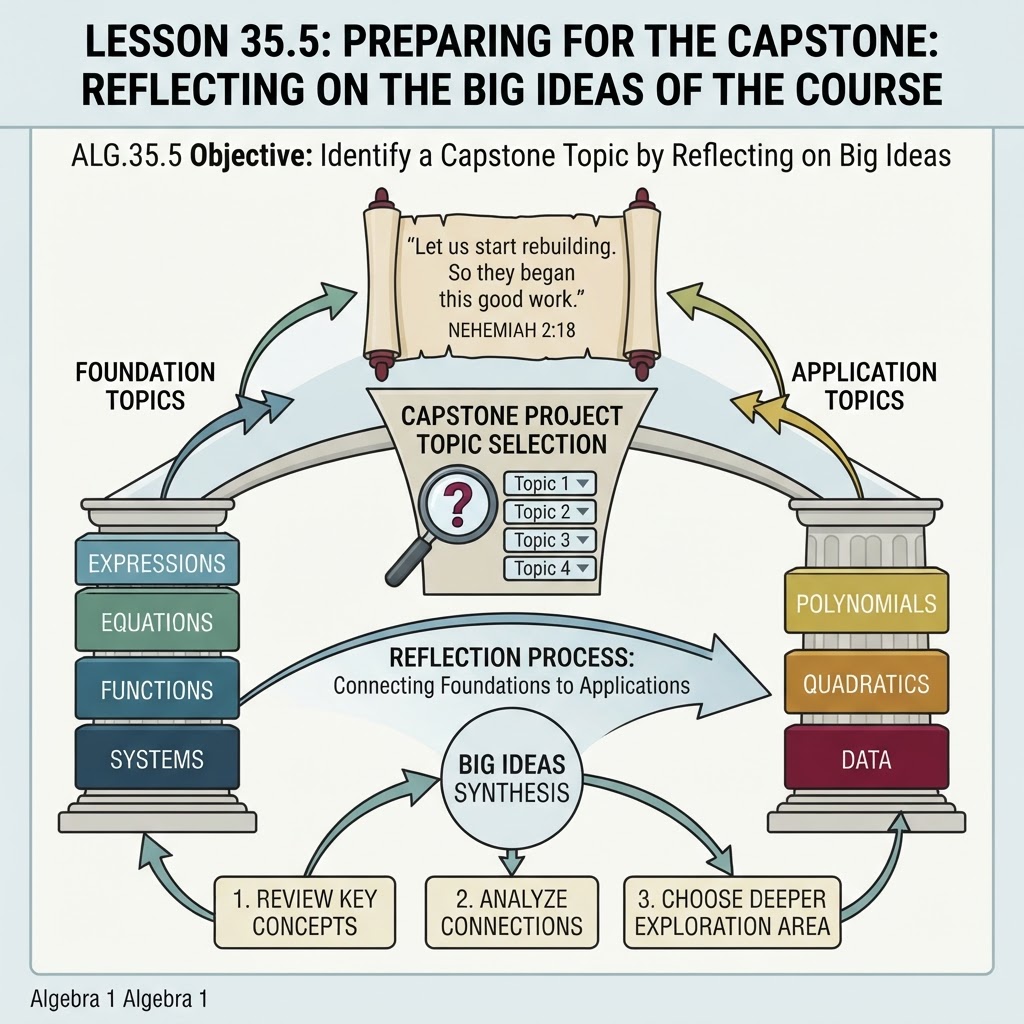
Lesson Narrative · Diagram
More videos
What are Capstone Projects? (EXAMPLES & TIPS)Unrulr
How to Develop a Good Research TopicKStateLibraries
Defending Your Research Project Proposal - 5 Minutes with CyrillCyrill Stachniss

Complementary Video
What career does this lesson unlock?
Adelaide will match a real-world profession to what you just learned and walk you through a day on the job.
Core Content
Today’s lesson prepares you for the capstone project ahead by reflecting on
Assess your past performance across the foundational units of the first semester. By examining the patterns in your problem-solving process, you can discern which algebraic concepts have become intuitive and which still require refinement. This meta-cognitive exercise acts as a diagnostic tool, allowing you to bridge the gap between simple memorization and deep conceptual mastery as you stand on the threshold of your upcoming capstone assessment for this class.
Begin by analyzing how you represent relationships. Whether you encounter a verbal description of a rate, a numerical data table, a coordinate plane graph, or a symbolic linear equation like y = mx + b, you are dealing with the same underlying mathematical structure. A common error is treating these modes as isolated islands. True algebraic fluency requires translating between them seamlessly to verify your conclusions across these multiple mathematical formats.
Consider the linear function y = 3x - 5. Verbally, this describes a constant rate of change where every unit increase in x yields a three-unit increase in y, with an initial vertical intercept at -5. Graphically, this is a line climbing steadily through the fourth and first quadrants.
Numerically, you can confirm this by plugging in x = 2 to yield y = 1. The result is 1 = 3(2) - 5.
To verify this result, we perform an independent check using substitution. If x = 2, then y = 3(2) - 5. This equals 6 - 5, which results in y = 1. This calculation validates our previous point coordinate. Understanding that these steps must always maintain the equality of both sides is fundamental to the logic governing all algebraic manipulation and problem solving. Consistency is the primary marker of true algebraic proficiency.
Next, evaluate your mastery of inequalities and domain restrictions. In real-world modeling, we often face constraints where a variable cannot be negative, such as time or physical length. If a project requires a function f(t) = 15t + 20 for t > 0, ignoring the domain constraint leads to solutions that fail in reality. Always identify the context of your variables to ensure your mathematical results remain logical and consistent.
- = 4x -
- First, distribute the coefficient 2 to obtain 2x + 8 = 4x -
- Subtracting 2x from both sides yields 8 = 2x -
- Adding 6 to both sides gives 14 = 2x, which simplifies to x =
- This methodical approach ensures we isolate the variable while keeping the original equation balance perfectly intact throughout the process.
To check this solution, we substitute x = 7 back into the original expression: 2(7 + 4) = 2(11) = 22, while 4(7) - 6 = 28 - 6 = 22. Because 22 equals 22, the solution is verified. This process of substitution is your most powerful tool for self-correction.
If your results do not match, re-examine your sign conventions, as negative values often cause errors during distribution or during the variable isolation steps.
As you prepare for the capstone, distinguish carefully between exact linear relationships and statistical approximations. A line of best fit through scattered data provides a trend, not an exact prediction for every individual point. Correlation does not imply causation; just because two variables move together in a scatterplot does not mean one forces the other to happen. Recognizing this difference prevents you from overstating your quantitative conclusions while analyzing data.
Reflect on your handling of negative signs, which remains a frequent area for errors. When subtracting a quantity, such as 10 - (x - 3), you must distribute the negative sign across both terms inside the parentheses to get 10 - x + 3, resulting in 13 - x.
Neglecting this distribution is a common pitfall that changes the meaning of the expression entirely. Discipline in notation preserves the truth of your math.
Your capstone will require you to synthesize these skills to build a model that answers a specific question. As you plan, ask yourself what units are involved. If your slope represents dollars per hour, ensure your final result is in dollars.
Dimensional analysis acts as a sanity check; if your units do not simplify to the expected output, you likely performed an operation incorrectly earlier in your complex algebraic derivation sequence.
Think of your mathematical accuracy as an extension of the integrity you bring to your daily responsibilities. Just as a builder uses a level to ensure a structure stands straight, you use logic and verification to ensure your arguments hold weight.
This pursuit of precision is not about achieving perfection, but about cultivating a disciplined mind capable of discerning the truth through structured, careful, and intentional mathematical analysis and evaluation.
Review the graphs you created throughout this semester. Did you label your axes clearly, identifying variables such as independent inputs and dependent outputs? Did you select a scale that makes your trends readable? These minor technical details are vital for clearly communicating your quantitative findings.
In the upcoming capstone, your ability to explain the specific rationale behind your algebraic methodology is just as significant as arriving at the final numerical value. Practice articulating your step-by-step process clearly to ensure your logical progression is accessible and convincing to your peers.
As you finalize your preparation, identify two topics from the past months where you previously struggled but now feel genuinely confident. Acknowledging this intellectual growth provides the necessary perspective to tackle complex, novel challenges in the capstone project. If you still find certain types of equations difficult, revisit foundational properties like the distributive or commutative laws.
Strengthening your grasp on these specific basics will provide the essential stability needed for more demanding algebraic tasks, such as solving systems of non-linear equations or simplifying complex polynomials.
Finally, embrace the capstone as a culmination of your persistent effort, not a burden. By applying systematic methods—using substitution for verification, practicing careful sign management during distribution, and maintaining explicit domain consideration—you are fully equipped to succeed. Trust the rigorous process of logical inquiry practiced all year.
Your preparation today builds the durable foundation upon which you will demonstrate your comprehensive understanding, showing your capacity to handle sophisticated algebraic reasoning with both technical skill and intentional care.
Subscription Library
Education.com Teacher Login
Standards-aligned lesson plans, worksheets, games, and activities for Pre-K through 8th grade.
Login credentials are being prepared. Check back soon, or ask your teacher.
© 2026 Learning by Grace. All rights reserved. This content is for enrolled students only and may not be copied, distributed, or reproduced.
Have something to share?
Submit your work — writing, art, videos, and more — for us to review.
My Submitted Work