Review: The Quadratic Formula
Lesson 30.4 Presentation
Lesson diagrams and audio narration
Lesson Narrative · Audio, part 1
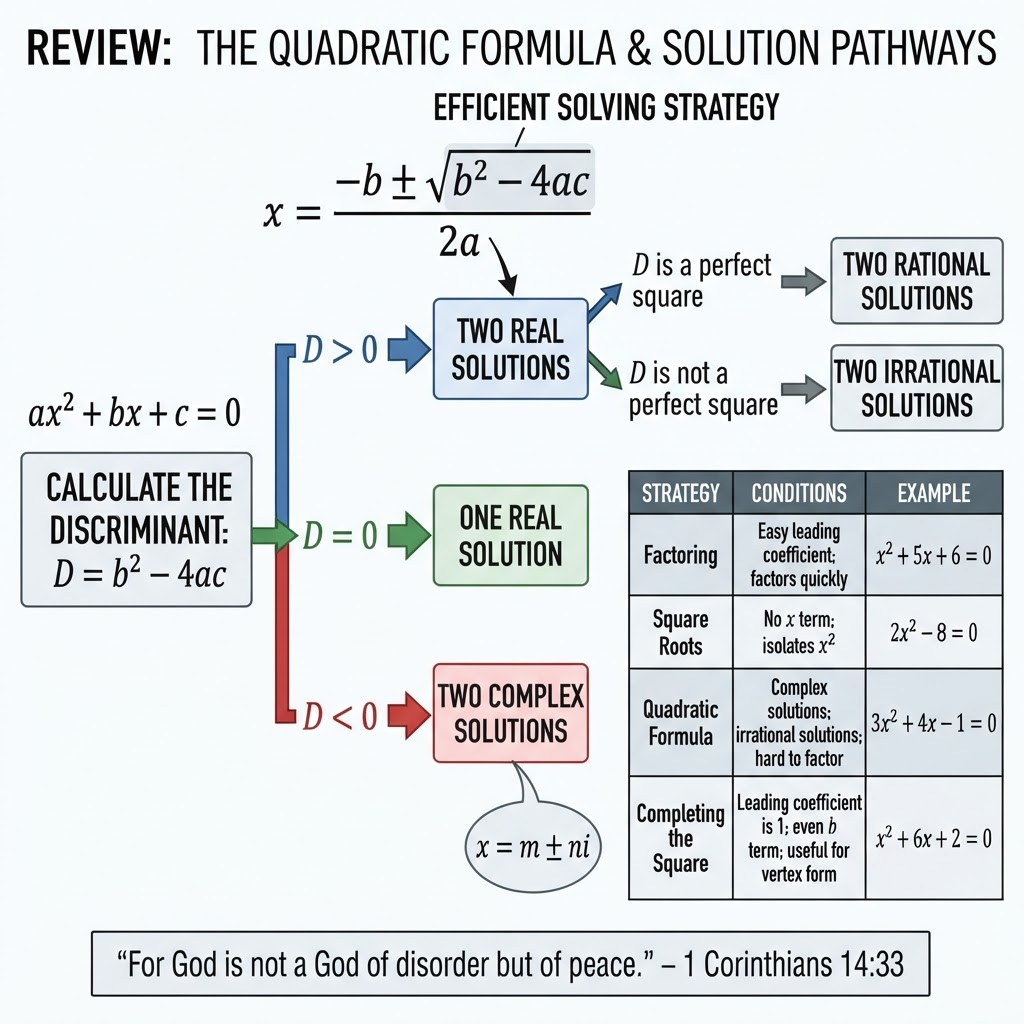
Lesson Narrative · Diagram
More videos
How To Solve Quadratic Equations Using The Quadratic FormulaThe Organic Chemistry Tutor
Factoring vs Completing the Square vs Quadratic FormulaBrian McLogan
4 WAYS TO SOLVE A QUADRATIC EQUATION | Algebra 1 & 2 | Factoring, Square Roots, Quadratic Formulayour math tutor
Solving Quadratic Equations (5 Methods)Mario's Math Tutoring

Complementary Video
What career does this lesson unlock?
Adelaide will match a real-world profession to what you just learned and walk you through a day on the job.
Core Content
Today’s review brings together every skill from Module 28: using the
Standard form ax^2 + bx + c = 0 allows you to extract coefficients that dictate parabola curvature. Mastery requires absolute precision in sign management, as a single misplaced negative within the radical can transform a solvable model into an impossible calculation.
By anchoring your work in the structure x = (-b plus or minus the square root of (b^2 - 4ac)) / 2a, you build a foundation for analyzing any quadratic relationship.
The discriminant, D = b^2 - 4ac, serves as a diagnostic tool that identifies the nature of roots. When D is a positive perfect square, roots are rational, meaning the parabola crosses the x-axis at clean points. If D is positive but not a perfect square, roots are irrational but real.
Recognizing this early prevents unnecessary frustration with complex decimal expansions during your assessments, ensuring you understand the geometric properties of the curve.
Consider the case where D equals zero. This scenario signifies that the parabola's vertex rests exactly on the horizontal axis, providing one single repeating real root. When D is negative, the square root involves an imaginary component, meaning the parabola never touches the x-axis.
Such cases represent systems that exist entirely above or below the threshold of the x-axis, remaining suspended in their own specific domain throughout the entire coordinate plane.
- We identify a = 2, b = -8, and c =
- Substituting into the discriminant, we get (-8)^2 - 4(2)(6), which simplifies to 64 - 48, totaling
- Because 16 is a perfect square, we expect two rational solutions. Applying the full formula, we calculate x = (8 plus or minus
- / 4, yielding x = 12/4 = 3 and x = 4/4 = 1.
To verify these results, we substitute x = 3 into the original equation: 2(3)^2 - 8(3) + 6 becomes 18 - 24 + 6, which equals zero. Similarly, testing x = 1 gives 2(1)^2 - 8(1) + 6, which is 2 - 8 + 6, also yielding zero. Both solutions are validated as correct.
This check confirms that our arithmetic precision aligns with the physical reality, providing confidence in our analytical methods and our quadratic logic.
A common error involves the sign of the constant. If the equation is presented as 2x^2 - 8x = -6, you must first add 6 to both sides to return to standard form. Failing to set the equation to zero before identifying coefficients leads to an incorrect discriminant and faulty roots.
Always prioritize standardizing the expression, as algebraic steps depend on the entire equation being balanced against zero to isolate the variable behavior successfully.
- Here, a = 3, b = 2, and c = -5. The discriminant is (2)^2 - 4(3)(-5), which simplifies to 4 + 60, resulting in
- Since 64 is a perfect square, the roots will be rational. We then compute x = (-2 plus or minus
- /
- This produces two solutions: x = 6/6 = 1 and x = -10/6, which reduces to -5/3.
We verify x = 1 by calculating 3(1)^2 + 2(1) - 5, which is 3 + 2 - 5, equaling zero. For x = -5/3, we evaluate 3(25/9) + 2(-5/3) - 5, which simplifies to 25/3 - 10/3 - 15/3. Combining these fractions gives zero. This verification proves the calculation is sound.
Each step follows the logical necessity of the quadratic formula, ensuring that our symbolic manipulations accurately describe the function's behavior across the coordinate plane without any remaining ambiguity.
In real-world applications, such as a ball thrown, the domain is often restricted to t greater than or equal to zero, where t represents time. Negative values for time are mathematically possible in the formula but physically irrelevant in trajectory modeling. Recognizing these domain restrictions is crucial for valid interpretation.
We must exercise wisdom to discern which mathematical results hold meaning within the specific context of the physical problem being solved today.
Be aware that linear relationships, characterized by a constant rate of change, differ from quadratic ones. A linear equation y = mx + b forms a straight line, while a quadratic equation produces a parabola. Correlation describes a trend, whereas the quadratic formula allows us to predict precise crossing points, which are causal in nature. Distinguishing between a general trend and a specific root prevents the misapplication of algebraic tools to data sets.
Signs require constant vigilance. When calculating -4ac, if c is negative, the product becomes positive. Many students neglect this double negative, leading to a diminished discriminant that hides the true nature of the roots. Treat every negative sign as an active operator that changes the direction of the term's impact on the total. Precision here is about respecting the integrity of the equation and the specific rules governing all mathematical operations.
When dealing with fractions in the formula, always simplify the entire fraction rather than just individual components. If you find yourself working with large integers, ensure you have factored out any common terms from the original equation to reduce the complexity of the arithmetic.
Dividing the entire quadratic equation by a common factor before applying the formula does not change the roots, but it significantly simplifies the calculation process and minimizes mistakes.
The way we approach complex equations can mirror our appreciation for order. Mathematical mastery is a tool for understanding the structure of reality. Just as we use formulas to find hidden solutions, we use our minds to perceive the consistent patterns woven into our environment, acknowledging that our capacity to reason is a unique human experience. These logical tools help us navigate challenges, providing a way to organize our thoughts and solutions.
As you finish this review, remember that the quadratic formula is a universal key. Whether the discriminant reveals two rational intersections, a single point of balance, or no intersection, the method remains robust. By integrating the discriminant analysis with the full quadratic formula, you possess a comprehensive approach to modeling curves.
Carry these skills forward with the confidence that you understand how and why they serve as a reliable framework for analysis.
Subscription Library
Education.com Teacher Login
Standards-aligned lesson plans, worksheets, games, and activities for Pre-K through 8th grade.
Login credentials are being prepared. Check back soon, or ask your teacher.
© 2026 Learning by Grace. All rights reserved. This content is for enrolled students only and may not be copied, distributed, or reproduced.
