A Final Reflection: Standing in Wonder at
Lesson 36.5 Presentation
Lesson diagrams and audio narration
Lesson Narrative · Audio, part 1
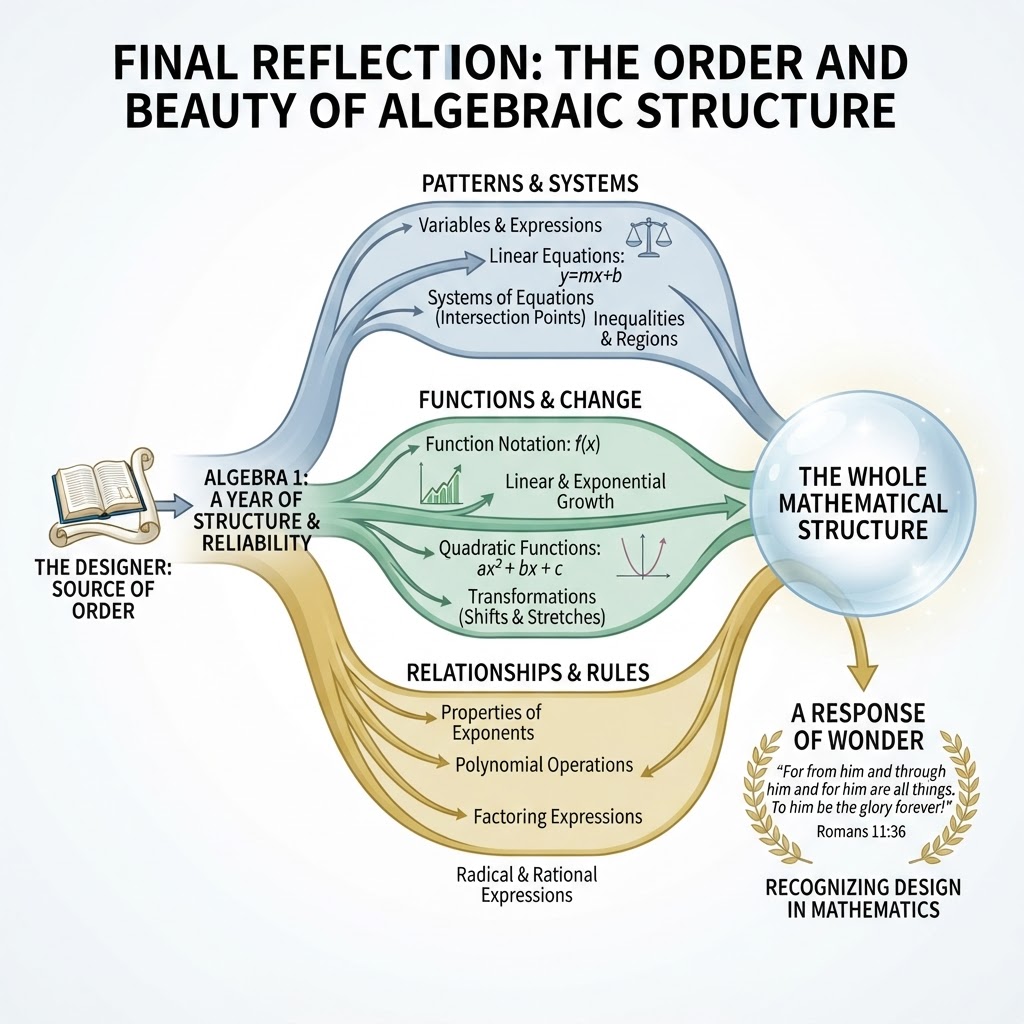
Lesson Narrative · Diagram
More videos
How to Think Clearly | The Philosophy of Marcus AureliusFreedom in Thought
Extraordinary Story of Poet who won Maths' Most Prestigious Prize | Meet June HuhTuring
The Valedictorian Speech that will change your lifeNeel Sharma

What career does this lesson unlock?
Adelaide will match a real-world profession to what you just learned and walk you through a day on the job.
Core Content
This is the final lesson of the course, a chance to step all the way back and
Contemplate the intricate tapestry we have spent the year unraveling. We began with simple expressions and moved through the complexities of linear equations, systems, inequalities, and functions. Throughout this journey, you have learned that symbols like x or y are not merely abstract placeholders.
They serve as a precise language to describe the physical constants and variables that govern our world, from gravity to the growth of biological populations.
Consider the linear equation y = mx + b, a cornerstone of our study. The slope m represents a rate of change, a quantitative measure of how one reality shifts in response to another. When we graph this on a Cartesian plane, we are mapping the relationship between variables.
A positive slope indicates a proportional increase, while a negative slope shows an inverse decline. This structure reflects the logic of order.
Take the task of calculating the time for a projectile to reach a height under constant acceleration. Suppose the equation is d = 0. 5 * a * t^2, where d is distance, a is acceleration, and t is time. If a = 9. 8 meters per second squared and d = 4.
9 meters, we solve for t. Dividing both sides by 4. 9, we get 1 = t^2. Taking the square root, we find t = 1.
- 5 *
- 8 * (1)^2, which equals
-
- We must remember that in physical applications, domain restrictions are vital; time cannot be negative.
The negative root of t^2 = 1, which is -1, is mathematically correct but physically irrelevant in this specific context of elapsed time.
We must distinguish between an exact model and a statistical approximation. Often, data points do not align perfectly on a line due to measurement errors. We use the line of best fit to summarize a trend. While the correlation might be strong, correlation does not prove causation.
Just because two variables move together does not mean one drives the other. Algebraic modeling requires us to discern the nature of relationships.
- To solve, we use substitution. From the second equation, x = y +
- Substituting this into the first, we get 3(y +
-
- 2y =
- Distributing the three yields 3y + 12 + 2y =
- Combining like terms gives 5y + 12 = 12, so 5y = 0, meaning y = 0 and x = 4.
Checking this result is essential. Plug x = 4 and y = 0 into the first equation: 3(4) + 2(0) = 12, which is true. For the second: 4 - 0 = 4, also true. The intersection point (4, 0) represents the unique solution where both conditions are satisfied.
Understanding these intersections helps us grasp how different constraints define a limited set of possibilities within a broader field of numeric values found in functions.
Why does this order exist? A Christian perspective suggests that the laws of mathematics reflect the faithfulness of the Creator. Just as the seasons return with reliable patterns, the behavior of numbers remains consistent across time and space. When you solve a quadratic or factor a polynomial, you are participating in a conversation with an objective reality. This consistency is not a product of human invention but a discovery of truth.
Exceptional cases, such as dividing by zero, remind us that even within a logical framework, there are boundaries. Division by zero is undefined because it lacks a reciprocal value that satisfies the equation. It is a limitation that mirrors the finite nature of our understanding.
These mathematical edges invite us to respect the structure of the system, teaching us that there is wisdom in recognizing where a process reaches completion.
Signs matter immensely. A missing negative sign can invert the meaning of an entire calculation, turning a loss into a gain or a cooling rate into a heating one. Being meticulous with signs is a form of integrity. It shows that you value the truth of the result over the speed of the process. In a world characterized by ambiguity, the binary clarity of an algebraic solution is a comfort.
The transition from symbolic manipulation to conceptual understanding is the hallmark of a mature mathematician. You no longer see algebra as a sequence of arbitrary steps to reach a box on a page. You see it as a map of relationships.
Whether you are dealing with radicals, exponents, or rational expressions, you are learning to translate complex phenomena into a language that is accessible, elegant, and deeply predictable for everyone.
Remember that the beauty of math lies in its generality. A formula for the area of a circle does not care about the size; the relationship between radius and area remains constant regardless of scale. This universality is a testament to an underlying design.
When you apply these principles to solve problems, you are not imposing your own will onto the numbers, but rather seeking the truth already hidden inside them.
As you move forward, carry with you the discipline learned here. Algebra has trained your mind to look for the structural foundation of a problem before attempting a solution. This analytical skill is valuable in every facet of life. Whether or not you pursue advanced calculus, the habits of precision, the appreciation for logical sequences, and the recognition of objective beauty will continue to shape how you interact with your world.
Finally, take a moment to stand in wonder at the coherence of it all. The fact that the physical universe behaves in ways that can be captured by the elegant symbols of algebra is a mystery worth pondering. We are observers of a grand design, granted the capacity to decode its patterns. As you close this course, let this sense of awe remain, reminding you that math is a window.
Subscription Library
Education.com Teacher Login
Standards-aligned lesson plans, worksheets, games, and activities for Pre-K through 8th grade.
Login credentials are being prepared. Check back soon, or ask your teacher.
© 2026 Learning by Grace. All rights reserved. This content is for enrolled students only and may not be copied, distributed, or reproduced.
Have something to share?
Submit your work — writing, art, videos, and more — for us to review.
My Submitted Work