Basic Probability: Understanding the
Lesson 33.1 Presentation
Lesson diagrams and audio narration
Lesson Narrative · Audio, part 1
Lesson Narrative · Diagram
More videos
Math Antics - Basic Probabilitymathantics
An Intro to Finding Probability | Basic Probability | Math with Mr. JMath with Mr. J
Probability: The Basics EXPLAINED with ExamplesAce Tutors
What is Theoretical Probability? | Math with Mr. JMath with Mr. J

What career does this lesson unlock?
Adelaide will match a real-world profession to what you just learned and walk you through a day on the job.
Core Content
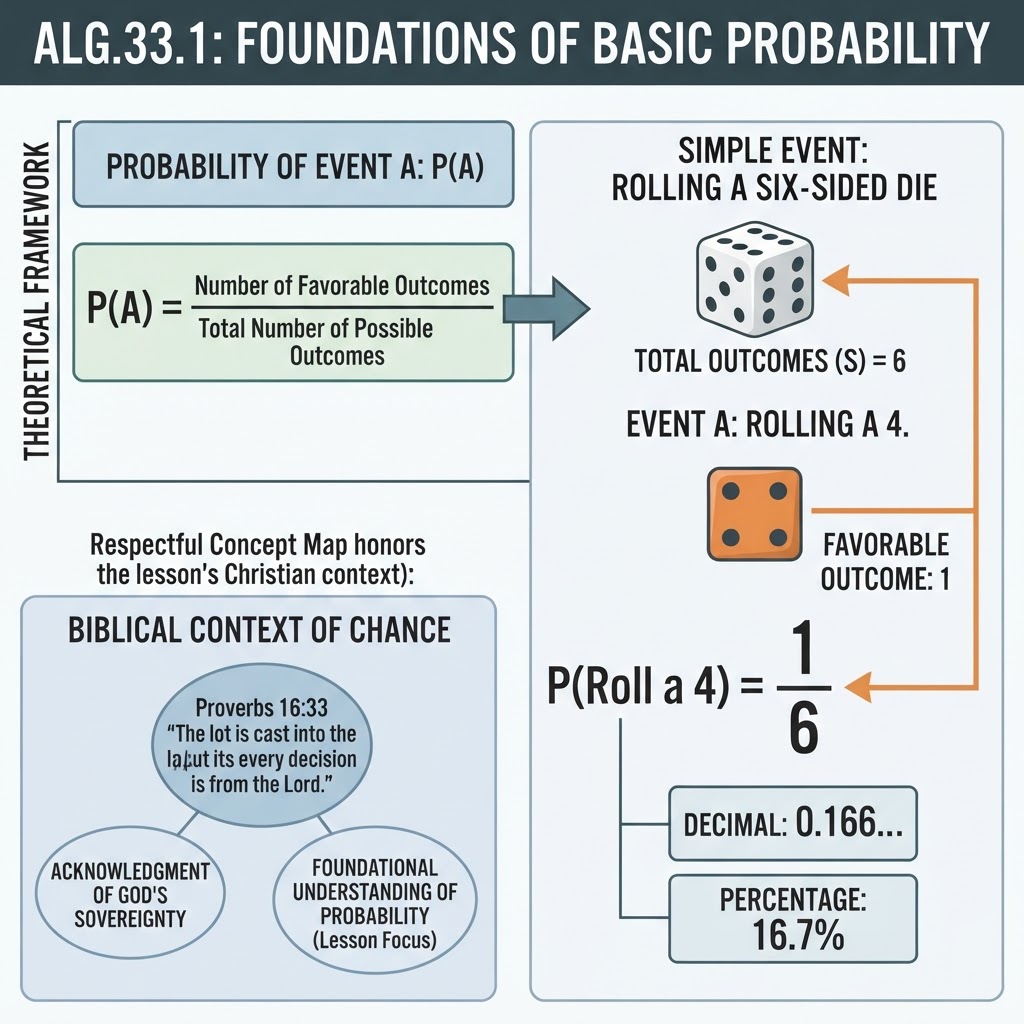
Basic probability measures how likely an event is to happen, calculated as
The ratio of favorable outcomes to the total number of possible outcomes within a sample space. This concept serves as the bedrock for modern statistics. When we define a sample space, denoted by S, we are identifying every possible occurrence that could result from a single trial.
A favorable outcome, or event E, is any subset of that sample space that meets the specific criteria of the problem you are solving.
The formula for theoretical probability is P(E) = n(E) / n(S), where n represents the count of outcomes in the set. This expression is valid only when all outcomes in the sample space are equally likely. If a die were weighted, the formula would no longer yield an accurate representation because the assumption of uniform probability would be violated. Always confirm your sample space is exhaustive and mutually exclusive before calculating.
Consider the first example: determining the probability of rolling a prime number on a standard six-sided die. First, we identify our sample space S = {1, 2, 3, 4, 5, 6}, which gives n(S) = 6. Next, we list the favorable outcomes for E, which are the prime numbers found within that set: {2, 3, 5}. Counting these, we find n(E) = 3. Substituting these into our formula, P(E) = 3 / 6.
- This yields 1 /
- We can convert this into a decimal by performing the division 1 divided by 2, resulting in
-
- Finally, multiplying by 100 gives a percentage of 50 percent. Substituting the values back into the ratio 3/6 confirms that the arithmetic result
- 5 is correct.
Common mistakes in this area often stem from misidentifying the sample space. For instance, if you were asked to find the probability of drawing a red card from a standard deck, you must acknowledge the total count is 52. If you accidentally include extra cards or ignore that half the deck is red, your fraction will be incorrect. Always verify the total count before attempting to derive the numerator for accuracy.
In our second example, imagine a bag containing 4 blue marbles, 3 red marbles, and 5 yellow marbles. We want the probability of selecting a red marble. The sample space total is 4 + 3 + 5 = 12 total marbles. Here, n(S) = 12.
The favorable outcomes are the red marbles, so n(E) = 3. Applying our formula, P(E) = 3 / 12, which simplifies to 1 / 4, or 0. 25, or 25 percent.
- The probability of the complement is 9 / 12, which simplifies to 3 /
- Since P(E) + P(not E) equals
- 25 +
- 75, which is 1, our calculation is confirmed through the simple rule of addition.
Domain restrictions are essential here because probabilities are strictly bound between 0 and 1 inclusive. A probability of 0 indicates an impossible event, such as rolling a 7 on a six-sided die. A probability of 1 denotes a certain event, like rolling a number less than 7.
If you ever calculate a value outside this range, check your work immediately, as you have likely swapped the numerator and denominator variables incorrectly.
It is vital to distinguish between theoretical probability and experimental probability. Theoretical probability relies on mathematical deduction, while experimental probability relies on observed frequency in repeated trials. While the two values may differ in small sample sizes due to random variation, the Law of Large Numbers dictates that the experimental frequency will approach the theoretical value as the number of trials increases, reflecting the logic inherent in the physical world.
When representing probability, you can use any of the three formats: fraction, decimal, or percentage. Fractions are preferred in exact algebraic work because they avoid rounding errors. Decimals are useful for comparisons, while percentages provide intuitive clarity in everyday contexts. Always ensure your final answer is simplified to its lowest terms.
If you leave a fraction like 6 / 12, it is equivalent to 1 / 2, but standard practice requires simplification.
Do not confuse correlation with causation when analyzing probabilistic data. Finding that two events happen together does not prove that one causes the other. In algebraic modeling, we define relationships using functions, but probability describes likelihood rather than a direct linear dependency.
Probability maps the state of uncertainty, providing a structured language to describe outcomes within a framework where multiple variables may interact without one forcing another outcome at all.
As you approach these problems, prioritize rigorous notation. Utilizing the formal P(E) identifies the specific event under analysis. By methodically documenting your progression—defining the sample space S, identifying the total count n(S), defining event E, determining the favorable outcome count n(E), and simplifying the resulting ratio—you construct a robust logical audit trail.
This disciplined approach minimizes arithmetic errors and facilitates efficient reviews. If you encounter complex scenarios, write out the set S explicitly. Explicitly listing the sample space effectively clarifies misconceptions regarding potential outcomes and ensures that every distinct possibility is correctly accounted for within your probability calculation.
Although mathematical patterns often appear perfectly predictable, recognize that probability models serve as sophisticated tools engineered by human intellect to interpret the inherent complexities of our universe. As we investigate these numerical relationships to improve our situational understanding, we acknowledge that the underlying order observed is a profound reflection of the logical structure established by the Creator.
Pursuing precision in every calculation acts as a deliberate way of honoring the intrinsic clarity, consistency, and reliability found within the laws of nature.
Concluding this lesson, remember that mastering probability is not about foretelling the future, but about quantifying the potential scope of the present moment. By calculating these ratios with meticulous care, you equip yourself to navigate uncertainty using evidence-based logic. Practice these foundational steps until they become intuitive, and consistently calculate the complement to verify your final answers. You are now fully prepared to analyze more complex, multi-stage events.
Subscription Library
Education.com Teacher Login
Standards-aligned lesson plans, worksheets, games, and activities for Pre-K through 8th grade.
Login credentials are being prepared. Check back soon, or ask your teacher.
© 2026 Learning by Grace. All rights reserved. This content is for enrolled students only and may not be copied, distributed, or reproduced.
