The Zero Product Property: Understanding
Lesson 27.2 Presentation
Lesson diagrams and audio narration
Lesson Narrative · Audio, part 1
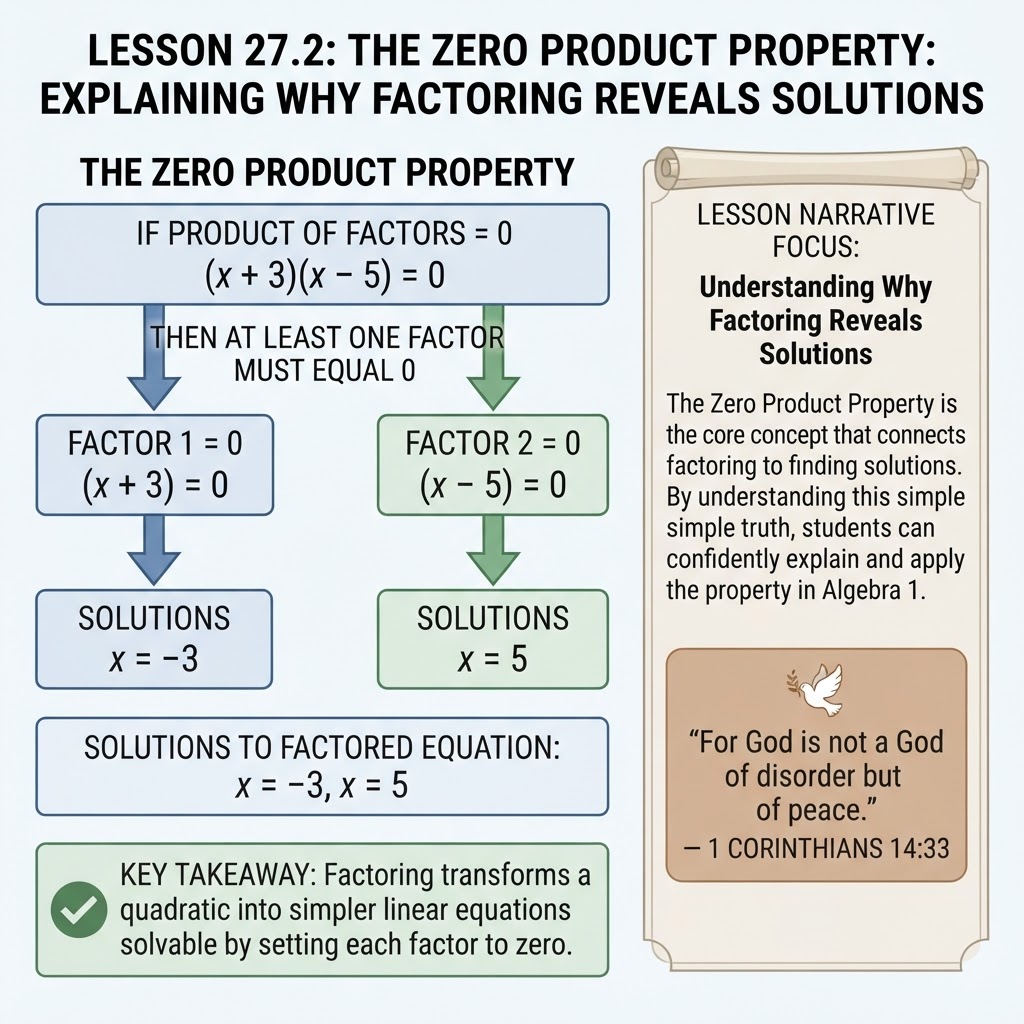
Lesson Narrative · Diagram
More videos
Solving equations with zero product propertyKhan Academy
Zero Product PropertyThe Organic Chemistry Tutor
Solving Quadratics Using the Zero Product PropertyCole's World of Mathematics
The Zero-Product PropertyMathispower4u

Complementary Video
What career does this lesson unlock?
Adelaide will match a real-world profession to what you just learned and walk you through a day on the job.
Core Content
The zero product property states that if the product of two or more factors
If a product of factors is zero, then at least one of those individual factors must itself be equal to zero. This principle functions as the bedrock for solving quadratic equations. When we manipulate a quadratic expression into its factored form, such as (x - a)(x - b) = 0, we acknowledge that the only way to reach a result of zero is for either (x - a) or (x - b) to be zero.
Consider the numerical reality behind this logic. If you multiply two numbers and the product is zero, one of them must be zero. There is no other mathematical path to reach zero through multiplication. If both factors were non-zero, their product would necessarily be a non-zero value.
Thus, we create two simpler linear equations, x - a = 0 and x - b = 0, which are far easier to solve independently.
- We begin by factoring the quadratic trinomial. We look for two numbers that multiply to 10 and add to
- These numbers are 5 and
- Therefore, we rewrite the equation as (x + 5)(x +
- =
- This transformation is valid because the distributive property confirms these expressions are perfectly equivalent.
Applying the zero product property to our factored equation, we establish two separate cases: x + 5 = 0 or x + 2 = 0. By subtracting 5 from the first equation, we find x equals -5. By subtracting 2 from the second, we find x equals -2.
These are the two potential solutions for our original quadratic equation. We must always verify these answers to ensure they satisfy the original equality constraint.
-
This results in 25 minus 35 plus 10, which equals
-
Substituting -2 gives (-2) squared plus 7 times -2 plus 10, resulting in 4 minus 14 plus 10, which also equals
-
Both solutions are correct. Verification serves as a safeguard, ensuring our algebraic manipulation remained consistent throughout the entire solving process.
-
This represents a difference of squares. We factor this into (x - 3)(x +
-
=
-
Setting each factor to zero, we obtain x - 3 = 0, giving x = 3, and x + 3 = 0, giving x = -3. These two distinct values represent the points where the parabola crosses the x-axis, identifying the roots of the function.
It is vital to distinguish between exact linear roots and approximations. In these examples, our results are exact because the quadratic expressions are factorable over the set of rational numbers. If a quadratic does not factor cleanly, we might encounter irrational solutions, requiring different methods like the quadratic formula.
However, the zero product property remains relevant, providing the conceptual framework for how these values relate to the graph's horizontal intercepts.
- =
- They might incorrectly assume that x - 3 = 5 or x + 4 =
- This is mathematically invalid. The zero product property applies exclusively to a product equaling zero. If the product is not zero, we must first rearrange the entire equation to set it to zero.
Understanding the graphical perspective aids our mastery. When we graph y = x squared plus 7x plus 10, we see a parabola that intersects the x-axis exactly at -5 and -2. These x-intercepts are the zeros of the function. The zero product property is essentially the symbolic tool we use to locate these intercepts precisely. Algebra connects the symbolic representation of the equation to the physical geometry of the coordinate plane.
We must also consider domain restrictions in applied contexts. For instance, if x represents physical length, negative solutions often become extraneous. If our equation models a dimension of a frame, a result of x = -5 would be rejected because a physical object cannot have negative length.
We must always interpret our algebraic outcomes through the lens of the reality described by the problem, ensuring our solutions remain logically consistent.
Sometimes, students forget that a single variable factor, like x(x - 4) = 0, also utilizes the zero product property. Here, x = 0 is a valid solution, as is x = 4. Failing to recognize the leading variable as a distinct factor often leads to missing a solution.
Every factor containing the variable must be addressed equally to ensure we have identified the full set of solutions for the equation.
The beauty of this method lies in its reductionist approach. By breaking a complex quadratic structure into its simplest linear components, we transform an intimidating problem into two manageable tasks. This mirrors how we often face life's complexities. When we break down overwhelming challenges into smaller, solvable components, we gain clarity. This focus allows us to move forward with confidence, trusting the foundational laws that govern both numbers and truth.
Logical analysis is essential for maintaining consistency. In algebra, the factors generate the product to equal zero, and the final x-values are the results of our operation. Distinguishing these helps us maintain rigorous thinking, preventing the assumption that any two numbers in an equation hold a direct causal relationship unless proven. Every calculation must be checked individually to ensure that each root satisfies the original provided quadratic equation statement.
Mastering the zero product property requires persistent practice and careful attention to signs. Check your work at every stage to avoid arithmetic errors. By internalizing these steps, you gain a powerful tool that unlocks deeper mathematical insights. Continue to approach these equations with the diligence of a builder, ensuring every step is level and true. The resulting clarity will prepare you for more advanced algebraic concepts for your future study.
Subscription Library
Education.com Teacher Login
Standards-aligned lesson plans, worksheets, games, and activities for Pre-K through 8th grade.
Login credentials are being prepared. Check back soon, or ask your teacher.
© 2026 Learning by Grace. All rights reserved. This content is for enrolled students only and may not be copied, distributed, or reproduced.
