Solving Quadratics by Taking Square Roots:
Lesson 27.3 Presentation
Lesson diagrams and audio narration
Lesson Narrative · Audio, part 1
Lesson Narrative · Diagram
More videos
How To Solve Quadratic Equations Using The Square Root Property | AlgebraThe Organic Chemistry Tutor
Solving quadratic equations by square roots | Algebra II | Khan AcademyKhan Academy
Solving quadratics by taking square roots examples | High School Math | Khan AcademyKhan Academy
Solving Quadratic Equations Using Square RootsMathispower4u

Complementary Video
What career does this lesson unlock?
Adelaide will match a real-world profession to what you just learned and walk you through a day on the job.
Core Content
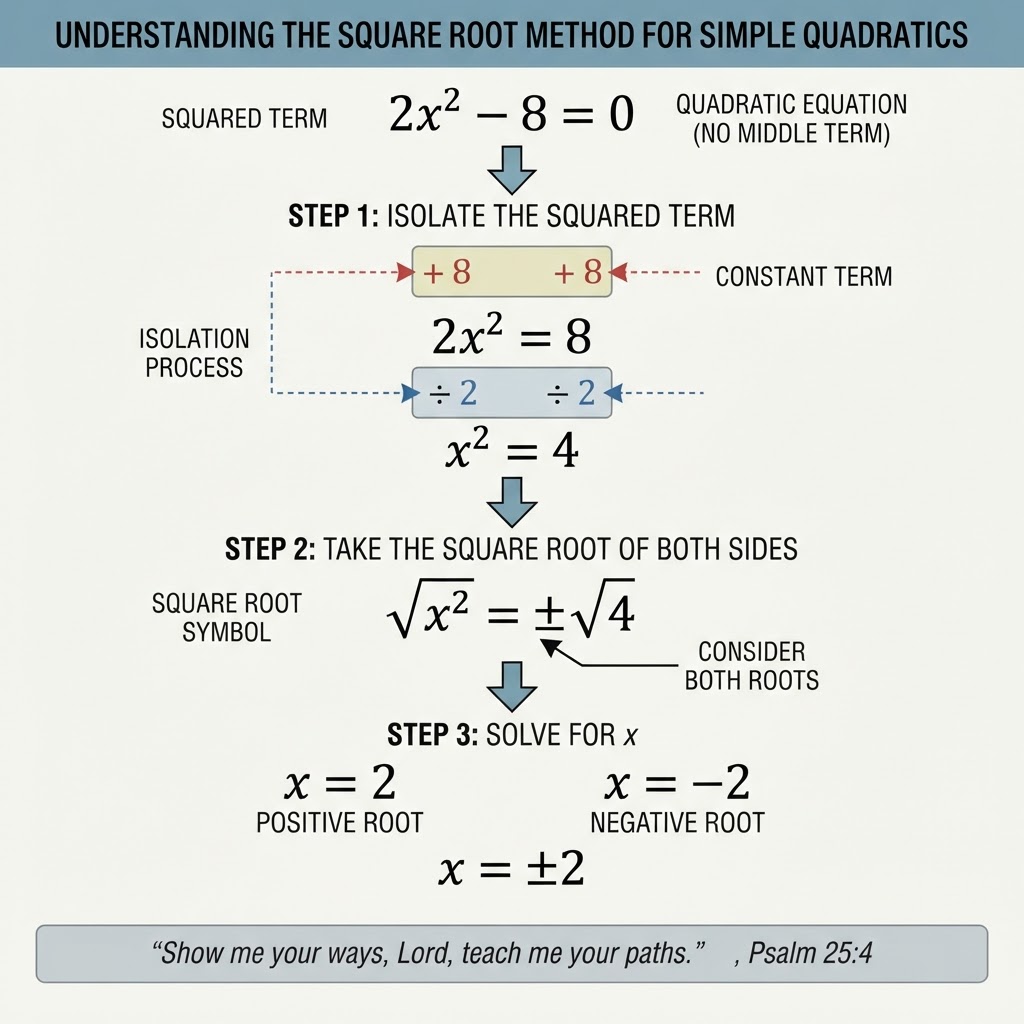
When a quadratic equation has no middle term, isolating the squared term
When a quadratic equation lacks a linear term, isolating the variable is the most efficient method. This technique utilizes foundational inverse operations. By treating the squared expression as a unit, we strip away surrounding operations one by one. This process reveals the essential value within the exponent.
Much like in life, where distractions cloud our core purpose, clearing away constants allows the mathematical truth to emerge with absolute clarity throughout the process.
Our equations require specific steps to reach the correct root, similar to how our lives require the steady truth of God to guide our path. We find the right direction not by ignoring realities around us, but by applying wisdom to balance our decisions. In mathematics, this balance is expressed through the symmetry of roots. Each calculation serves as a quiet reminder that both sides of an equation are linked.
The square root property provides an elegant mechanism for solving quadratics. It asserts that if a variable squared equals a non-negative constant, the solution must include both positive and negative values. This is a requirement of the definition of squaring.
When we solve x^2 = 9, we recognize that both 3 and -3 return 9 when squared. This duality mirrors the complexity of human choices where every single action carries weight.
- Our objective is to isolate x^2. We begin by adding 100 to both sides, resulting in 4x^2 =
- Then, we divide by 4, yielding x^2 =
- Applying the property, x equals the positive or negative square root of
- Therefore, x = 5 or x = -5. These roots represent points where the function intersects the horizontal axis on a coordinate plane.
Verifying our work ensures academic integrity. If we substitute x = 5 into 4x^2 - 100 = 0, we calculate 4(25) - 100, which equals 100 - 100 = 0. Similarly, for x = -5, we get 4(25) - 100 = 0. Both solutions satisfy the equation perfectly.
Verification acts as a safeguard against calculation errors, confirming our symbolic logic aligns with the actual numerical behavior of the function, reinforcing confidence in the final result.
Consider another instance: 5x^2 + 20 = 0. Subtracting 20 gives 5x^2 = -20, and dividing by 5 yields x^2 = -4. Because no real number multiplied by itself results in a negative product, we conclude that no real solution exists.
This boundary is not a failure of our method but a demonstration of the limits of real numbers. Acknowledging this limit shows a mature understanding of the real number system rules.
Graphically, these cases manifest differently. A function like y = 4x^2 - 100 creates an upward-opening parabola that crosses the x-axis twice, confirming our two distinct roots. Conversely, the function y = 5x^2 + 20 shifts the vertex above the x-axis and opens upward, never touching the axis.
This visual evidence corroborates the algebraic conclusion that no real roots exist. Everything in mathematics is connected through logical threads reinforcing underlying functional behavior.
A frequent error occurs when students neglect the plus or minus sign. It is tempting to consider only the positive root, but doing so provides an incomplete picture of the quadratic relationship. Always record both potential values immediately when applying the square root. This disciplined habit prevents the loss of critical information.
By consistently applying this notation, you maintain the symmetry of the equation, ensuring that your final answer is mathematically rigorous.
Another mistake is attempting to take the root before the term is isolated. If you have 2x^2 = 50 and try to take the root of both sides immediately, you might incorrectly write x = sqrt(50). You must divide by the coefficient first to isolate the squared variable entirely.
Proper order of operations is the bedrock of successful algebra. Always perform operations in the correct sequence to ensure your logic remains flawless.
In applied scenarios, context might restrict our domain. If a variable represents a length, a negative root might be physically impossible. However, in pure algebra, we include both roots unless explicitly constrained by the problem. Balancing algebraic properties with real-world application requires discernment.
When you apply math to the world, remember that variables must remain tethered to the physical reality of the specific situation currently being analyzed for your work.
Exact values remain preferable to decimal approximations. If your equation leads to x^2 = 11, the solution is plus or minus the square root of 11. Do not rush to a calculator for a decimal. Using radical notation ensures that your answer is precise and avoids rounding errors that could cascade through subsequent steps. Strive for the exactness provided by algebraic representation, as this maintains the integrity of your work throughout.
Algebraic reasoning demands that we treat every equation as a structured system. By isolating the x^2 term through balanced operations, we prepare the equation for its final resolution. Every addition, subtraction, or division is governed by the principles of equality, ensuring that the relationships between variables remain consistent.
This methodical approach is the hallmark of a disciplined student, turning abstract symbols into a reliable language for describing patterns within our universe.
Mastering this property requires patience and deliberate mental focus. As you transition from linear equations to quadratic ones, the shift in logic is significant. You are no longer just solving for a single value; you are identifying the roots of a symmetric function.
Take your time to move constants, divide by coefficients, and apply the root property with care. Through persistence, you build a foundation that supports more complex studies.
These procedural steps lead to ultimate mathematical clarity. By clearing away secondary terms and honoring the dual nature of square roots, you unlock the solutions within the quadratic form. Avoid shortcuts that lead to errors; instead, embrace the rigor of the process.
Every equation solved is a testament to your growing ability to navigate systems of logic. Maintain high standards, verify your findings, and trust in the order reasoning provides.
Subscription Library
Education.com Teacher Login
Standards-aligned lesson plans, worksheets, games, and activities for Pre-K through 8th grade.
Login credentials are being prepared. Check back soon, or ask your teacher.
© 2026 Learning by Grace. All rights reserved. This content is for enrolled students only and may not be copied, distributed, or reproduced.
