Quadratics in the Real World:
Lesson 29.5 Presentation
Lesson diagrams and audio narration
Lesson Narrative · Audio, part 1
Lesson Narrative · Diagram

Complementary Video
What career does this lesson unlock?
Adelaide will match a real-world profession to what you just learned and walk you through a day on the job.
Core Content
Today’s lesson steps back to survey just how widely quadratic functions
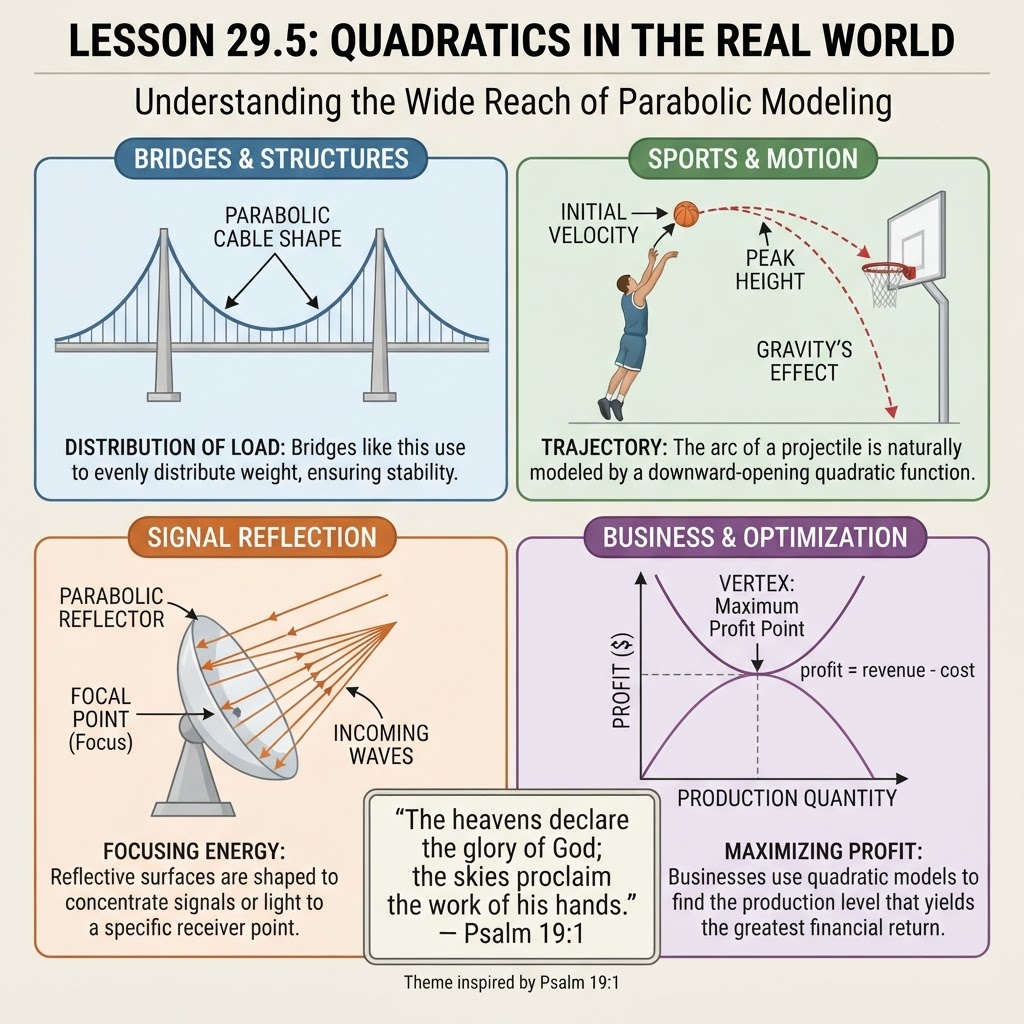
Quadratic patterns appear in the natural world. When we examine the arc of a ball thrown through the air or the path of a fountain spray, we observe the power of gravity acting upon objects in motion. This motion is not chaotic; it follows a precise parabolic trajectory described by the function h(t) = -16t^2 + vt + h0, where h is height, t is time, v is velocity, and h0 is altitude.
The coefficient -16 represents the downward pull of gravity acting on an object in feet per second squared. This term creates the negative curvature that turns our graph downward, forming a peak or vertex. If the coefficient were positive, the parabola would open upward, representing different scenarios like the shape of a satellite dish or the path of light through a lens. These shapes serve functional, purposeful roles in our world.
Let us examine a practical scenario: a student throws a basketball with an initial velocity of 24 feet per second from a height of 6 feet. Our equation becomes h(t) = -16t^2 + 24t + 6. To find the maximum height, we identify the vertex using the formula t = -b / (2a).
Here, a is -16 and b is 24, so t = -24 / (2 * -16), which simplifies to t = 0. 75 seconds.
- 75 into our original function allows us to solve for h. We calculate -16(0. 75)^2 + 24(0.
-
- 6, which yields -16(0.
-
- 18 +
- This evaluates to -9 + 18 + 6, resulting in a maximum height of 15 feet. By substituting 0.
75 into the function h(t), we confirm our result. The vertex (0. 75, 15) represents the moment when the upward velocity is neutralized by the constant acceleration due to gravity.
Understanding domain restrictions is vital in these models. While algebraic parabolas extend infinitely in both directions, real-world projectile motion is bound by time. Time cannot be negative, and the height becomes zero when the ball hits the ground. Therefore, the practical domain starts at t = 0 and ends at the positive x-intercept. Calculating this intercept requires the quadratic formula, ensuring our model reflects the physical reality of the landing.
Another application involves optimization, such as maximizing the area of a garden enclosed by a fixed length of fencing. Suppose you have 40 feet of fencing to create a rectangular enclosure. If the width is w, the length must be 20 - w to ensure the perimeter is 40.
The area function becomes A(w) = w(20 - w), or A(w) = -w^2 + 20w, which is a classic downward-opening quadratic equation.
To maximize the area, we again locate the vertex. The axis of symmetry occurs at w = -20 / (2 * -1), which equals 10 feet. If the width is 10, the length is also 10, meaning a square provides the optimal area. The maximum area is 10 * 10 = 100 square feet.
This demonstrates how mathematical limits help us use resources wisely, reflecting the value of careful stewardship in our daily tasks.
Common errors often involve sign mistakes during substitution. Always ensure that the negative sign is applied correctly to the squared term. If you calculate the vertex using the quadratic formula but forget the double negative in the denominator for downward parabolas, you might obtain an incorrect time value.
Physically, this would be impossible, so use such inconsistencies as an immediate signal to recheck your arithmetic and your understanding of context.
Distinguishing between correlation and causation is essential. While data points might fit a quadratic curve, we must ensure there is a physical reason for that pattern. For example, stopping distances for cars relate to the square of velocity due to kinetic energy. This is a causal link established by physics.
Simply plotting arbitrary points that happen to form a curve does not imply a quadratic relationship governs the underlying physical process.
Units must remain consistent throughout your calculations. If the initial velocity is in meters per second, the gravitational constant must be roughly -4. 9, not -16. Mixing units leads to errors that can obscure the true nature of the modeled phenomenon.
By maintaining unit integrity, you ensure that your symbolic representations accurately mirror the physical quantities being measured, keeping the mathematical language precise and reliable for anyone interpreting your data or conclusions.
When interpreting intercepts, consider the context of the question. The y-intercept represents the initial state when time is zero, while the x-intercepts define the lifespan of the movement. If the parabola intersects the x-axis at a negative value, it signifies a point in time before your measurement began.
In most practical applications, we ignore these values and focus only on the segment where the function values are non-negative.
Reflect on the harmony between the abstract variables and the concrete world. When you solve for height or area, you are translating the messy reality of the physical world into the clean, ordered language of algebra. This ability to model suggests that the universe possesses an inherent mathematical structure.
Observing this order reinforces the idea that our efforts to understand these laws are part of a larger, orderly, and beautiful design.
To check your work, consider independent methods. If you solved for the vertex algebraically, test a point slightly to the left and right of your vertex time. If the heights at these points are lower than the vertex height, you have confirmed that the vertex is indeed a maximum.
This process of verification builds confidence in your results and ensures that your model correctly describes the physical system being analyzed.
Finally, remember that mathematics is a tool for exploration. As you advance through these lessons, keep looking for parabolas in the world around you, from the curve of a bridge cable to the flight path of a bird. By applying these concepts consistently, you sharpen your mind to perceive the structural elegance of the world, growing in your capability to solve problems while appreciating the intentionality embedded in every physical measurement.
Subscription Library
Education.com Teacher Login
Standards-aligned lesson plans, worksheets, games, and activities for Pre-K through 8th grade.
Login credentials are being prepared. Check back soon, or ask your teacher.
© 2026 Learning by Grace. All rights reserved. This content is for enrolled students only and may not be copied, distributed, or reproduced.
Have something to share?
Submit your work — writing, art, videos, and more — for us to review.
My Submitted Work