Review: Introduction to Polynomials
Lesson 24.3 Presentation
Lesson diagrams and audio narration
Lesson Narrative · Audio, part 1
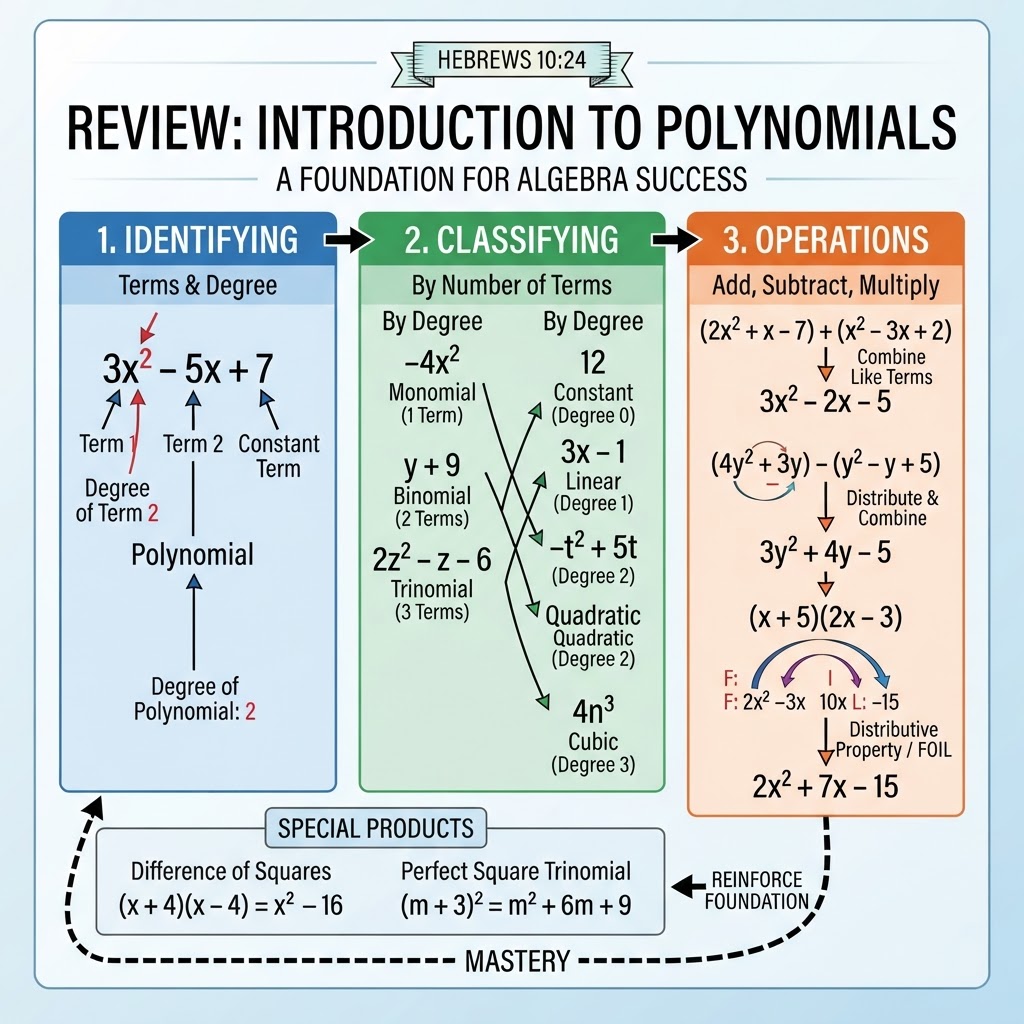
Lesson Narrative · Diagram
More videos
Algebra Basics: What Are Polynomials? - Math Anticsmathantics
Polynomials - Classifying Monomials, Binomials & Trinomials - Degree & Leading CoefficientThe Organic Chemistry Tutor
Introduction & Concepts | Class 9 Maths Chapter 2 | PolynomialsMagnet Brains
Mastering Polynomials Review: 5 Must-know Concepts!Algebra-1 with Mr. Peters

Complementary Video
What career does this lesson unlock?
Adelaide will match a real-world profession to what you just learned and walk you through a day on the job.
Core Content
Today’s review revisits every skill from Module 21: identifying terms and
Coefficients define polynomials, which we classify by degree using fundamental rules for addition and subtraction. We view a polynomial as a sum of monomials where each term is a product of a constant and a variable raised to a whole number exponent. Standard form requires listing exponents in descending order.
This structure transforms chaotic lists into predictable patterns, facilitating efficient computation and ensuring that our logical communication remains clear and consistent.
Consider the expression 5x^2 - 3x + 7 - 2x^2 + 8x - 4. To simplify, we group terms sharing identical variable parts. Combining like terms is valid because the distributive property allows us to factor out the shared variable component, leaving coefficients to be added or subtracted.
This operation preserves equality because we are merely rearranging the sum according to the commutative and associative properties, ensuring the overall numerical value remains consistent throughout the entire process.
- The simplified polynomial is 3x^2 + 5x +
- To verify this, substitute x = 2 into both expressions. The original gives 20 - 6 + 7 - 8 + 16 - 4, totaling
- The simplified version gives 12 + 10 + 3, which also totals
- The results match perfectly.
Beyond simple calculation, classifying polynomials by degree provides insight into function behavior. A degree of zero indicates a constant, one represents a linear relationship, and two indicates a quadratic. We must distinguish between exact algebraic identities and statistical approximations. Linear relationships imply constant rates of change, whereas quadratic models capture curvature.
Confusing the two often leads to erroneous predictions when applying algebraic models to data sets within various real-world scenarios or complex applications.
Subtraction requires careful attention to signs. Subtracting a polynomial is equivalent to adding its opposite. We distribute the negative sign across every term inside the parentheses before combining like terms. A common mistake involves failing to negate every term in the subtrahend, leading to errors in the final result.
Always treat the negative sign as a scalar multiplier of -1 to ensure you properly negate every single coefficient involved in the subtraction process.
-
- (x^3 + 5x - 2). We rewrite this as 4x^3 - 2x + 5 - x^3 - 5x +
- Distributing the negative across the second polynomial transforms terms into -x^3, -5x, and +2. Grouping like terms gives (4x^3 - x^3) + (-2x - 5x) + (5 + 2). This simplifies to 3x^3 - 7x +
- Substituting x = 1 shows both the original and result yield
- Both sides are identical.
When representing polynomials graphically, the degree dictates potential roots and curve end behavior. While an algebraic expression is symbolic, its graph serves as a visual bridge to understanding domain and range. For most polynomials, the domain includes all real numbers. However, specific contexts involving physical measurements might require restricting the domain to non-negative values. Understanding these boundaries ensures our algebraic models remain meaningful and applicable within the constraints of the physical world.
Precision in notation is an exercise in intellectual honesty. When we write an equation, we make a claim about equality. If we fail to account for signs or incorrectly combine non-like terms, we create false statements about the values represented. Mathematics rewards those who value accuracy, much like how integrity in speech builds trust. Our primary goal is to represent reality accurately through the precise, disciplined, and logical language of formal algebra.
Correlation versus causation is a vital concept when working with expressions. Just because two variables change together does not mean one forces the other to behave in a specific way. Symbolic representations are tools for modeling, not inherent laws of causality.
By maintaining this distinction, we avoid the logical fallacy of over-interpreting algebraic models when applying them to complex systems where hidden variables might actually be driving the observed changes over time.
Common errors often stem from ignoring exponent laws during simplification. Adding like terms affects only coefficients, never exponents. For example, x^2 plus x^2 equals 2x^2, not 2x^4. This is a fundamental error of confusing addition with multiplication. Always pause to check if you are operating on coefficients or exponents.
Maintaining this vigilance prevents the accidental creation of unintended functions during your step-by-step simplification of complex polynomial expressions within your homework assignments.
Units provide a sanity check for your algebraic work. If you add two polynomials representing lengths or areas, the final result must preserve those dimensions. If input terms have units like meters, the output of an addition operation must carry those same consistent units.
Adding a linear term to a quadratic term is dimensionally inconsistent in many physical contexts, reminding us to verify if our model correctly aligns with physical reality.
Reflecting on the structure of these expressions allows us to see the unity of mathematics. Whether dealing with simple binomials or complex trinomials, the rules remain stable. This consistency mirrors the reliability we find in the laws of nature. We do not invent these rules; we discover them as part of an existing order. Mastering these fundamentals prepares you for calculus, where these simple structures form the necessary, robust foundational blocks.
As we synthesize these concepts, recognize that your proficiency grows through repeated practice and intentional self-correction. When you identify a mistake, treat it as a data point that clarifies where your understanding needs further development. Mastery is not about avoiding every error, but about developing the habit of verification and the discipline to correct your trajectory. These cognitive habits are valuable beyond the classroom, fostering resilience and deep analytical clarity.
Final mastery of polynomial operations requires synthesizing your knowledge of classification, standard form, and arithmetic rules. You are now equipped to navigate expressions with greater confidence. Continue to approach every problem by observing the structure, applying rules systematically, and verifying your work through substitution or alternative methods.
Through this rigorous process, you develop the logical, organized, and precise approach to problem solving that defines true mathematical maturity in your academic journey.
Subscription Library
Education.com Teacher Login
Standards-aligned lesson plans, worksheets, games, and activities for Pre-K through 8th grade.
Login credentials are being prepared. Check back soon, or ask your teacher.
© 2026 Learning by Grace. All rights reserved. This content is for enrolled students only and may not be copied, distributed, or reproduced.
