Strand Review: Factoring Polynomials II,
Lesson 24.5 Presentation
Lesson diagrams and audio narration
Lesson Narrative · Audio, part 1
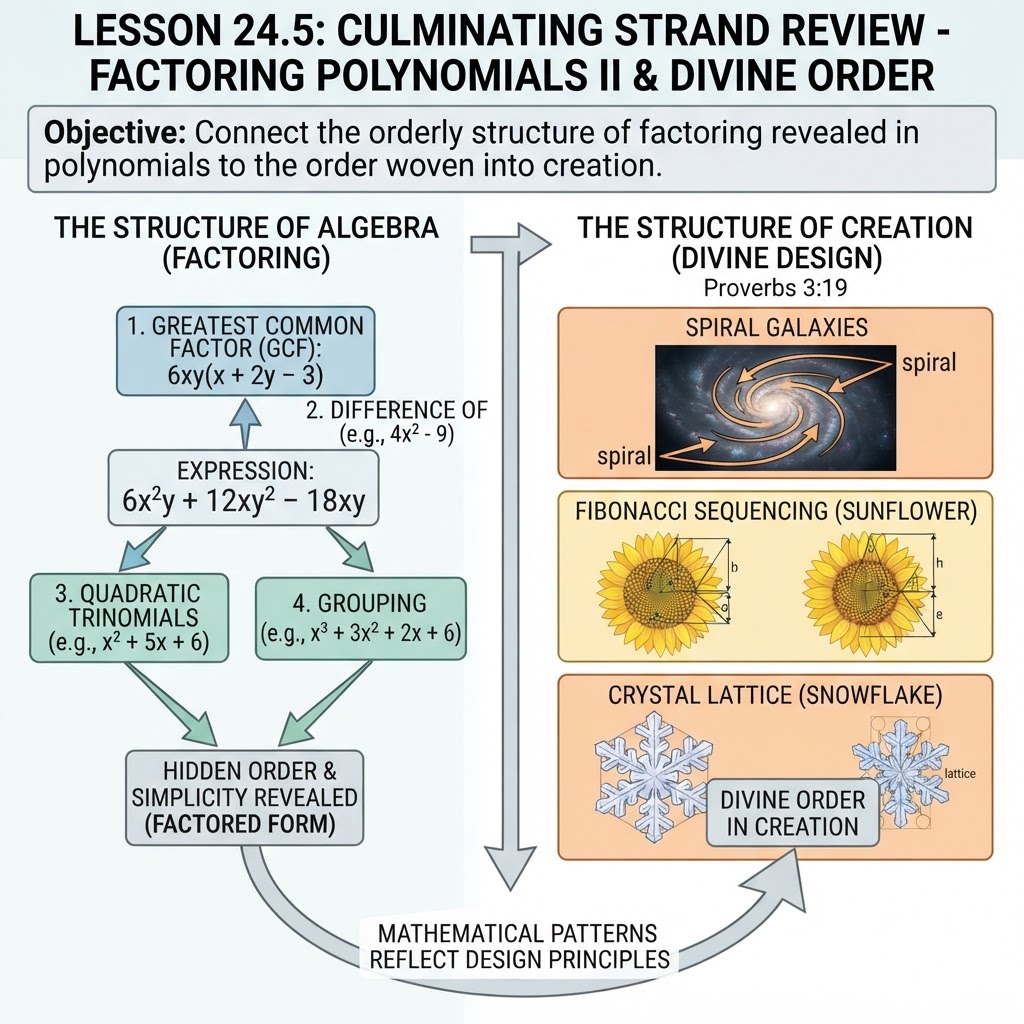
Lesson Narrative · Diagram
More videos
SOL - A.02c - FactoringDouglas Fordham
Factorising Algebraic Expressions ( factoring / factorizing )mathonify
Solve quadratic equation by factorisationJacob Sichamba Online Math

Complementary Video
What career does this lesson unlock?
Adelaide will match a real-world profession to what you just learned and walk you through a day on the job.
Core Content
You have spent this whole strand learning to work with exponents,
Algebra reveals how numbers interact within specific frameworks. Factoring is the inverse of expanding, deconstructing products into fundamental building blocks. In this lesson, we move beyond basic inspection to use structural recognition. By identifying patterns, you avoid cumbersome trial and error, transforming expressions into manageable factors.
This reveals the behavior of the functions you study, allowing you to manipulate complex expressions with high precision and logical clarity throughout your work.
The difference of squares is a primary structural shortcut. When you see a binomial where two squares are subtracted, such as a squared minus b squared, you factor it into the product of two conjugates: a plus b and a minus b. This pattern exists because middle terms created during multiplication cancel exactly. Understanding this symmetry is vital, as it reflects the balance found in many stable mathematical systems we analyze daily.
- Observe that 16x squared is the square of 4x and 49 is the square of
- Since this follows the difference of squares identity, the result is the product of 4x plus 7 and 4x minus
- Substituting x equals 1 confirms this: 16 minus 49 is negative 33, while the factors yield 11 times negative 3, which equals negative
- This confirms our factoring is correct.
The middle terms in that binomial product vanish, leaving our original expression. This confirmation proves our factorization is correct and demonstrates the internal consistency of algebraic laws. Such consistency is a hallmark of the logical world. When expressions seem disconnected, look for these hidden structures, as they simplify complex problems into operations you already know how to perform. Always maintain this focus on structure to ensure every simplification step remains logically sound and accurate.
Perfect square trinomials provide another elegant shortcut. These arise when you square a binomial, resulting in either a squared plus 2ab plus b squared or a squared minus 2ab plus b squared. Identifying these patterns saves time during simplification. The key is to check if the first and last terms are perfect squares and if the middle term is twice the product of their roots. This prevents errors during algebraic manipulation throughout.
Examine 9x squared plus 30x plus 25. The first term is the square of 3x and the last is 5 squared. Twice the product of 3x and 5 equals 30x. Because this matches the middle term, we confirm it is a perfect square trinomial. The factored form is the square of 3x plus 5. This compact representation is highly useful when solving quadratic equations in practical applications, simplifying complex algebraic steps very effectively.
To check, expand 3x plus 5 squared by multiplying 3x plus 5 by itself. Using distribution, we get 9x squared plus 15x plus 15x plus 25, which simplifies to 9x squared plus 30x plus 25. This verification reinforces that the relationship between these factors is absolute.
Algebraic precision allows us to trust the results, moving forward with the certainty that our initial factorization was both logically sound and mathematically accurate in every instance.
Common mistakes in these patterns often involve misidentifying signs or overlooking a greatest common factor. For instance, in the sum of two squares like x squared plus 9, many students mistakenly attempt to factor it using real numbers. However, this binomial is prime over the real numbers because there are no real factors that multiply to a positive square while summing to zero. Always verify your work to avoid these specific pitfalls.
Domain restrictions must remain at the forefront of your thinking. If you factor an expression found in the denominator of a fraction, you must identify any values of the variable that make that expression zero. Even after you factor and potentially cancel terms, the original restriction persists.
This teaches us that the history of an equation matters; we cannot ignore the previous state of an expression just because the notation was simplified.
Units are equally important when factoring physical models. If you represent the area of a rectangle as x squared plus 7x plus 10, the factors x plus 2 and x plus 5 represent the physical dimensions of that area. Factoring here transitions an abstract polynomial into tangible length and width.
When you work with these models, keep your units consistent throughout the entire process, as shifting units mid-calculation is a frequent error source.
Distinguishing between exact relationships and approximations is essential. Factoring leads to an exact symbolic representation, which is superior to numerical approximation because it remains true for all values of the variable. While a graph might help you visualize where a function hits the axis, factoring provides the exact coordinates.
Trust the symbolic proof over visual estimation, as the former is derived from the fundamental properties of the real number system today.
Correlation versus causation is worth noting in your analytical journey. Just because variables appear to change together in a pattern does not mean one causes the other. However, in our algebraic equations, the relationship is one of direct causation. Changing the value of x directly causes the output to change according to our factored expression. Recognizing this difference helps you interpret not just the math, but the nature of the systems.
As you master these techniques, remember your ability to analyze these patterns mirrors the order found in the universe. There is beauty in how variables behave and how equations can be transformed without losing their integrity. By sharpening your algebraic vision, you become better equipped to handle the complexities of higher mathematics.
Stay diligent with your checking, stay mindful of signs, and keep your focus on the structure that makes math work.
In your final assessment, rely on these methods of recognition and verification. Do not rush through the identification phase of a problem, as catching a difference of squares early saves you from unnecessary labor later. If you find yourself stuck, go back to the basic principles of distribution and expansion.
These foundational steps are the keys to unlocking complex expressions. You possess the tools necessary to navigate this strand with deep understanding.
Subscription Library
Education.com Teacher Login
Standards-aligned lesson plans, worksheets, games, and activities for Pre-K through 8th grade.
Login credentials are being prepared. Check back soon, or ask your teacher.
© 2026 Learning by Grace. All rights reserved. This content is for enrolled students only and may not be copied, distributed, or reproduced.
Have something to share?
Submit your work — writing, art, videos, and more — for us to review.
My Submitted Work