Solving Quadratics by Factoring:
Lesson 27.1 Presentation
Lesson diagrams and audio narration
Lesson Narrative · Audio, part 1
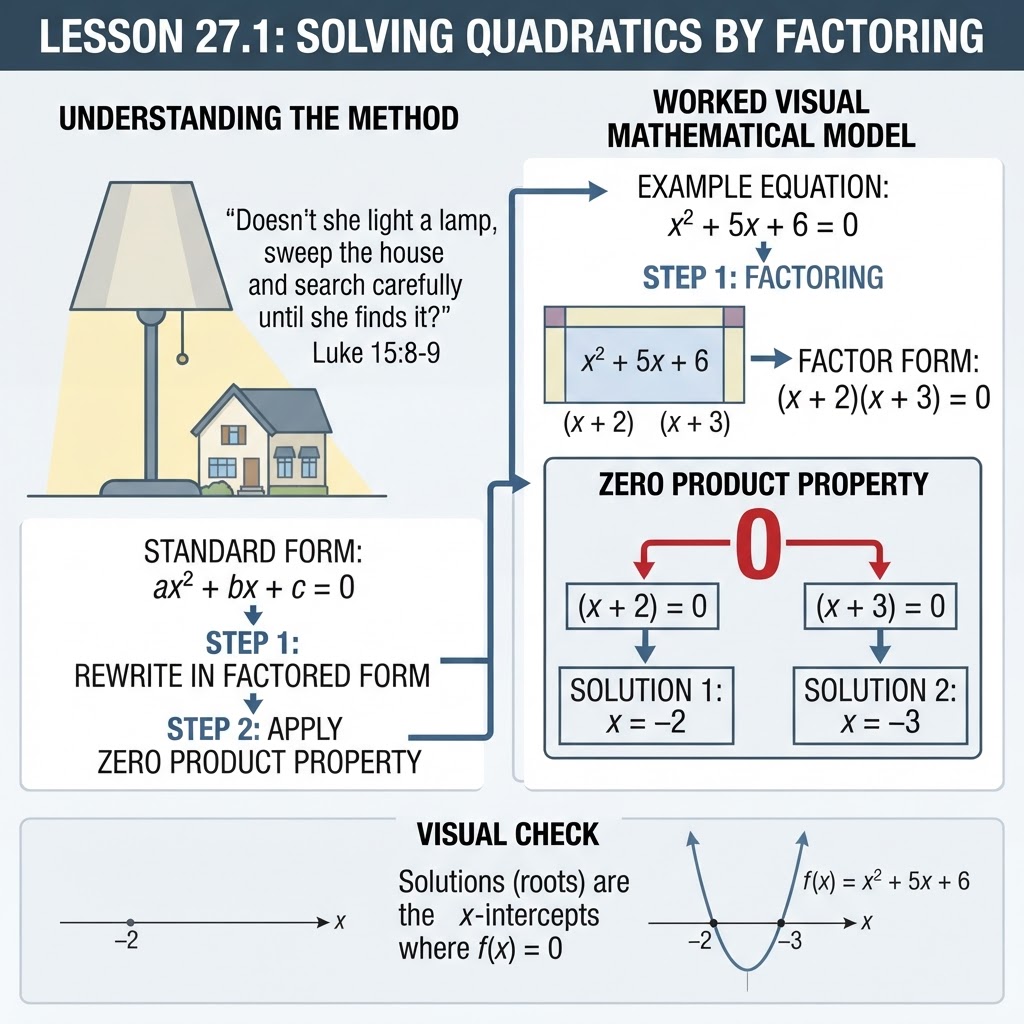
Lesson Narrative · Diagram
More videos
Solving Quadratic Equations by FactoringMathispower4u
Solving Quadratics Using the Zero Product PropertyCole's World of Mathematics
Solving a quadratic by factoring | Quadratic equations | Algebra I | Khan AcademyKhan Academy
Solving Quadratics by FactoringProfessor Dave Explains

Complementary Video
What career does this lesson unlock?
Adelaide will match a real-world profession to what you just learned and walk you through a day on the job.
Core Content
Solving a quadratic equation by factoring means rewriting it in factored
To solve quadratic equations, we utilize the form where the expression equals zero. This method relies heavily on the Zero Product Property, which states that if the product of two real numbers is zero, then at least one factor must be zero. If a times b equals zero, then a or b is zero. We apply this logic by transforming a trinomial into two linear factors multiplied together.
When we set each binomial factor to zero, we create two simple linear equations. Each individual equation becomes easy to solve by isolating the variable. These resulting values represent the roots of the quadratic equation, known as the zeros or x-intercepts.
Graphically, these roots are the specific points where the parabola crosses the x-axis, marking the moments when the vertical height of the function is precisely zero, yielding defined roots.
- To solve this, we seek two integers that multiply to give the constant term, 10, and add to give the coefficient of the linear term,
- Through testing factors of 10, we identify 2 and
- Thus, we rewrite the quadratic expression as (x + 2)(x +
- =
- This symbolic representation captures the entire equation in a factored structure ready.
Applying the Zero Product Property means we set x + 2 = 0 or x + 5 = 0. Solving the first yields x = -2, and solving the second yields x = -5. These are our two distinct roots. To verify, we substitute these into the original equation.
For x = -2, we calculate (-2)^2 + 7(-2) + 10, which results in 4 - 14 + 10, equaling zero. Our solution is confirmed as correct.
For the second check, we substitute x = -5 into the expression, yielding (-5)^2 + 7(-5) + 10. Calculating this gives 25 - 35 + 10, which simplifies exactly to zero. By performing these checks, we ensure that our factoring process was accurate.
This systematic verification serves as a safeguard against arithmetic errors, mirroring the diligence we should apply in all analytical tasks when we seek truth through careful, logical processes of examination.
A common mistake students encounter involves failing to set the equation to zero before beginning the factoring process. If an equation appears as x^2 + 7x = -10, one must first add 10 to both sides to reach the standard form. Without this step, the Zero Product Property cannot be applied.
The equation must equate to zero because the property is exclusive to the multiplication of factors totaling that specific value.
Another error occurs when students confuse signs during the factoring process, especially when the constant term is negative. If you have x^2 - x - 12 = 0, you need factors of -12 that sum to -1. Testing pairs like 3 and -4 works because 3 times -4 is -12 and 3 plus -4 is -1. Using incorrect signs would lead to the wrong roots, changing the intersection points on the grid.
- First, we simplify by factoring out the greatest common factor, which is
- This leaves 2(x^2 - 4x -
- =
- We then focus on the trinomial x^2 - 4x -
- We need factors of -5 that add to -4. The pair -5 and 1 satisfies this condition. Therefore, the factored form is 2(x - 5)(x +
- = 0.
With the equation fully factored, we identify the factors involving the variable: x - 5 and x + 1. The constant factor 2 does not affect the roots because 2 can never equal zero. Setting x - 5 = 0 gives x = 5, and x + 1 = 0 gives x = -1.
These are the roots of our equation. The parabola crosses the horizontal axis at these two specific locations on the grid.
To verify this result, substitute x = 5 into the original expression: 2(5)^2 - 8(5) - 10 equals 2(25) - 40 - 10, which is 50 - 50 = 0. Then substitute x = -1: 2(-1)^2 - 8(-1) - 10 equals 2(1) + 8 - 10, which is 2 + 8 - 10 = 0.
Both roots are verified. Consistency in these calculations reinforces the reliability of the algebraic methods we use to define patterns and valid results.
It is helpful to remember that algebraic representations like these are approximations of relationships found in nature. While a quadratic equation provides an exact model, real-world measurements often include variables or outside forces that influence outcomes. Our math teaches us how to find clarity within the idealized model, recognizing that precision in symbols helps us understand the underlying structure of the problems we are trying to solve in our daily tasks.
When dealing with word problems, always ensure that your roots make sense within the given context. If x represents time or physical distance, a negative root might be extraneous or physically impossible, even if it is algebraically valid. Domain restrictions are essential.
Always evaluate whether your mathematical answers align with the physical reality described by the problem statement, acknowledging that math is a tool serving a higher purpose of human understanding.
Understanding the signs of the quadratic coefficients is also vital for visual intuition. If a coefficient is negative, it influences the direction the parabola opens. Factoring identifies the roots, but visualizing the parabola helps you understand the shape between those points.
Just as we look at the start and end of a journey, factoring allows us to see the critical boundaries of the quadratic function defined by the equation itself.
In conclusion, mastering the art of factoring requires patience and the willingness to check every step. The Zero Product Property remains your strongest asset in finding roots efficiently. By breaking down trinomials into linear components, you simplify daunting expressions into manageable parts.
Always maintain your integrity in calculations, knowing that even small steps taken with care lead to the correct destination, much like how consistent small choices define your results.
Subscription Library
Education.com Teacher Login
Standards-aligned lesson plans, worksheets, games, and activities for Pre-K through 8th grade.
Login credentials are being prepared. Check back soon, or ask your teacher.
© 2026 Learning by Grace. All rights reserved. This content is for enrolled students only and may not be copied, distributed, or reproduced.
