Choosing the Best Strategy: Understanding
Lesson diagrams and audio narration
Lesson Narrative · Audio, part 1
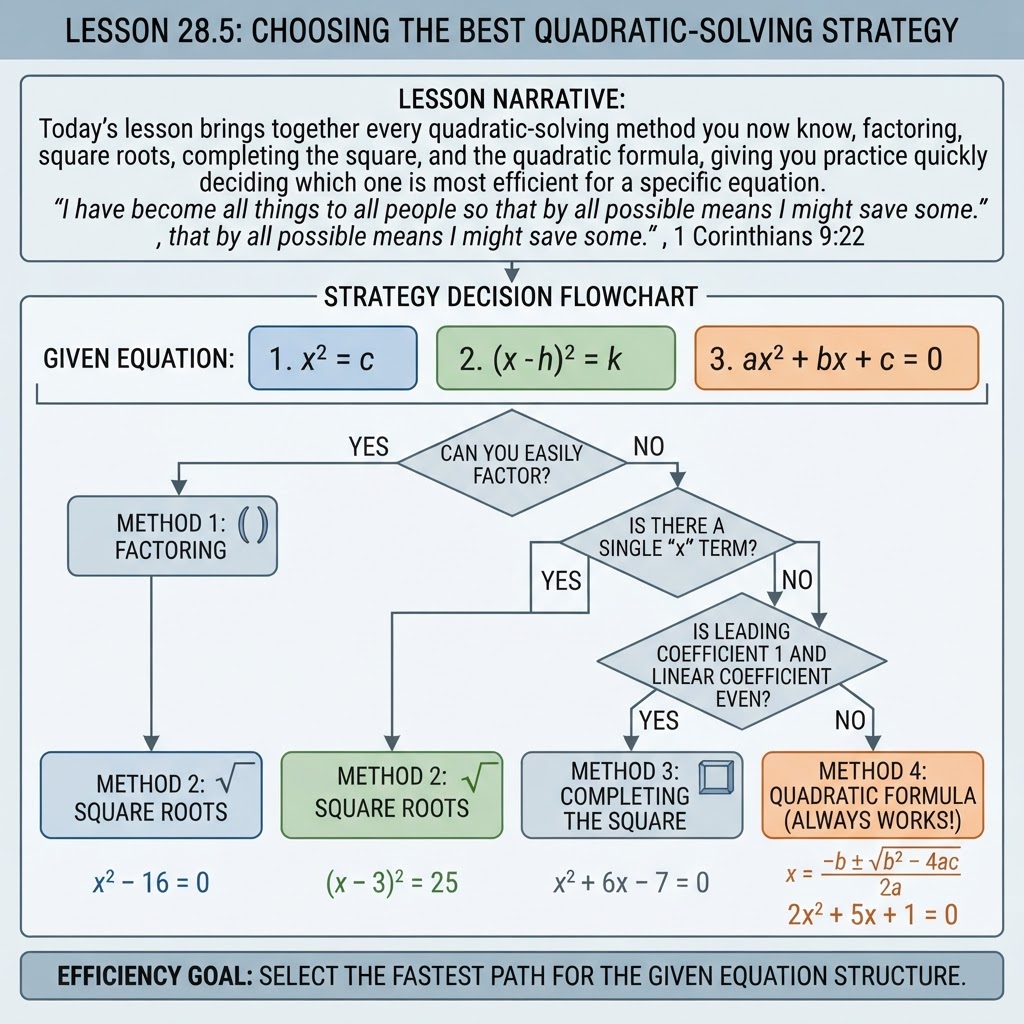
Lesson Narrative · Diagram
More videos
Tips to taking any math multiple choice test or examBrian McLogan
4 Equation Tricks You MUST Know for SAT & ACT MathArtin Academy
Boosting Confidence With Student-Driven MathEdutopia

Complementary Video
What career does this lesson unlock?
Adelaide will match a real-world profession to what you just learned and walk you through a day on the job.
Core Content
Today’s lesson brings together every quadratic-solving method you now
Mastering algebra involves discerning the right path for solving quadratic equations. Before calculating, examine the structure of ax^2 + bx + c = 0. If the b term is missing, the square root method offers a rapid solution. When an expression factors easily, factoring is most efficient.
However, these methods may not apply to every complex scenario, necessitating a flexible approach to identify the most suitable strategy for each unique mathematical problem.
The quadratic formula serves as a universal tool because it functions regardless of whether an equation can be factored. When you encounter coefficients that are large or non-integer, do not waste time hunting for factors. Instead, rely on x = (-b +/- sqrt(b^2 - 4ac)) / (2a) to derive precise solutions.
Accuracy in arithmetic is vital, so calculate the discriminant carefully to ensure your final results are indeed correct and reliable.
Let us examine an example to clarify these strategic choices. Consider the equation 2x^2 - 8 = 0. A hasty student might attempt the quadratic formula, but a wise student recognizes the missing linear x term. By isolating x^2, we obtain 2x^2 = 8, which simplifies to x^2 = 4.
Taking the square root of both sides yields x = 2 and x = -2. This efficiency avoids complex calculations and reduces potential arithmetic mistakes.
To verify our work, substitute x = 2 into the original equation. We calculate 2(2^2) - 8, which is 2(4) - 8, resulting in 8 - 8 = 0. Substituting -2 yields 2((-2)^2) - 8, also resulting in 8 - 8 = 0. Both solutions hold true, confirming the effectiveness of the square root method.
This strategy works because the relationship between variables lacks a linear middle term, simplifying the required algebraic symbolic path significantly.
- While the quadratic formula would work here, always look for factors first. We seek two numbers that multiply to 5 and add to
- Identifying 5 and 1 allows us to write (x + 5)(x +
- =
- The zero product property then dictates that either x + 5 = 0 or x + 1 = 0, giving us final solutions of -5 and -1.
Verify these results by plugging them into the original quadratic expression. If x is -1, then (-1)^2 + 6(-1) + 5 = 1 - 6 + 5 = 0. If x is -5, then (-5)^2 + 6(-5) + 5 = 25 - 30 + 5 = 0. Both values satisfy the equation perfectly.
Choosing to factor here was a wise stewardship of time, allowing us to find the roots without the intensive computation of using the quadratic discriminant formula.
Completing the square is a powerful tool, particularly when the a coefficient is 1 and the b coefficient is an even number. This method reveals the vertex of the parabola, providing geometric insight alongside numerical answers. By transforming x^2 + bx into (x + b/2)^2, we rearrange the equation into a form that highlights the peak or valley of the graph. It is a systematic way to find where the function intersects.
Students often struggle when the discriminant, b^2 - 4ac, is negative. This indicates that the parabola never crosses the x-axis, meaning there are no real roots. Recognizing this early prevents wasted effort searching for intersections that do not exist. In such cases, the graph remains entirely above or below the x-axis, a visual truth that our algebraic result confirms. Being attentive to these details helps us understand the behavior of functions.
Be cautious with signs when dealing with the quadratic formula. A common error involves the negative b term or the subtraction inside the square root. Always use parentheses when substituting negative numbers to avoid sign errors that lead to incorrect answers.
Just as a builder must measure twice to cut once, we must double-check our substitutions into the formula. Precision in these small steps builds confidence in the overall final solution.
Domain restrictions are rare in simple quadratic equations, but they become critical when solving word problems. If your variable represents a physical dimension like time or length, negative roots are often extraneous. Context is essential in applied mathematics. If you solve an equation for the height of a projectile and obtain a negative time value, disregard it. You are modeling real-world behavior, so your mathematical conclusions must align with physical reality.
We must distinguish clearly between exact results and decimal approximations. Unless instructed otherwise, always provide the exact radical form. Approximations like 1. 41 for the square root of 2 introduce rounding errors that compound during later steps of a multi-part problem. Keep your work in simplest radical form as long as possible.
This maintains the integrity of the math and ensures your final answer is as precise as the logic governing the equation.
Understanding the relationship between the graph and the symbolic solution is vital for mastery. If the quadratic formula yields a single repeating root, the vertex of the parabola rests exactly on the x-axis. If the roots are irrational, they represent points that are not easily identified on a standard graph.
Recognizing these connections helps you visualize the equation's behavior. The graph is the picture, while the algebra provides precise, truthful coordinates.
In these equations, the coefficients directly determine the roots. The structure of the equation is the blueprint. By evaluating the discriminant and the potential for factoring, you are essentially reading the blueprint to decide which tool to pull from your kit. This foresight is a mark of growing maturity in your mathematical journey. You are no longer just calculating; you are strategically solving problems by selecting the most efficient path forward.
As you move forward, continue to refine your discernment. Practice makes permanent. By evaluating each problem before starting, you strengthen your ability to think critically and solve efficiently. Remember that mathematics is a tool for exploring the order in our world. As you hone these skills, appreciate the consistency of the principles you use. You have the knowledge and the method; now apply them with steady, focused intention for success.
Subscription Library
Education.com Teacher Login
Standards-aligned lesson plans, worksheets, games, and activities for Pre-K through 8th grade.
Login credentials are being prepared. Check back soon, or ask your teacher.
© 2026 Learning by Grace. All rights reserved. This content is for enrolled students only and may not be copied, distributed, or reproduced.
Have something to share?
Submit your work — writing, art, videos, and more — for us to review.
My Submitted Work