Review: Expressions, Equations, and
Lesson 35.1 Presentation
Lesson diagrams and audio narration
Lesson Narrative · Audio, part 1
Lesson Narrative · Diagram
More videos
What are variables, expressions, and equations? | Introduction to algebra | Algebra I | Khan AcademyKhan Academy
Intro to Evaluating Algebraic Expressions | How to Evaluate Algebraic Expressions | Math with Mr. JMath with Mr. J
Algebra Basics: Solving 2-Step Equations - Math Anticsmathantics
Simplifying Algebraic Expressions | Distributive Property & Combining Like Terms | Math with Mr. JMath with Mr. J
Algebraic Expressions – Algebra BasicsTabletClass Math
Algebra Basics: What Is Algebra? - Math Anticsmathantics

Complementary Video
What career does this lesson unlock?
Adelaide will match a real-world profession to what you just learned and walk you through a day on the job.
Core Content
Today’s review reaches all the way back to Strand 1, bringing together
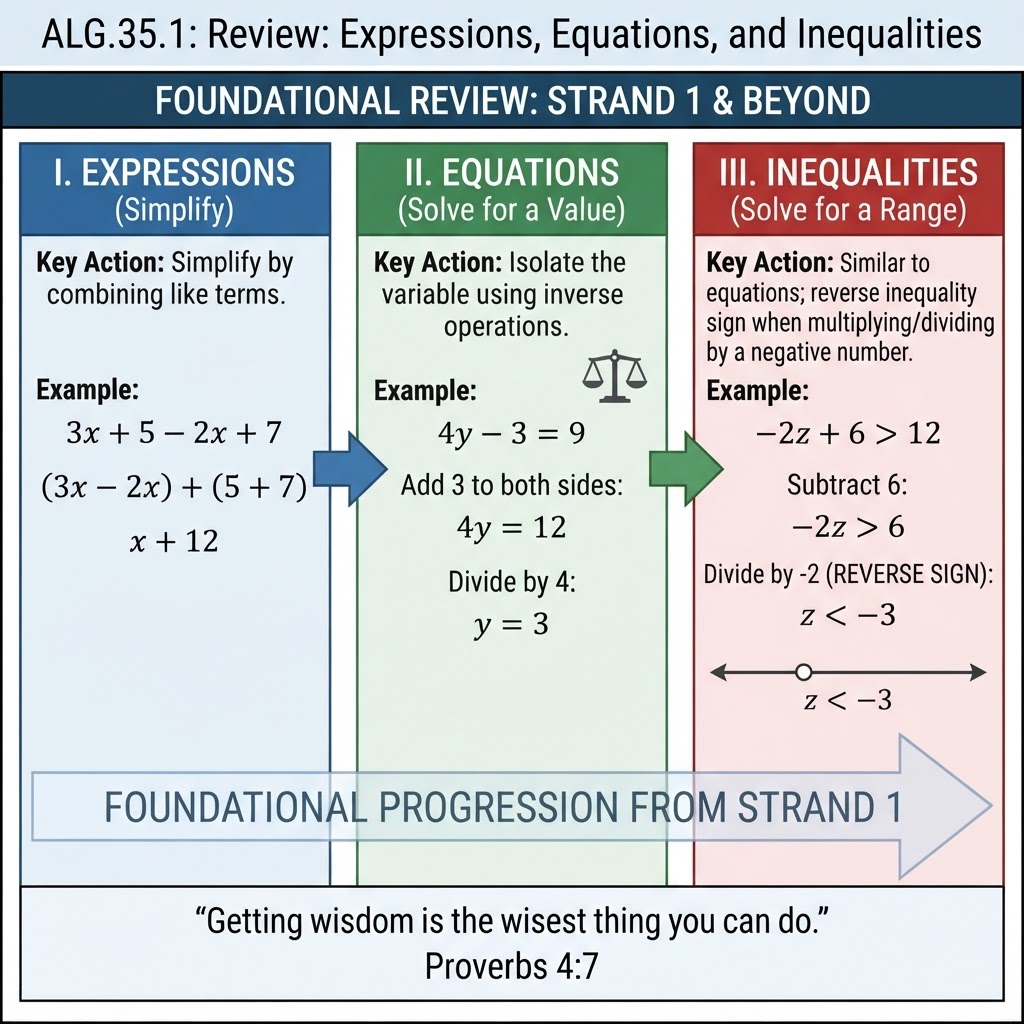
Algebraic expressions and equations define the foundation of mathematical problem solving. We distinguish between these concepts. An expression represents a variable quantity but lacks an equals sign, acting as a mathematical phrase. An equation asserts that two expressions remain equivalent, establishing a state of balance.
Mastery requires transitioning fluidly between these states, simplifying expressions before applying the properties of equality to solve for the specific values of any unknown variables.
Consider the expression 3(x + 4) - 2x. To simplify this, we apply the distributive property, multiplying the constant by each term inside the parentheses. This yields 3x + 12 - 2x. We then use the commutative property to group like terms, specifically 3x - 2x + 12, resulting in the simplified form x + 12.
This step-by-step refinement remains essential for clarity, mirroring the orderliness required to handle complex variables while maintaining the integrity of numeric relationships.
-
- 2x = 18, we substitute the simplified expression derived earlier. Given the equivalence x + 12 = 18, we isolate the variable by applying inverse operations. Subtracting 12 from both sides preserves equality, resulting in x =
- To verify, we substitute 6 into the original equation: 3(6 +
-
- 2(6) equals 30 - 12, which successfully confirms 18.
A common error involves improper handling of negative signs during distribution. If an expression reads -2(x - 5), many students mistakenly write -2x - 10. The correct distribution requires multiplying by negative two, leading to -2x + 10. Vigilance with signs serves as a form of mathematical stewardship, ensuring our work remains accurate.
Truth in algebra relies on the consistent application of distributive and additive inverse properties throughout every single step of the calculation process.
- The objective is to gather all variable terms on one side and constants on the other. Subtracting 2y from both sides gives 3y - 7 =
- Adding 7 to both sides yields 3y =
- Finally, dividing by 3 results in y =
- Each algebraic transformation remains valid as we treat both sides equally.
To verify this result, we perform substitution back into the original equation. For the left side, 5(5) - 7 equals 25 - 7, yielding 18. For the right side, 2(5) + 8 equals 10 + 8, also yielding 18. Because 18 equals 18, the solution is confirmed.
Checking work is not merely a task for accuracy, but a disciplined practice that builds confidence in the reliability of logical systems, verifying truth through rigorous avenues of reasoning.
Equations often represent scenarios where variables carry specific units. If an equation calculates distance where d = rt, the result for distance must maintain consistency with the units of rate and time. If time is in hours and rate is in miles per hour, distance is expressed in miles.
Ignoring units is a frequent source of error, as it strips math of its concrete reality. We maintain accountability by ensuring units align perfectly.
Domain restrictions are a critical consideration. In equations involving fractions where the variable appears in the denominator, such as 10/x = 2, we must acknowledge that x cannot be zero. Division by zero is undefined, representing an impossible state. Identifying these exclusions before solving prevents the derivation of extraneous solutions.
Recognizing boundaries helps us appreciate that logic operates best within defined parameters, honoring the absolute necessity of structure in all mathematical tasks.
Graphs offer a visual representation of these algebraic truths. A linear equation like y = 2x - 4 depicts a straight line where the solution set represents all points falling on that line. The intersection of two lines represents the point where their values are identical.
While symbolic algebra provides the exact value, the graph offers a bird's-eye view of how quantities relate to one another, illustrating the progression of values within the coordinate plane.
We must distinguish clearly between correlation and causation. In algebra, an equation shows a functional relationship, which is a specific form of correlation. However, finding a trend in data does not imply that one variable causes the other. For instance, an equation might track the height of a tree over time, but time itself does not cause growth. Distinguishing these concepts is vital for developing sound analytical skills beyond the classroom setting.
Approximations are used when dealing with complex coefficients or real-world measurements. If we round to a specific decimal place, we accept a degree of precision loss for readability. However, in pure algebra, we strive for exact fractions or square roots whenever possible. Maintaining exactness prevents rounding errors from compounding.
It is a commitment to excellence, preserving the fidelity of the numbers until the final step of the computation process is fully completed.
Systematic error analysis is a powerful tool for growth. When a solution check fails, resist the urge to discard the work. Instead, retrace each line to pinpoint where the logic diverged. Perhaps a sign was flipped, or a distributive step was missed. By carefully inspecting our process, we transform mistakes into insights. This habit of self-correction reflects a humble approach to learning, acknowledging that even dedicated students require patience to succeed.
The power of variables lies in their flexibility. Whether we use x, y, or any other symbol, the structural rules of equations remain constant. This universality allows us to model diverse problems using the same logical tools. By focusing on the properties of equality—addition, subtraction, multiplication, and division—we ensure our methods are robust. Regardless of the complexity of the expression, foundational principles remain the anchor that keeps our mathematical arguments stable.
As we conclude this review, reflect on the consistency of the methods you have employed. Every algebraic operation relies on the preceding ones, creating a chain of logic that leads to a definitive result. By mastering these foundational manipulations, you prepare yourself for more advanced topics like quadratics and systems.
Keep your steps clear, check your work diligently, and maintain the spirit of orderly inquiry that allows you to see the elegance.
Subscription Library
Education.com Teacher Login
Standards-aligned lesson plans, worksheets, games, and activities for Pre-K through 8th grade.
Login credentials are being prepared. Check back soon, or ask your teacher.
© 2026 Learning by Grace. All rights reserved. This content is for enrolled students only and may not be copied, distributed, or reproduced.
