Meet the Architect: Understanding How
Lesson 34.4 Presentation
Lesson diagrams and audio narration
Lesson Narrative · Audio, part 1
Lesson Narrative · Diagram
More videos
Math at Work - ArchitectMeagan Bubulka
The Math in ArchitectureInteGirlsDerived
MATH IN REAL LIFE: Architectmathmagicians2013
Art + Math Equals Architecture / PENCIL TO PAPER Ep. 9Pencil to Paper

What career does this lesson unlock?
Adelaide will match a real-world profession to what you just learned and walk you through a day on the job.
Core Content
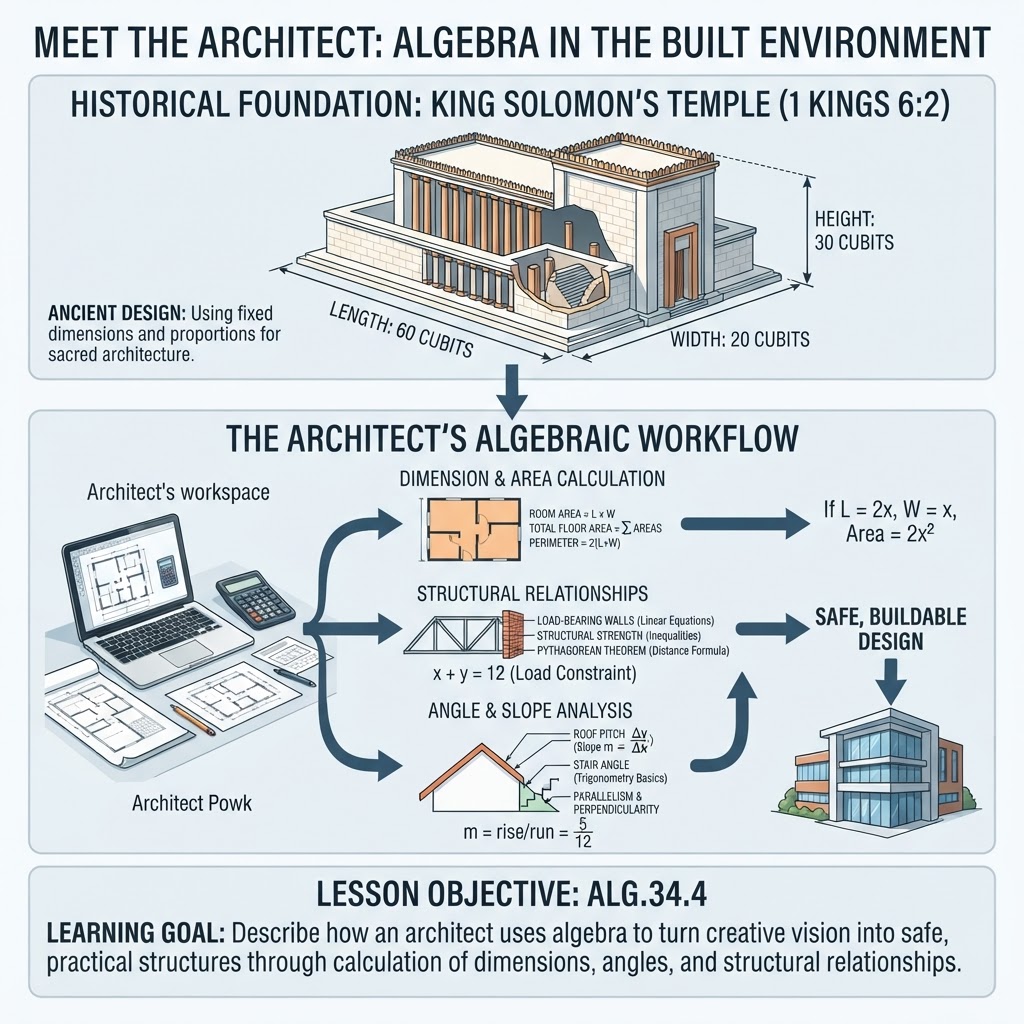
Architects rely on algebra to calculate dimensions, angles, and structural
Structural integrity is the priority, ensuring every load-bearing beam and foundation footing is positioned to withstand natural forces. An architect begins with a vision, but that vision must be translated into precise mathematical language so builders can bring it to life safely.
Algebra acts as the critical bridge between the artistic inspiration found in the mind of the architect and the tangible reality of steel, concrete, and timber used on sites.
Consider the fundamental relationship between a roof span and the length of rafters required to support it. If we define the span as s and the rise of the roof as h, the rafter length is modeled using the Pythagorean theorem, an algebraic expression of geometric space.
Architects often work with slope ratios, which are linear functions expressed as m = rise divided by run to determine roof pitch and rafter length.
Let us examine a practical scenario where an architect calculates a rafter for a shed with a span of twelve feet and a height of five feet. The rafter represents the hypotenuse of a right triangle where one leg is six feet, which is half the total span, and the other leg is five feet. Using the algebraic formula c squared equals a squared plus b squared, we find the rafter length.
To solve this, substitute the known values into the equation: c squared equals 6 squared plus 5 squared. This simplifies to c squared equals 36 plus 25, which totals 61. Taking the square root of 61, we find the rafter length is approximately 7. 81 feet.
We must ensure our units remain in feet throughout the process. This calculation is a vital check for material ordering, preventing waste and ensuring structural integrity.
- 81 to see if we return to the sum. Squaring
- 81 yields approximately
- 996, which is close to 61 for construction purposes, accounting for rounding. This demonstrates the reliability of algebraic modeling.
A common error students make is failing to account for the full span versus the run. Always verify if the variable represents the entire distance or the segment for accuracy.
Beyond geometry, architects use linear equations to manage budgets, another form of design. Suppose an architect has a total budget of 50,000 dollars for materials, with a fixed cost of 10,000 dollars for site preparation and a variable cost of 50 dollars per square foot of flooring.
We can represent this as the linear equation C equals 50x plus 10,000, where C is the total cost and x is square footage.
In this linear model, 50 represents the slope or the rate of cost increase per square foot, while 10,000 represents the y-intercept or the starting cost before installation. If the client asks how many square feet can be afforded, we set C to 50,000 and solve for x.
Subtracting 10,000 from both sides gives 40,000 equals 50x. Dividing both sides by 50 reveals that x equals exactly 800 square feet.
To check this solution, we substitute 800 back into the original equation: 50 times 800 equals 40,000, and 40,000 plus 10,000 equals 50,000. This confirms our calculation is accurate. When using such models, remember the domain of x is limited by physical reality; x cannot be a negative number, as we cannot build negative square footage. Additionally, costs might fluctuate, so we treat these as exact relationships, not absolute truths.
When architects design a room, they balance window surface area with floor area to ensure adequate lighting. This is a ratio problem that functions as a direct variation, y = kx. If the code requires that the window area y must be at least 15 percent of the floor area x, the architect sets the inequality y is greater than or equal to 0. 15x. This constraint dictates design choices for every room.
It is important to distinguish between exact relationships and statistical correlations. While a formula like y = 0. 15x provides an exact design constraint, the actual light level in a room might depend on window orientation or tree placement. That is a correlation, not a mathematical certainty.
Architects use algebra to satisfy the law of the land, while using their creative judgment to account for the variables that cannot be easily contained.
Mistakes in construction often stem from sign errors or neglecting unit conversions. If a measurement is provided in inches but the formula requires feet, the final calculation will be catastrophically wrong. Always normalize units before applying algebraic operations. If you are calculating the volume of a concrete slab, ensure length, width, and height are in the same units—typically feet—before multiplying to arrive at the final volume in cubic feet.
The wisdom required to balance structural constraints mirrors the discipline needed for a meaningful life. Just as an architect must strictly adhere to mathematical laws to ensure a building remains stable and secure, we are similarly called to live by foundational moral principles that hold our character together.
Algebra is never merely about abstract numbers; it is fundamentally about training your mind to recognize the profound order and logical architecture inherent in the physical world. This discipline fosters a deeper appreciation for the precision required in every design choice.
When analyzing a blueprint, we observe that every line, angle, and dimension serves a distinct, purposeful function. Nothing is arbitrary; every coefficient and variable reflects a specific intention. In our daily pursuits, whether we are solving complex equations or navigating personal challenges, we should appreciate this underlying harmony.
Approaching our work with diligence, while seeking to grasp these foundational structures, reflects a deep respect for the gifts of intelligence and logic that empower us to serve others effectively. By applying these logical patterns, we transform raw concepts into stable, reliable solutions.
As you advance in your studies, remember that algebra is a powerful tool of stewardship. By mastering these precise methods, you prepare yourself to handle modern complexities with clarity and confidence. Regardless of whether you pursue architecture or a different career path, the analytical skills developed here are essential.
Always check your work, verify calculations, and seek the truth inherent in numbers, as all things are created with purpose.
Subscription Library
Education.com Teacher Login
Standards-aligned lesson plans, worksheets, games, and activities for Pre-K through 8th grade.
Login credentials are being prepared. Check back soon, or ask your teacher.
© 2026 Learning by Grace. All rights reserved. This content is for enrolled students only and may not be copied, distributed, or reproduced.
