Permutations and Combinations:
Lesson 33.4 Presentation
Lesson diagrams and audio narration
Lesson Narrative · Audio, part 1
Lesson Narrative · Diagram
More videos
How to tell the difference between permutation and combinationsearching4math
How to Use Permutations and CombinationsMario's Math Tutoring
Introduction to Permutations and CombinationsTambuwal Maths Class
Combinations and Permutations Word Problemstecmath

Complementary Video
What career does this lesson unlock?
Adelaide will match a real-world profession to what you just learned and walk you through a day on the job.
Core Content
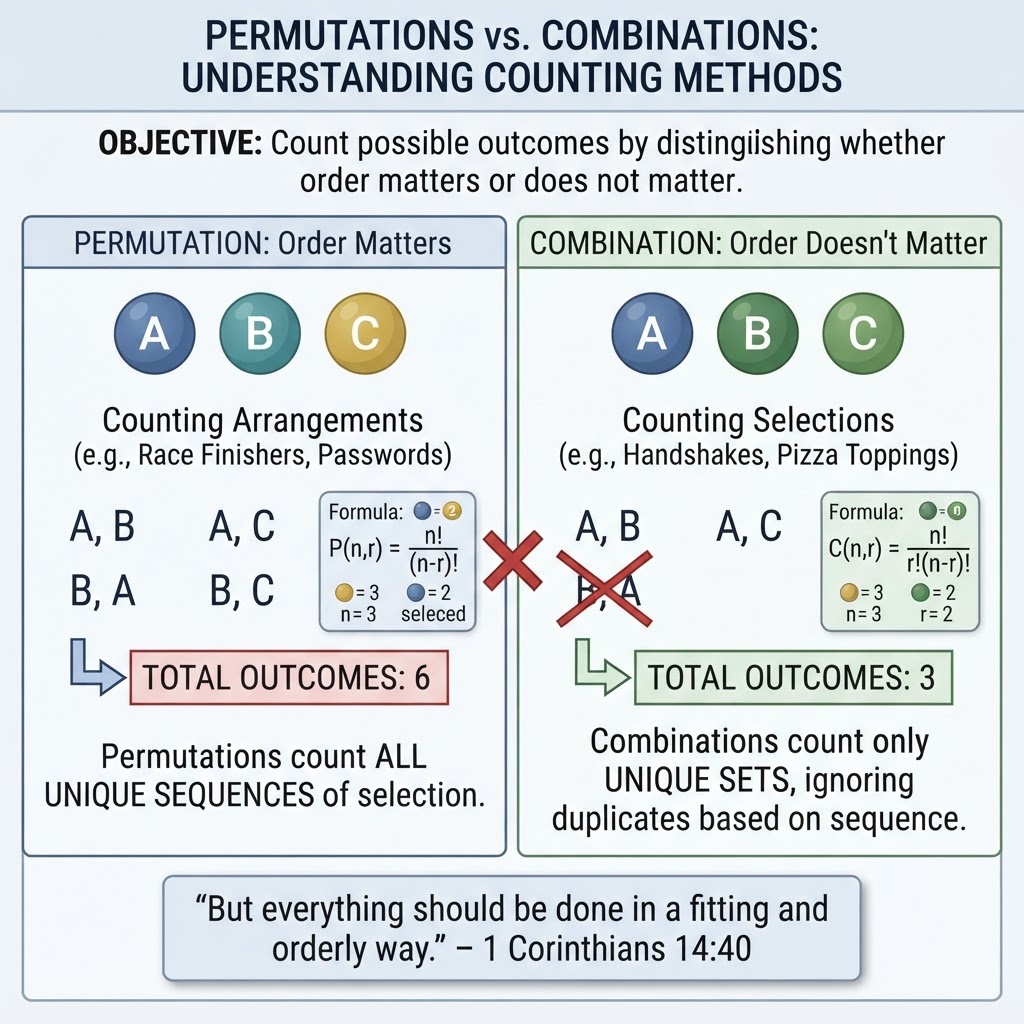
Permutations count arrangements where order matters, while
Combinations focus solely on selecting items without regard to sequence. This distinction dictates the mathematical tools we use to model situations. When we arrange books on a shelf or assign specific seats in a classroom, the outcome changes if the order shifts, necessitating permutations.
Conversely, when choosing ingredients for a salad or members for a team, the identity of the group remains constant regardless of the order of selection.
The Fundamental Counting Principle acts as the cornerstone for these concepts. It states that if one task can be completed in m ways and a subsequent task in n ways, the total number of possibilities is m multiplied by n. This principle extends to any number of tasks.
By visualizing these choices as a branching tree diagram, we see how order creates unique pathways within the logic of our mathematical framework.
A permutation is an ordered arrangement of objects. Mathematically, the number of permutations of n distinct items taken r at a time is denoted by P(n, r) and calculated as n! divided by (n minus r)!. The factorial symbol, n! , represents the product of all positive integers up to n.
Using factorials allows us to quantify arrangements systematically, reflecting the structural integrity inherent in mathematical logic, which mirrors the intentionality of universal laws.
Consider a trophy case with five distinct medals. We display three in a specific sequence. Here, n equals 5 and r equals 3. Applying the formula, we calculate 5! divided by (5-3)! , which is 120 divided by 2. This results in 60 unique arrangements.
We verify this by multiplying the choices for each position: five choices for the first, four for the second, and three for the third, yielding exactly 60 arrangements.
This verification by multiplication confirms the factorial formula works because it accounts for the shrinking pool of items as each slot is filled. If we ignore order, we overcount the possibilities. The discipline required to track these variables reminds us that math requires precision.
Just as we organize these permutations carefully, we should approach our daily work with a sense of purposeful direction rather than allowing for chaotic or impulsive mistakes.
Combinations differ because they remove redundant sequences that permutations include. When selecting a committee of three from a group of ten, we use the combination formula C(n, r) = n! divided by (r! times (n minus r)!) The inclusion of r! in the denominator divides out the duplicate arrangements.
This division removes the influence of order, leaving us with only the distinct sets of individuals who form the specific team.
Let us work through a second example: selecting a three-person committee from ten students. Using the formula, we find 10! divided by (3! times 7!) Expanding this, we have (10 times 9 times 8) divided by (3 times 2 times 1), which equals 720 divided by 6, resulting in 120 unique combinations.
We verify this result by acknowledging that each unique group of three can be arranged in 3! or 6 ways.
It is common to confuse these concepts. A helpful strategy is to ask whether swapping two items creates a different scenario. If changing the order of people in a line creates a new situation, you are dealing with a permutation.
If the committee remains the same regardless of who was picked first, you are dealing with a combination. Recognizing this distinction is essential for solving problems accurately and avoiding common calculation errors.
Domain restrictions are vital in these operations. Both n and r must be non-negative integers where n is greater than or equal to r. If these constraints are violated, the factorial of a negative number becomes undefined in standard arithmetic.
Furthermore, the empty set, or choosing zero items, is defined as having one way of occurring. These boundaries define the scope of our mathematical reality, mirroring the laws governing the physical universe.
Units are not applicable to pure counting problems, but the logic remains consistent. Whether counting people, coins, or abstract points on a coordinate plane, the logic holds. We must be careful not to conflate this with probability, which is a ratio.
While counting gives us the total sample space, it does not imply a likelihood of any single outcome. Distinguishing between raw counts and statistical probability is a critical skill.
When representing these relationships symbolically, we see that P(n, r) is always greater than or equal to C(n, r). As r increases toward n, the number of permutations grows faster than the number of combinations. Graphical representations show a steep curve for permutations, illustrating how quickly complexity expands when order is introduced. This rapid growth highlights why structured thinking is necessary when managing large sets of information or complex decision-making processes.
A common error involves computing large factorials before division. When solving expressions like 10! /7! , avoid calculating massive products directly. Instead, express 10! as 10 × 9 × 8 × 7! , allowing you to cancel the 7! term immediately. This leaves the simplified product of 10 × 9 × 8, which equals 720.
Utilizing these algebraic properties prevents unnecessary arithmetic, minimizes potential errors, and demonstrates a sophisticated grasp of mathematical efficiency within your calculations.
As you master these methods, recognize that mathematics serves as a universal language for navigating complex scenarios. Whether you are analyzing statistical data or optimizing logistical systems, permutations and combinations provide the essential logic required to evaluate arrangements and selections.
By identifying the underlying patterns in these problems, you transition from simple computation to thoughtful analysis. This intentional application of logic allows you to exercise your cognitive capabilities with greater precision and discipline, reflecting the inherent order found in the natural world.
Ultimately, success depends on your ability to verify if order is relevant before choosing a formula. If sequencing is critical, utilize permutations; if only the group composition matters, apply combinations. After substituting your variables, always validate your results through simplification or logical checks.
Cultivating this structured, methodical habit ensures that your mathematical conclusions remain both robust and defensible. Remember that every problem solved is a foundational step toward higher reasoning, preparing you to interpret complex systems with the clarity and intellectual rigor required for advanced academic study.
Subscription Library
Education.com Teacher Login
Standards-aligned lesson plans, worksheets, games, and activities for Pre-K through 8th grade.
Login credentials are being prepared. Check back soon, or ask your teacher.
© 2026 Learning by Grace. All rights reserved. This content is for enrolled students only and may not be copied, distributed, or reproduced.
