Algebra as a Tool for Service: Reflecting on
Lesson 34.5 Presentation
Lesson diagrams and audio narration
Lesson Narrative · Audio, part 1
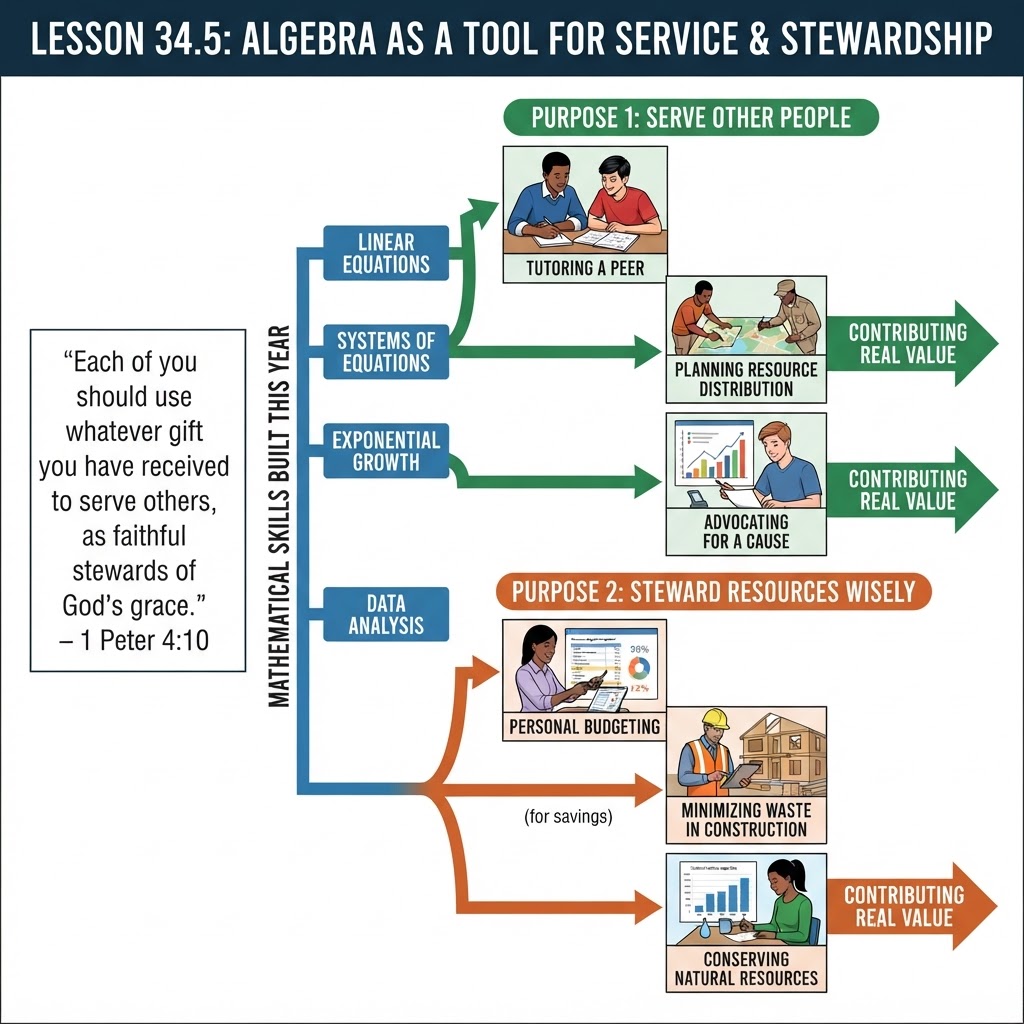
Lesson Narrative · Diagram
More videos
Key Features of Functions: The BasicsHartzler University
Transformations of Quadratic Functions with Desmos - The Basics | Algebra 1 LessonMrs. Casias Math
Algebra: Graphing with Parent Functions and TransformationsFSW Tutoring Services

What career does this lesson unlock?
Adelaide will match a real-world profession to what you just learned and walk you through a day on the job.
Core Content
Today’s lesson steps back from any single career to reflect more broadly:
Developing a servant heart requires viewing mathematical proficiency as a mechanism for stewardship. When we model the resource needs of a food bank, we translate variables into relief. For instance, consider an organization distributing meal kits to families. If each kit costs fifteen dollars to assemble and the group has a weekly budget of twelve hundred dollars, we model this using c = 15k, where c is cost and k is kits.
This symbolic representation, c = 15k, allows us to analyze the constraint of our budget relative to service capacity. By setting c to twelve hundred, we arrive at the equation 15k = 1200. To solve for k, we divide both sides of the equation by fifteen, maintaining the balance of the equality.
Calculating 1200 divided by 15 yields 80. Thus, the organization can provide 80 kits weekly through this simple linear model.
Verification of our result is a crucial step in responsible stewardship, ensuring planning avoids errors that hinder aid delivery. We substitute k = 80 back into the original cost function, calculating 15 multiplied by 80. The product is 1200, which matches our initial budget constraint perfectly.
Had the calculation resulted in a non-integer, we would round down to avoid exceeding the budget. Such detail reflects a commitment to integrity in our work.
Beyond simple budgeting, algebra helps us understand the dynamics of growth within community projects, such as volunteer recruitment. Imagine a community garden starting with twenty volunteers that plans to add five new volunteers every month. We model the total number of volunteers, V, as a function of time, t, in months using the equation V = 5t + 20. This linear model illustrates expected expansion, assuming the recruitment rate remains constant over time.
If we aim to reach a target of one hundred volunteers for a garden expansion, we set V equal to one hundred and solve for t: 100 = 5t + 20. Subtracting 20 from both sides isolates the variable term, resulting in 80 = 5t.
Dividing both sides by 5 confirms that t equals 16 months. This timeline allows coordinators to set realistic goals, ensuring labor is available when the project needs it most.
Validating this timeline requires checking the result against the verbal constraints. After 16 months, the five added volunteers per month result in 80 new recruits. Adding these 80 recruits to the original base of 20 volunteers equals 100, which satisfies our requirement for the project.
By distinguishing between the constant rate of growth and the initial baseline, we gain clarity. Algebra provides a structured way to anticipate needs before they become urgent.
It is important to note that these linear models are approximations rather than absolute prophecies. In real-world scenarios, recruitment might fluctuate, or costs for materials might change due to inflation or supply shortages. While our algebraic model provides a strong foundation, it is not a rigid cage.
We must remain flexible, updating our equations as new information becomes available. Stewardship demands we remain attentive, using our tools to adapt service efforts as circumstances dictate.
Common errors in these applications often involve confusing the independent and dependent variables, or failing to identify domain restrictions. In the garden example, the domain consists of non-negative integers representing time in months, since fractional months or negative time are irrelevant. If we ignore physical limitations, we might mistakenly project infinite growth.
Algebraic thinking forces us to confront these boundaries, grounding our idealism in the practical realities of space, budget, and time.
We must also be careful to avoid confusing correlation with causation when analyzing the success of service programs. For example, a program might notice that neighborhoods with more library visits show higher reading scores. While this correlation is observable, the algebraic relationship does not prove that visiting the library causes the higher scores. Other variables, like income or school quality, might influence both. Algebra quantifies these relationships, but we must apply wisdom.
The power of linear models lies in their ability to simplify complex data into meaningful insights. By converting a verbal description of a problem—like needing to feed people or gather workers—into symbolic variables, we strip away the noise. We are left with a skeleton of the situation that we can manipulate, solve, and analyze. This process allows us to serve more effectively by anticipating outcomes rather than merely reacting to crises.
Units play a vital role in ensuring our algebraic work remains grounded in truth. Whether we are calculating dollars, kits, volunteers, or time, the units must remain consistent across all sides of our equations. If we define the variable c in dollars, the coefficient 15 must represent dollars per kit.
If we fail to track these units, we risk creating results that are logically sound in arithmetic but meaningless in practice.
Reflecting on these applications, we recognize that our ability to perform these calculations is a stewardship of the intellect. When we use algebra to help a neighbor or organize a volunteer effort, we are using logic to restore order and provide for the needs of others.
This is the essence of being a neighbor in a daily sense. Each equation solved is an opportunity to practice the rigor service demands.
As you approach future algebraic problems, consider what hidden service they might represent. Even when the problems seem purely theoretical, they are training your mind to see structures and patterns that govern the world. By mastering these patterns, you are preparing yourself to be a more effective servant.
Accuracy is not just a requirement for a grade; it is a way of ensuring that your efforts yield the benefit intended for others.
Ultimately, the goal of this lesson is to help you see that mathematics is a language of logic that facilitates love in action. Whether you are budgeting for a project or planning for growth, the equations you write serve as bridges between your resources and the needs of those around you.
Keep honing these skills, not for personal status, but as a dedicated instrument for the good of your community, acting with precision.
Subscription Library
Education.com Teacher Login
Standards-aligned lesson plans, worksheets, games, and activities for Pre-K through 8th grade.
Login credentials are being prepared. Check back soon, or ask your teacher.
© 2026 Learning by Grace. All rights reserved. This content is for enrolled students only and may not be copied, distributed, or reproduced.
Have something to share?
Submit your work — writing, art, videos, and more — for us to review.
My Submitted Work