Projectile Motion: Understanding How
Lesson 29.1 Presentation
Lesson diagrams and audio narration
Lesson Narrative · Audio, part 1
Lesson Narrative · Diagram
More videos
Projectile Motion (1 of 5: Defining Conditions for Projectile Motion and how time is built into it)Eddie Woo
Projectile Motion & Parabolas [Science of NFL Football]National Science Foundation News
1) Vertical projectile motion introductionKevinmathscience
Vertical Motion Math Problem (Formula)Mario's Math Tutoring

Complementary Video
What career does this lesson unlock?
Adelaide will match a real-world profession to what you just learned and walk you through a day on the job.
Core Content
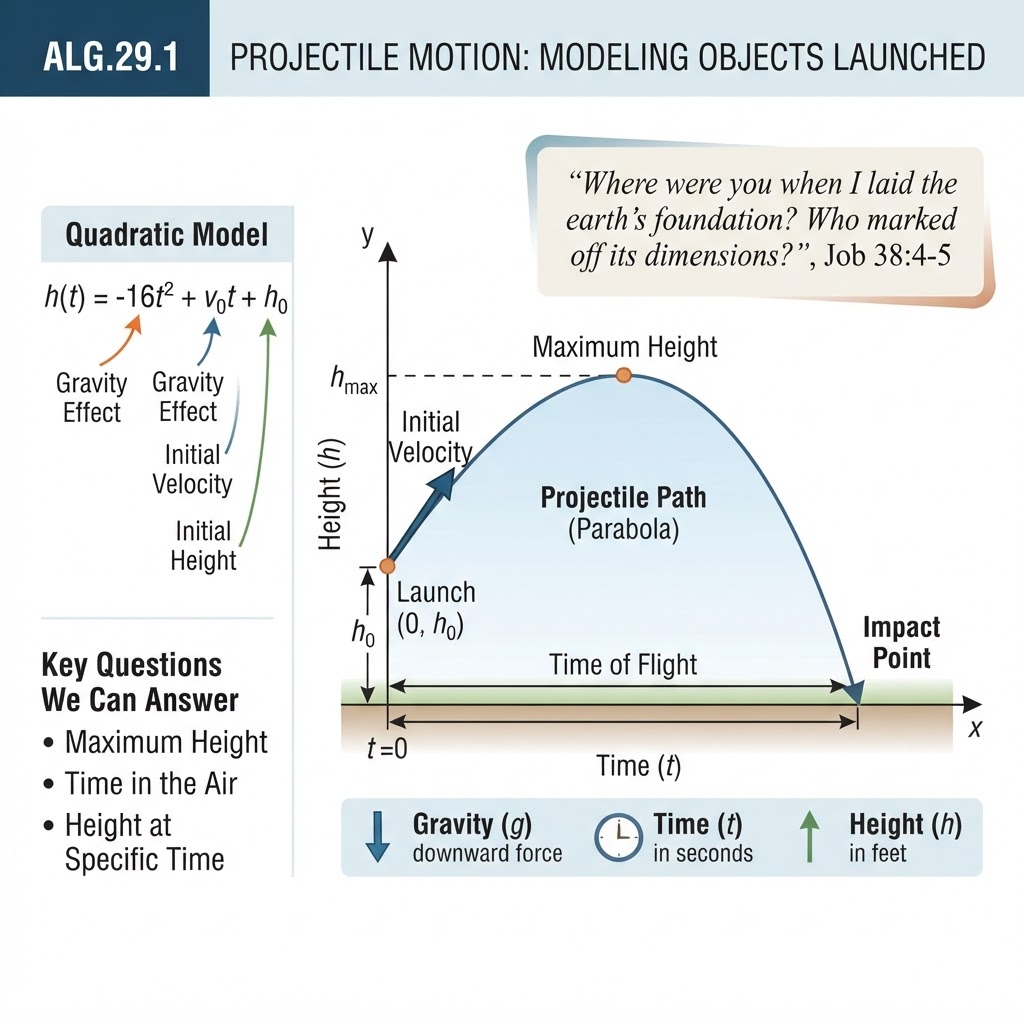
When an object is thrown or launched, gravity causes its height over time
Objects in flight often change positions, defining a parabolic arc known as a trajectory. In studying physics through algebra, we recognize that vertical displacement is governed by the constant acceleration of gravity. Near Earth, this downward force pulls objects at approximately 16 feet per second squared.
By modeling this using a quadratic equation, we accurately predict future vertical positions based on the object's initial velocity and its starting elevation.
The standard form for vertical motion models is h(t) = -16t^2 + v_0t + h_0. Here, h(t) represents the height at time t, v_0 is the initial vertical velocity in feet per second, and h_0 is the starting height. The negative leading coefficient accounts for gravity resisting upward motion.
This algebraic structure reflects the mathematical order inherent in the world, showing that our physical environment operates under consistent, predictable, and measurable laws.
- To find when the object hits the ground, we set h(t) =
- This creates the equation -16t^2 + 32t + 48 =
- Dividing each term by -16 simplifies this to t^2 - 2t - 3 = 0, which factors into (t - 3)(t +
- = 0.
Solving the factored equation yields t = 3 and t = -1. Because time cannot be negative in this physical context, we reject t = -1 as an extraneous solution. We accept t = 3 as the only valid time, meaning the object hits the ground three seconds after launch.
By substituting t = 3 into our original equation, we confirm that -16(9) + 32(3) + 48 equals exactly zero, validating our result with precision.
Domain restrictions are essential here because mathematical functions extend infinitely while physical scenarios are constrained by time and space. The domain for this projectile begins at t = 0 and terminates when the object impacts the ground. Any time value outside this interval lacks physical meaning.
Just as mathematical parameters define the range of a function, we understand that our lives have boundaries shaped by purpose, moving within a logical framework of intentionality.
Let us examine another scenario: a soccer ball kicked from the ground, where h_0 = 0, with an initial upward velocity of 64 feet per second. The model is h(t) = -16t^2 + 64t. To find the time of peak height, we identify the vertex of the parabola.
The formula for the vertex time is t = -b / 2a. With a = -16 and b = 64, we get t = -64 / -32, which is 2 seconds.
Knowing the peak occurs at 2 seconds, we calculate the maximum height by substituting t = 2 into the function. Thus, h(2) = -16(4) + 64(2) = -64 + 128 = 64 feet. We check this by testing values slightly before and after t = 2. At t = 1. 9, the height is 63.
84 feet; at t = 2. 1, it is 63. 84 feet. This symmetry confirms our vertex calculation, demonstrating how quadratic behavior relies on reflection around the axis.
Common mistakes often arise from sign errors when handling the gravity constant. If the initial velocity is directed downward, it must be represented as a negative value in the equation. Failure to recognize the direction of the initial force results in an incorrect trajectory model. Precision in defining variables determines the accuracy of our predictions. Mathematical stewardship requires careful attention to detail, ensuring that our symbols accurately represent the physical realities being examined.
Units must remain consistent throughout the entire calculation to maintain validity. If your velocity is in feet per second and height is in feet, you cannot mix those with meters without performing necessary unit conversions first. Discrepancies in units lead to nonsensical answers that fail to describe the object's true path.
Maintaining logical consistency in our units mirrors the consistency we observe in the orderly mechanics of the natural, created world.
We must distinguish between correlation and causation when interpreting these graphs. The graph shows a correlation between time and height, but gravity is the cause of the downward curve. Mathematical models provide the 'how' by mapping the path, while physical laws provide the 'why.'
Understanding this distinction helps us appreciate that while math reveals the mechanics of motion, it does not fully explain the deeper mystery of our surrounding reality.
Graphical representation provides a visual confirmation of our algebraic work. When you plot h(t) = -16t^2 + 32t + 48, the curve shows a clear starting point on the y-axis, a peak where the vertical speed momentarily reaches zero, and an intercept on the x-axis where motion ceases.
By checking the vertex and intercepts on a coordinate plane, you verify the solutions found through factoring, ensuring that the results are logically robust.
Sometimes, objects are launched from moving platforms, adding complexity to our models. While Algebra 1 focuses on vertical motion, understanding that initial velocity is a vector quantity prepares you for higher-level physics. Even in these complex situations, the quadratic nature of gravity remains constant.
Our ability to model such motion demonstrates that we can observe and describe the intricate dance of creation through the reliable language of quadratic equations and functions.
When you solve for these trajectories, remember that equations are tools for discovery. Whether finding the maximum height or the duration of flight, you are practicing a form of orderliness. This exercise encourages disciplined thinking and patient calculation. By mastering these algebraic steps, you are not just memorizing formulas; you are learning to interpret the consistent language in which the physical world is written, acknowledging the depth of wisdom required for systems.
As you conclude this lesson, reflect on how these parabolic paths intersect with the concept of design. The trajectory is fixed by the initial conditions, yet the result is a graceful, predictable arc. In our own lives, we may feel like projectiles launched into the unknown, but we are moving through a space defined by a greater purpose. Mathematical proficiency allows us to calculate the path, while faith provides assurance regarding our destination.
Subscription Library
Education.com Teacher Login
Standards-aligned lesson plans, worksheets, games, and activities for Pre-K through 8th grade.
Login credentials are being prepared. Check back soon, or ask your teacher.
© 2026 Learning by Grace. All rights reserved. This content is for enrolled students only and may not be copied, distributed, or reproduced.
